Pasajes Destacados: Isaías 14:12-14; Ezequiel 28:15-17; Lucas 10:18; 2 Pedro 2:4; Judas 6; Apocalipsis 12:7–9; 20:1–3,10.
Lucifer fue creado por Dios como un poderoso arcángel con grandes responsabilidades. Sin embargo, Lucifer permitió que el orgullo y la vanidad pervirtieran sus pensamientos y acciones. Lucifer comenzó a creer que él sabía más que Dios y que su camino de obtener y competir era mejor que el camino de Dios de cooperación y amor. Satanás ideó un plan para tratar de derrocar a Dios. Convenció a una tercera parte de los ángeles de rebelarse con él para tomar el trono de Dios ¡Lucifer quería la posición de Dios! Por supuesto, el ser creado no era más poderoso que su Creador. Dios arrojó a Lucifer y sus ángeles de vuelta a la Tierra. Dios nombra las cosas tal como son, así que cuando Lucifer se rebeló, Dios cambió el nombre de Lucifer a Satanás, que significa adversario o enemigo, y a los ángeles de Satanás los llamó demonios.
Discusión:
Ayude a sus hijos a demostrar que la ley existió antes que Moisés. Pídales que lean 1 Juan 3:4 y 2 Pedro 2:4 y guíelos en sus conclusiones.
Explique que no tenemos nada que temer de Satanás porque Dios está a cargo y Satanás no puede hacernos nada sin el permiso de Dios.
Explique que todos tendrán la oportunidad de estar en la familia de Dios y que solo quienes rechacen voluntariamente a Dios morirán en el lago de fuego (Malaquías 4:1,3). Ningún ser humano pasará la eternidad ardiendo en el fuego del infierno.
Memorizar y revisar:
Isaías 14:12-14 “¡Cómo caíste del cielo, oh Lucero, hijo de la mañana! Cortado fuiste por tierra, tú que debilitabas a las naciones. Tú que decías en tu corazón: Subiré al cielo; en lo alto, junto a las estrellas de Dios, levantaré mi trono, y en el monte del testimonio me sentaré, a los lados del norte; sobre las alturas de las nubes subiré, y seré semejante al Altísimo”.
https://www.lcgeducation.org/wp-content/uploads/2018/10/tom-strecker-669343-unsplash.jpg9961500lcgadminhttps://www.lcgeducation.org/wp-content/uploads/2021/02/logo_basic-website-300x94.pnglcgadmin2020-07-08 09:30:162020-07-08 09:30:18Programa Bíblico para Niños – Nivel 3: Lección 5 “La rebelión de Satanás”
Pasaje Destacado:Isaías 14:12-14; Ezequiel 28:15-17; Lucas 10:18
Lucifer era un poderoso arcángel con grandes responsabilidades, sin embargo, él permitió que el orgullo y la vanidad pervirtieran sus pensamientos y acciones. Lucifer comenzó a creer que él sabía más que Dios y que su camino de obtener y competir era mejor que el camino de Dios de cooperación y amor. Satanás ideó un plan para tratar de derrocar a Dios. Convenció a un tercio de los ángeles de rebelarse con él para tomar el trono de Dios ¡Lucifer quería la posición de Dios! Por supuesto, este ser creado no era más poderoso que su Creador. Dios arrojó a Lucifer y sus ángeles de vuelta a la Tierra. Dios nombra las cosas tal como son, así que cuando Lucifer se rebeló, Dios cambió su nombre de Lucifer a Satanás, que significa adversario o enemigo, y a los ángeles de Satanás los llamó demonios.
Discusión:
Satanás fue un hijo de Dios porque Dios fue su Creador. Pregunte a sus hijos si pueden pensar en alguna película, programa de televisión o ejemplo personal en el que el niño pensaba que sabía más que sus padres.
Ayude a sus hijos a comprender que no tenemos nada que temer de Satanás porque Dios está a cargo y Satanás no puede hacernos nada sin el permiso de Dios.
Explique que todos tendrán la oportunidad de estar en la familia de Dios y que solo quienes rechacen voluntariamente a Dios morirán en el lago de fuego (Malaquías 4:1,3).
Memorizar y revisar:
Isaías 14:12-14 “¡Cómo caíste del cielo, oh Lucero, hijo de la mañana! Cortado fuiste por tierra, tú que debilitabas a las naciones. Tú que decías en tu corazón: Subiré al cielo; en lo alto, junto a las estrellas de Dios, levantaré mi trono, y en el monte del testimonio me sentaré, a los lados del norte; sobre las alturas de las nubes subiré, y seré semejante al Altísimo”.
https://www.lcgeducation.org/wp-content/uploads/2018/10/layne-lawson-101816-unsplash.jpg8601500lcgadminhttps://www.lcgeducation.org/wp-content/uploads/2021/02/logo_basic-website-300x94.pnglcgadmin2020-07-08 09:30:112020-07-08 09:30:13Programa Bíblico para Niños – Nivel 2: Lección 5 “Lucifer se convierte en Satanás”
Dios restauró la Tierra, creando el ambiente perfecto para la humanidad. Dios siempre hace las cosas de forma planificada, así que creó a un hombre, Adán, como el comienzo de Su familia. Dios hizo a Adán del polvo de la tierra, parecido a Él mismo y sopló la vida en él. Dios colocó a Adán en el Edén, un hermoso jardín, y le dijo que lo cuidara y lo mantuviera. Todo árbol hermoso y toda planta con semillas estaban en el Edén. Los animales eran mansos y juguetones. Fue un hermoso comienzo para la humanidad. Contrario a lo que enseñan los evolucionistas, Dios literalmente creó a Adán y a Eva y los colocó en un jardín físico, y de estos dos seres humanos vinieron todas las personas que han existido durante toda la historia de la humanidad hasta el presente.
Discusión:
Ayude a sus hijos a comprender que Adán fue el comienzo del plan de Dios para tener una familia.
Pregunte a sus hijos qué trabajo le dio Dios a Adán.
Hable sobre el hermoso jardín y los animales que eran mansos como lo son mascotas familiares.
Pregunte a sus hijos qué tipo de animal les gustaría tener como mascota si fuera posible. (Use esto como una oportunidad para hablar sobre el maravilloso mundo de mañana).
Hable sobre el vínculo cercano y la relación amorosa que Adán tuvo con Dios.
Memorizar y revisar:
Génesis 1:27 “Y creó Dios al hombre a su imagen, a imagen de Dios lo creó; varón y hembra los creó”.
https://www.lcgeducation.org/wp-content/uploads/2020/07/86892091_s-123rf-2.jpg377598lcgadminhttps://www.lcgeducation.org/wp-content/uploads/2021/02/logo_basic-website-300x94.pnglcgadmin2020-07-08 09:30:062020-07-08 09:30:09Programa Bíblico para Niños – Nivel 1: Lección 5 “Dios crea a Adán”
Read Together: Israel did not bring a good report during their wandering in the wilderness. During this time, Korah, Dathan, Abiram, and On stirred up the people in rebellion, saying Moses and Aaron should no longer be the leaders of Israel. God had something to say about that! He caused the earth to open up and swallow these rebellious men, their families, and all their possessions. After the rebellion was put down, the Israelites complained that Moses had killed the people of God. They gathered against Moses and Aaron, but again God saved them and sent a plague that killed 14,700 more people. After a victory over the king of Arad, the people started complaining again, calling the manna worthless. This time God sent fiery serpents through the camp which killed many of the people. After Israel wandered for forty years, the time finally came for them to inherit the Promised Land. God lead Israel to defeat and take the lands of Sihon King of the Amorites, and Og King of Bashan. The Moabites heard of Israel’s conquests and were afraid. Balak, king of Moab, sent for Balaam to curse Israel, but God would not allow it, but allowed Balaam to bless them instead. However, the Israelites started worshipping idols and marrying foreign women. The Lord became angry and sent a plague that killed 24,000 people. Time and again Israel tested God. Israel failed to keep the covenant they had made with God, but their deeds were recorded for our benefit so that we can learn from their mistakes.
Remind your child that God promised Israel the land of the Canaanites, Amorites, Hittites, Perizzites, Jebusites, and the Hivites (Exodus 3:7–8). Their conquests were in partial fulfillment of God’s promise.
Ask your child what lessons they think we can learn from Korah’s rebellion. Use this as an opportunity to talk about God’s government and how we are to respect those God has put in leadership positions.
Read 1 Corinthians 10:6–11 with your child. Discuss how we can get caught up in the same sins that Israel committed. Help them come up with some examples.
Review Memorization.
Deuteronomy 30:15–16 “See, I have set before you today life and good, death and evil, in that I command you today to love the LORD your God, to walk in His ways, and to keep His commandments, His statutes, and His judgments, that you may live and multiply; and the LORD your God will bless you in the land which you go to possess.”
https://www.lcgeducation.org/wp-content/uploads/2019/03/001-moses-spies.jpg360480Jonathan McNairhttps://www.lcgeducation.org/wp-content/uploads/2021/02/logo_basic-website-300x94.pngJonathan McNair2020-07-07 17:56:042026-02-13 10:32:47Children’s Bible Program – Level 3: Lesson 18 “Forty Years in the Wilderness”
Read Together: God promised to make Abram a great nation, saying that all the nations of the earth would be blessed through him. God showed Abram all the land of Canaan and promised it to his descendants. Abram had traveled throughout the land of Canaan for 24 years, and now he was 99 years old. God had promised that his descendants would be as numerous as the sand on the seashore, but he still did not have a son. It was at this time that God appeared to Abram and expanded the promises. He told Abram that he was going to make him a father of many nations and that some of his descendants would be kings. God changed Abram’s name to Abraham and his wife’s name, Sarai, to Sarah, to reflect the promise that many nations would come from them. God told Abraham that he and Sarah would have a son the next year, and they were to call him Isaac, which means laughter. Perhaps Isaac was given that name because both Abraham and Sarah laughed when they first heard they would have a son. The next year Isaac was born, just as God had said. Isaac was the beginning of the fulfillment of God’s promises to Abraham.
Discuss with your child how Abraham remained faithful to God year after year, believing that God’s promises would be fulfilled through his descendants. Include Hebrews 11:1 in the discussion. Remind your son or daughter that if God says something, it is as good as done!
Ask your child if they can remember some of the promises God gave to Abraham. Discuss with them how these promises have been fulfilled (e.g. through Jesus Christ, European kingdoms, Great Britain, and the United States).
Remind your child that the promises were also made to Sarah. She was an important part of the covenant God made with Abraham. God loves both men and women. All human beings are created in His image (Genesis 1:27).
God names things what they are. From the Bible, we learn that in the Kingdom we will all to be given a new name. Ask your child what name he or she would choose for themselves to reflect their character and personality.
Review Memorization: Hebrews 11:17–18 “By faith Abraham, when he was tested, offered up Isaac, and he who had received the promises offered up his only begotten son, of whom it was said, ‘In Isaac your seed shall be called,’ concluding that God was able to raise him up, even from the dead, from which he also received him in a figurative sense.”
Author: Mr. Kenneth Frank | Faculty in Theology, Living Education
Estimated Reading Time:7 min.
Did you know that welcoming instruction in the Bible from others is a desirable and necessary quality for effective Bible study?
There are numerous examples in Scripture, but this article will deal with an incident involving a non-Israelite in the early years of the Church of God. This person realized that his understanding from his reading of the Book of Isaiah was limited and that he needed someone to guide him. The two individuals involved in this account from Acts 8:26-40 are Philip and the Ethiopian eunuch.
We are first introduced to Philip in Acts 6, where he was appointed as one of seven men (later known as deacons) to serve the needy widows of the church. Philip appears next in Acts 8 when he travels to the city of Samaria to preach Christ following a scattering of the church in Jerusalem due to persecution. From here on, some sources refer to him as Philip the Evangelist to distinguish him from the Apostle Philip (Acts 21:8).
Starting in Acts 8:26 we learn that God’s angel next moves Philip to head south from Jerusalem to Gaza on the main road to Egypt. There he meets a God-fearer (a Gentile who worshiped the God of Israel but was not a full convert) from Ethiopia (Nubia) who is heading home from Jerusalem where he had traveled to worship. This man is described as a eunuch (v. 26), which was either an emasculated man or a high official, who worked closely with the queen as her finance minister. While riding in his chariot (indicating he was a man of means), he reads the scroll of Isaiah (vv. 27-28). It was common then to read aloud. Philip is guided by the Spirit (v. 29) to join this man’s chariot after hearing the Ethiopian’s reading of a particular Messianic passage.
Upon approaching this man’s entourage, Philip asked the man if he understood what he was reading (v. 30). The Ethiopian could have been insulted by such a question, assuming he did not need anyone to teach him God’s written word. John Gill’s Exposition of the Bible characterizes this Ethiopian’s attitude as “…of an excellent spirit and temper; since instead of answering in a haughty and disdainful manner, as great men are too apt to do; and instead of charging Philip with, impertinence and insolence, in interrupting him whilst reading, and putting such a question to him, he expresses himself with great and uncommon modesty; with a sense and confession of his ignorance and incapacity and of the necessity and usefulness of the instructions of men, appointed of God to open and explain the Scriptures…” (e-Sword 12.1).
Instead, the Ethiopian replies in v. 31, “How can I except some man guide me?” He recognized his need for a man of God to teach him the meaning of this passage. The Pulpit Commentary explains his approach: “The humility and thirst for instruction of this great courtier are very remarkable, and the instance of the joint use of the written Word and the living teacher is noteworthy” (e-Sword 12.1). He humbled himself before this man of God, inviting Philip to climb aboard his chariot to provide spiritual instruction. He was reading a passage from Isaiah 53, one of the clearest prophecies of Jesus’ sacrifice, which is requoted in Acts 8:32-33.
In v. 34 the eunuch asked if this passage referred to Isaiah or someone else. This opened the door for Philip to preach to him Jesus as the expected Messiah (v. 35). Philip then asked the man if he believed what he read and the Ethiopian replied that he did and then asked what hindered him from baptism (v. 36). Philip baptizes him after the man professed his faith in Jesus Christ as the Son of God (v. 37). Philip then is instantly guided by the Spirit on to new territory (v. 39). The eunuch never saw Philip again but continued his journey home rejoicing (v. 38-39).
This story contains a significant lesson for every serious student of God’s written word: we all need teachers. Some mistakenly believe today that when they begin to study the Bible as novices that they are already fully equipped to “rightly divide the Word of Truth” (2 Timothy_2:15 ). This self-reliant approach can lead well-intentioned but ill-equipped people to erroneous conclusions about what the Bible teaches. The Common Man’s Reference Bible annotation on John 16:13 says, “The Holy Ghost [Spirit] will guide a sincere and humble student into all truth who does not seek to justify his preconceived ideas” (Bible Analyzer 5.4.1.22).
God has provided us with trained and skilled teachers who have spent years studying the Bible and who are guided by God’s Holy Spirit with discernment, wisdom, and understanding. Each of us needs to tap into their reservoir of knowledge for principles on how to apply the Scriptures. Notice Paul’s questions about this learning process: Rom 10:14 KJV “How then shall they call on him in whom they have not believed? and how shall they believe in him of whom they have not heard? and how shall they hear without a preacher?”
Albert Barnes’ Notes on the Bible identifies this Ethiopian as: “The humble, the teachable, the prayerful, the gentle of spirit – those who are willing to learn. A proud person who supposes that he already knows enough cannot be taught; a haughty person who has no respect for others, cannot learn of them; a person who is willing to believe nothing cannot be instructed. The first requisite, therefore, in the work of religion, as in respect to all kinds of knowledge, is a meek and docile spirit. See Matthew 18:3” (e-Sword 12.1). The word of God is a large and sometimes complex book with deep spiritual concepts that are not always self-evident. We need teachers to guide us.
This is not to say we cannot learn a limited amount on our own. David Guzik’s Enduring Word Commentary adds this explanation on v. 31: “This is the proper question of anyone who wants to understand the Bible. We should never feel bad if we need to be taught before we can understand many things…It is glorious when we come to understand the great truths of Scripture on our own, but God always has a place and a purpose for teachers in the body of Christ” (e-Sword 12.1).
There is also a place for utilizing Bible reference works. The Ultimate Cross-reference Library draws this important principle about personal Bible study from v. 31: “There is no necessity to reinvent the wheel. It is the height of egotism to suppose that we can go ourselves to the Bible alone, and learn all that God has for us in His Word, never utilizing cross references, concordances, commentaries and specialized topical studies, as though the Holy Spirit never assisted the labors of the writers and scholars that have gone before us. God will hold us responsible not only for what we know, but for what we could have known had we made the proper and diligent use of the means He has made available to us. Proper spiritual growth is dependent upon our careful and systematic study of the Word of God” (e-Sword 12.1).
We all could learn much more if only we applied ourselves to studying the Bible with the assistance of those who have “blazed the trail” before us! This enriching Bible narrative from Acts is for our learning (Romans 15:4). Let us all model this humble Gentile’s approach to biblical instruction.
Kenneth Frank was born and raised in New Jersey, USA, and attended Ambassador College, graduating in 1973. He served in the Canadian ministry from 1973-1999, after which he returned to the USA to pastor churches in Maryland, Virginia, and North Carolina for 15 years. Having earned a BA degree from Ambassador College he later earned a MA degree from Grand Canyon University before being assigned to the Charlotte office to teach at Living University, now Living Education. Currently, he teaches the Survey of the Bible course to the on-campus students and writes the Digging Deeper column for our online Bible study program. He is married, has four children, and seven grandchildren.
https://www.lcgeducation.org/wp-content/uploads/2020/07/josh-applegate-g3O4mCifZEk-unsplash.jpg9991500Jonathan McNairhttps://www.lcgeducation.org/wp-content/uploads/2021/02/logo_basic-website-300x94.pngJonathan McNair2020-07-07 17:16:422021-08-12 17:24:21Digging Deeper: A Lesson From the Ethiopian Eunuch
Read Together: The events at Kadesh marked a crucial point in Moses’ life. First, Moses’ sister Miriam died there. Next came a day that would change Moses’ future. Once again, the people were complaining about their lack of water, forgetting how God had provided for their needs again and again. All they needed to do was to turn to God and ask Him for His help. Moses went to God and asked Him to provide the water they needed. God patiently gave Moses and Aaron instructions, telling them exactly how to provide for the people. He told Moses to speak to the rock and water would flow from it. Moses, however, lost his temper. He was so angry at the Israelites that he hit the rock with his rod. In fact, he hit it twice! God made water start miraculously pouring out of the rock, providing for the needs of the thirsty people. But He was very displeased with Moses. According to God, Moses and Aaron did not show honor and respect to Him. Moses had allowed his anger to guide his actions instead of trusting God’s hand and obeying Him as He had instructed .
God does not play favorites, and this act of disobedience on the part of Moses and Aaron in front of all the people was just as wrong as the disobedience shown by others. Because they disobeyed God, Moses and Aaron were not allowed to enter the Promised Land. However, before he died, Moses reminded the people of Israel to never forget the laws of their God. He encouraged them, saying that if they obeyed, God would bless their families, give rain in its season, increase their crops, increase their livestock, protect them from their enemies, and give them peace. However, if they disobeyed, they would be cursed. The weather would be harsh, the earth would not yield its crops, disease would cling to the people, their enemies would pursue them and overtake them, and they would eventually become slaves again. God gave Israel a clear choice between living the way that brings life and peace, or the way that brings curses and death. He gives us the same choice.
Discuss with your child Moses’ and Aaron’s punishment for disobeying God. Was this an unfair punishment?
Even though God punished Moses and Aaron for their disobedience, God forgave them. We know that Moses will have a high position in the Kingdom. Explain the fact that even though God forgives us, sin still has consequences.
Explain to your child that there are only two ways to live, God’s way and man’s way. God’s way is the only way that brings true joy, peace, and happiness. This may be a good opportunity to discuss the difference between the world today (governed by man) and the Kingdom of God (governed by God).
Point out to your child that even when we sin, God offers us forgiveness when we repent and turn to Him.
Review Memorization.
Deuteronomy 30:15–16
“See, I have set before you today life and good, death and evil, in that I
command you today to love the LORD your God, to walk in His ways, and to keep
His commandments, His statutes, and His judgments, that you may live and
multiply; and the LORD your God will bless you in the land which you go to
possess.”
Read Together: After the flood, people began to raise families, and gradually moved further and further away from where the ark had come to rest. The Bible tells us about the families of Shem, Ham, and Japheth, and how they began to populate the earth. We read about one man who became famous as a great hunter. This man’s name was Nimrod, and he was the grandson of Ham, one of Noah’s three sons. As his fame grew, he was idolized by many. In fact, some people began to look to Nimrod instead of God for protection and leadership. They called him “the mighty hunter before [“instead of” or “in place of”] the Lord” (Genesis 10:9). Remember, God had commanded the sons of Noah to fill the earth (Genesis 9:1). But proud Nimrod rebelled against God, building cities and a kingdom. One of the cities he built was the famous Babel, where the people began to build a giant tower, reaching into the sky.
Read Together: Genesis 10:6, 8-12
Discuss:
Help your child to understand that the people were looking to Nimrod as their provider and protector and not looking to God. Remind your child that God is our ultimate provider and protector.
Nimrod was setting up a kingdom for himself to make himself the ruler over the people. You may want to take this opportunity to explain that in God’s government, men do not choose to be in charge themselves. God selects the leaders.
Explain to your child that moving people into cities as Nimrod did was not what God intended. Imagine and discuss what cities may be like in the wonderful world tomorrow and how they will be much different than the cities of Nimrod or of today
Help your child to understand that Nimrod was leading the people away from God.
Review Memorization:
Genesis 11:6 “And the LORD said, ‘Indeed the people are one and they all have one language, and this is what they begin to do; now nothing that they propose to do will be withheld from them.’”
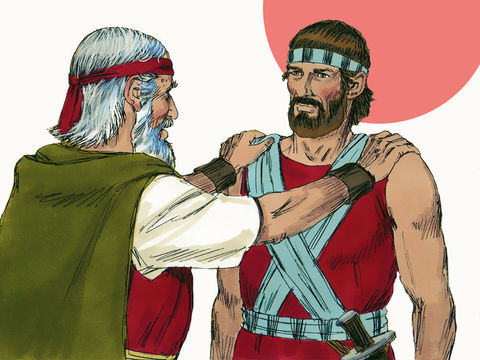
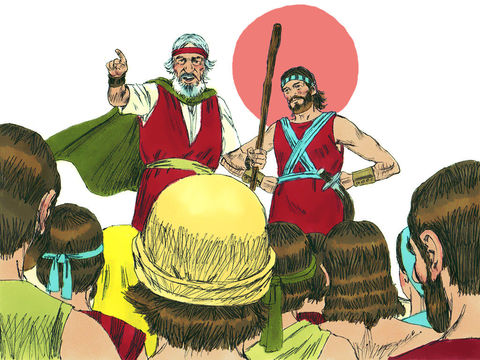
Read Together: Before his death, one of Moses’ final duties was to appoint Israel’s next leader. God had chosen Joshua, the son of Nun. Joshua had been at Moses’ side from the time the Israelites left Egypt. He was the first general who led Israel into war. He was also with the seventy elders who saw God and ate before Him. Joshua was with Moses on the mountain for forty days when he received the Ten Commandments from God. Joshua and Caleb were the only spies who brought back a good report of the promised land and tried to convince the others to go in and take it. He had been thoroughly trained, having served Moses for forty years, so God chose him to lead the nation after Moses. Joshua must have felt the burden of leading this nation with millions of people, but Moses encouraged him to be strong and courageous. Moses died on Mt. Nebo and was buried by God. After Moses’ death, God spoke to Joshua, letting him know that He was with him. God told Joshua to be strong and courageous. The rest of the story of Joshua – his leadership, exploits, bravery, and commitment — is for another lesson.
Ask your child what is their favorite story about Joshua. Why?
Talk about what might be some reasons that God did not reveal to us exactly where He buried Moses.
Discuss with your child how Joshua must have felt being personally encouraged by God. Remind your son or daughter that God speaks to us through His word, the Bible.
Express to your child that God wants each of us to be strong and courageous in our daily lives as we represent Him to the world. Why do we need to be strong and courageous?
Point out to your child that God trained Joshua from a young age to work in His service. Remind your child that if they are willing to do God’s will, they too can be used mightily by God.
Review Memorization:Deuteronomy 30:15-16 “See, I have set before you today life and good, death and evil, in that I command you today to love the LORD your God, to walk in His ways, and to keep His commandments, His statutes, and His judgments, that you may live and multiply; and the LORD your God will bless you in the land which you go to possess.”
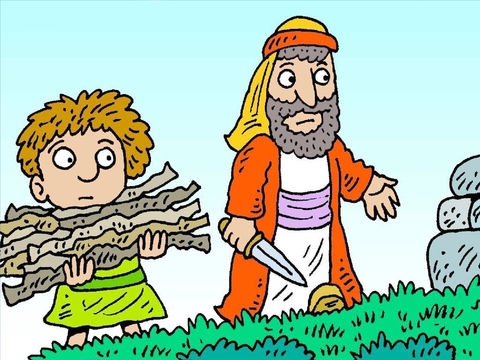
Read Together: Abraham and Sarah watched and guided Isaac as he grew into a young man. Abraham taught Isaac about God and told him about the promises He had made. Then, when Isaac was still a young man, God told Abraham to take him to the land of Moriah and offer him as a sacrifice! After hearing God’s instruction, Abraham dutifully arose the next morning, prepared for the journey, and headed toward the mountain with Isaac and two of his servants. It took them three days to reach the place where Isaac was to be offered. One can only imagine how difficult this journey was for Abraham. Nevertheless, He was willing to obey God’s command. Remember, God had promised that He would give many descendants to Abraham, and Isaac was the son who was miraculously born to Abraham and Sarah to bring about that promise. He knew that God was able to raise Isaac from the dead, if necessary, to keep His promise. Abraham and Isaac went up to the top of the mountain where Isaac allowed himself to be bound. Then Abraham laid his son on the wood of the altar to become the offering. Abraham raised the knife to slay his son when God stopped him. God then knew without any doubt that Abraham feared Him, trusted Him and loved Him more than anything or anyone – even his own son. God blessed Abraham for his faith and obedience and gave him even greater promises than before! God told him that all the people on earth would be blessed because of Abraham’s obedience!
Point out some great examples in the Bible of young people seeking God’s will and obeying Him. Isaac is one of them. Who else can you remember?
Discuss with your child some examples in Abraham’s life that validate why he is called the father of the faithful (Romans 4:16).
Help your child think about how difficult it would be to sacrifice your child or to be the person who is sacrificed. Ask them to imagine what it would have been like to be Isaac. Isaac could have run away, but instead he followed his father’s instruction, just as Abraham was following God’s instruction. This would have taken great courage and faith on the part of Isaac toward his father!
Explain to your child how Abraham and Isaac pictured the Father and Jesus Christ during their test. Abraham was a type of the Father who offered His Son, and Isaac pictured Christ, who willingly laid down His life (John 10:17–18).
Review Memorization:
Hebrews 11:17–18 “By faith Abraham, when he was tested, offered up
Isaac, and he who had received the promises offered up his only begotten son,
of whom it was said, ‘In Isaac your seed shall be called,’ concluding that God
was able to raise him up, even from the dead, from which he also received him
in a figurative sense.”
https://www.lcgeducation.org/wp-content/uploads/2019/03/005-ls-abraham-isaac.jpg360480Jonathan McNairhttps://www.lcgeducation.org/wp-content/uploads/2021/02/logo_basic-website-300x94.pngJonathan McNair2020-07-06 10:32:292026-02-24 17:04:53Children’s Bible Program – Level 2: Lesson 19 “Abraham and Isaac Are Tested”



 Read Together: After the flood, people began to raise families, and gradually moved further and further away from where the ark had come to rest. The Bible tells us about the families of Shem, Ham, and Japheth, and how they began to populate the earth. We read about one man who became famous as a great hunter. This man’s name was Nimrod, and he was the grandson of Ham, one of Noah’s three sons. As his fame grew, he was idolized by many. In fact, some people began to look to Nimrod instead of God for protection and leadership. They called him “the mighty hunter before [“instead of” or “in place of”] the Lord” (Genesis 10:9). Remember, God had commanded the sons of Noah to fill the earth (Genesis 9:1). But proud Nimrod rebelled against God, building cities and a kingdom. One of the cities he built was the famous Babel, where the people began to build a giant tower, reaching into the sky.