Children’s Bible Program – Level 3: NT Lesson 7 “Put God First”
/in LivingEd - YouthFeatured Passage: Matthew 6

In the message He gave on the mountain (often known as “The Sermon on the Mount”), Jesus first encouraged His disciples in the attitudes they should have to be blessed and happy. He then began to address the importance of keeping the Commandments – emphasizing that Christians should keep the spiritual intent of the law and not just the letter of the law. Jesus Christ continued the message by talking about everyday circumstances that people have and the usual concerns that this life brings. Christ told them, and tells us today, that the answer to life’s problems is to put God first.

Discuss:
- What does it mean to do “charitable deeds”? Can you think of some charitable deeds that you could do?
- When we do a good deed, should we tell everyone? Why or why not?
- What does it mean to fast? What are some instructions Jesus tells us about fasting in this passage?
- Do you worry about things? What does God say about worrying? What are some solutions to keep from worrying about things?
- What things did God say we should seek first? What is righteousness? How do we seek the kingdom and God’s righteousness?

Memory Challenge:
Matthew 6:33
“But seek first the kingdom of God and His righteousness, and all these things shall be added to you.”
Children’s Bible Program – Level 2: NT Lesson 7 “Jesus Heals a Blind Man”
/in LivingEd - YouthFeatured Passage: John 9

As Jesus taught and worked many wonderful miracles, the Jewish leaders were becoming very jealous and angry. One day, when Jesus was teaching in the temple, He said something that made the Jews so mad they wanted to stone Him! Jesus quickly hid and escaped out of the temple, but as He was leaving He noticed a man who had been blind from birth. Jesus’ disciples asked Him why the man was born blind and He told them God had something very special planned for this particular man.

Discuss:
- What explanation did the disciples say was the reason the man was born blind? How did Jesus answer them?
- What did Jesus do to heal the man? What instructions did he give to the man?
- On what day of the week did this miracle occur?
- When questioned, who did the man say had healed him? Why do you think the Pharisees wanted the man to deny that Jesus had healed him?
- Why did the Pharisees question the man’s parents?
- What did the Pharisees say was their reason for not believing Jesus was from God? Why did the man who was healed believe that Jesus was from God?
- What did Jesus mean when He said, “those who see may be made blind”?
- What things did you learn about who Jesus is in this passage?

Memory Challenge:
John 9:39
“For judgment I have come into this world, that those who do not see may see, and that those who see may be made blind.”
Forum Summary: Only You Can Buy It
/in LivingEd - CharlotteAuthor: Juliette McNair | Student, Living Education Charlotte 2020
Estimated reading time: 2 minutes, 5 seconds.
“If you haven’t noticed already, we’re here to sell you something.”
Mr. Gerald Weston gave the last Living Education forum for the semester. He began by saying Living Education is trying to “sell” a better way of life. This is also the purpose for the Living Youth Programs. Society sells young people all kinds of lifestyles—all, supposedly, equally virtuous. “But,” Mr. Weston said, “God does something that the world doesn’t do. He says, ‘Look, there is a better way—choose that one.’”
“We have traditions here at Living Ed that try to teach a better way of life.”
The decisions students make at Living Ed have a profound effect on the following groups. Mr. Weston explained that through the examples of today, a pattern is set for the students of following years. Likewise, at summer camp, a camper’s children could be attending as campers themselves only 15 years later. Mr. Weston said, “We are looking for young people who understand and internalize our values.” There are certain qualifications needed above and beyond physical skills.
Character Qualifications
Mr. Weston listed several of those qualifications: Young people who set a good example by their language, social media use, financial responsibilities, and standards of male-female interactions. Mr. Weston explained that the programs discourage young people from pairing off and engaging in intimate physical contact. “We’re not against love,” he said. But there is an appropriate time to be exclusive—there is “a time to embrace, and a time to refrain from embracing… a time to love” (Ecclesiastes 3:5-8). A young person’s example of handling male-female interactions determines their usefulness and trustworthiness in these programs.
“Trust is absolutely essential here at Living Ed and in the Living Youth Programs.”
Trustworthiness is at the core of these qualifications. Mr. Weston said, “If we cannot trust an individual, then we have no basis to work with that individual.” Yet, mistakes are expected. Mr. Weston said, “Mistakes will be made. And that’s okay.” But there’s a difference between honest mistakes and rule violations. He said, “Violations of rules bring loss of trust.”
“When you think about it, what is God looking for in you in this life? It’s trust.” Young people who can be trusted to uphold the traditions and values of the programs of the Living Church of God can be trusted to be good examples for younger teens in their formative years. Then, they become a part of selling the right way of life.
Mr. Weston concluded, “We can sell God’s way of life, but only you can buy it.”
This post is part of our new series of student-written content for LivingEd-Charlotte. These summaries cover topics originally presented by our faculty and guest speakers in our weekly Forum and Assembly. For more Assembly-related content check out our Second Thoughts posts.

Assembly Summary: The Benefits of Marriage
/in LivingEd - CharlotteAuthor: Juliette McNair | Student, Living Education Charlotte 2020
Estimated reading time: 2 minutes, 15 seconds.
Mr. Wallace Smith, the Church’s executive editor, gave the Living Education assembly this week. Mr. Smith spoke about the benefits of marriage and encouraged the students to seek a godly, fulfilling marriage for their futures.
Sex is a blessing in marriage.
One obvious benefit is sex. One deception promoted by society is that two people must discover if they’re “sexually compatible” before they marry. Mr. Smith responded to this lie: “Only over time do you become compatible.” He recommended that young people prepare for marriage by “wiping clean from your mind any ideas about sex you’ve seen on a screen or anywhere else.” Only in marriage is “the stage set for sex to be the blessing it’s meant to be.”
In marriage, you are all in.
Another is commitment. Mr. Smith explained that our world has normalized a lack of commitment before and even during a marriage. But to God, it is a big deal. “The fact is that whatever is not according to God’s design is not normal.” A spouse should be someone who is all in and devoted to you for the long run, and there is a deep peace of mind that comes from knowing someone is that committed to you.
Marriage builds companionship.
Companionship is a third benefit. Contrary to popular belief, true companionship is built through journeying through life together—it doesn’t instantly occur with one perfect “soul-mate.” And after it is built, it will be utterly unique from all your other relationships. That uniqueness explains why it is so painful for someone to lose their spouse: “They’ve lost something irreplaceable. You can’t just replace a journey of 50 years.”
A godly marriage allows you to be vulnerable.
With companionship and commitment, marriage creates a safe place for vulnerability that one does not experience in other relationships. Marriage becomes a place where you are free to let down your guard, compared to how you might feel around others.
Other benefits of marriage Mr. Smith addressed included the blessing of children, for whom marriage is the God-designed environment, and design fulfillment—the satisfaction that comes from completing the picture God designed with man and woman at creation.
Ultimate Fulfillment
Yet, those who are not married can still achieve fulfillment through their relationship with God. In fact, Mr. Smith emphasized that even married individuals are ultimately only fulfilled by God and that expecting your husband or wife to fulfill you in a way only God can is a crushing burden not to be placed upon your spouse. But marriage is something young people should want in their future and be willing to pursue and prepare for. It is a source of many benefits and God uses it as a mechanism to reward His servants and to teach us about Himself.
This post is part of our new series of student-written content for LivingEd-Charlotte. These summaries cover topics originally presented by our faculty and guest speakers in our weekly Forum and Assembly. For more Assembly-related content check out our Second Thoughts posts.
Programme biblique pour enfants : niveau 3 – NT leçon 1 “La Parole”
/in LivingEd - YouthPassage étudié : Jean 1

Qui est Jésus-Christ et pourquoi devrions-nous L’adorer ? C’est probablement la question la plus importante qu’un être humain devrait se poser, car elle peut changer toute une vie ! Beaucoup de gens considèrent qu’ils connaissent la réponse à cette question très importante, et beaucoup d’autres n’y ont même jamais réfléchi. Pourtant, Dieu y répond dans la Sainte Bible. La réponse à cette question commence avant la Genèse… avant le commencement !

Discussion :
- Qui existait déjà “au commencement” ?
- Que dit l’Évangile de Jean au sujet de “la Parole” ? Qui est Celui qui parla lorsque le monde fut créé ? Qui a créé le premier homme et la première femme ?
- À ton avis, que signifie la phrase : “Le monde ne l’a point connue”, ou “Le monde n’a point connu la Parole” ?
- Jean 1:14 dit que “la Parole a été faite chair, et elle a habité parmi nous”. Qui est devenu la Parole ?
- Pourquoi Jésus-Christ est-Il venu vivre sur la terre comme un simple être humain ?

Mémorisation :
Jean 1:1
“Au commencement était la Parole, et la Parole était avec Dieu, et la Parole était Dieu.”
Programme biblique pour enfants : niveau 2 – NT leçon 1 “Une voix dans le désert”
/in LivingEd - YouthPassage étudié : Jean 1

Dès le début, Dieu a prévu un plan pour toute l’humanité. Le grand Être appelé “la Parole” a créé le monde, mais Dieu savait que les gens auraient besoin d’un Sauveur, à cause du péché. Ce Sauveur serait “la Parole” elle-même, envoyée en tant que Fils de Dieu pour sauver tous les êtres humains qui ont jamais vécu. Pour préparer les gens à la venue de Son Fils, Dieu choisit un messager spécial – un prophète – pour leur annoncer que Son propre Fils arrivera très bientôt avec un plan pour sauver l’humanité !

Discussion :
- Qui est Jésus ?
- Qui était Jean-Baptiste pour certains Juifs ? Comment Jean-Baptiste se considérait-il ? (Ne confondez pas l’apôtre Jean et Jean-Baptiste ! L’apôtre Jean a écrit l’Évangile de Jean.)
- Pourquoi Jean-Baptiste baptisait-il les gens ? Que signifie se repentir ?
- Pourquoi Jean a-t-il baptisé Jésus, alors que nous savons qu’Il n’a jamais péché ? (Vous trouverez des précisions dans Matthieu 3.)
- Qu’est-ce qu’un disciple ? Peux-tu donner le nom d’un disciple de Jean-Baptiste qui est devenu ensuite un disciple de Jésus ?
- Quels sont les quatre hommes cités dans ce chapitre qui sont devenus les disciples de Jésus ? À ton avis, se connaissaient-ils entre eux ?

Mémorisation :
Jean 1:29
“Le lendemain, [Jean] vit Jésus venant à lui, et il dit : Voici l’Agneau de Dieu, qui ôte le péché du monde.”
Programme biblique pour enfants : niveau 1 – NT leçon 1 “Élisabeth et Marie”
/in LivingEd - YouthPassage étudié : Luc 1

De nombreuses années ont passé depuis que le peuple juif est revenu dans son pays d’origine, après avoir été emmené en captivité. Mais le peuple n’est pas libre pour autant. La Judée est sous la domination des Romains dont l’empire s’étend sur tout le continent. Les Juifs attendent le Messie pour les délivrer des Romains, comme de nombreux prophètes de Dieu l’ont annoncé depuis des centaines d’années. Dans Son plan pour toute l’humanité, Dieu a prévu d’envoyer Son Fils comme le Messie. Il a également prévu d’envoyer un prophète pour préparer les gens à entendre le message du Messie.
L’histoire commence à Jérusalem où habite une femme, nommée Élisabeth, qui vit avec son mari Zacharie. Ils sont très âgés et ils n’ont pas d’enfants. Un jour, alors que Zacharie est dans le temple pour s’acquitter de ses fonctions de sacrificateur, un ange lui apparaît ! L’ange a un message spécial pour Zacharie et Élisabeth, au sujet du Messie à venir et de l’homme qui doit préparer le chemin pour Sa venue.

Discussion :
- Quel message l’ange a-t-il apporté à Zacharie ? Comment Zacharie a-t-il réagi à ce message ?
- Comment Zacharie devait-il appeler son fils, selon l’ange Gabriel ? Qu’est-il arrivé à Zacharie lorsqu’il est sorti du temple ? Comment a-t-il communiqué à ses proches le nom de son fils ?
- Quel message l’ange a-t-il apporté à Marie ? Comment Marie a-t-elle répondu à ce message ?
- Comment Marie devait-elle appeler son fils ? Que signifie ce nom ?
- Que s’est-il passé lorsque Marie est allée rendre visite à sa cousine ?

Mémorisation :
Luc 1 : 31
“Et voici, tu deviendras enceinte, et tu enfanteras un fils, et tu lui donneras le nom de Jésus.”
Student Life: A Need for Speed
/in LivingEd - CharlotteAuthor: Juliette McNair | Student, Living Education Charlotte 2020
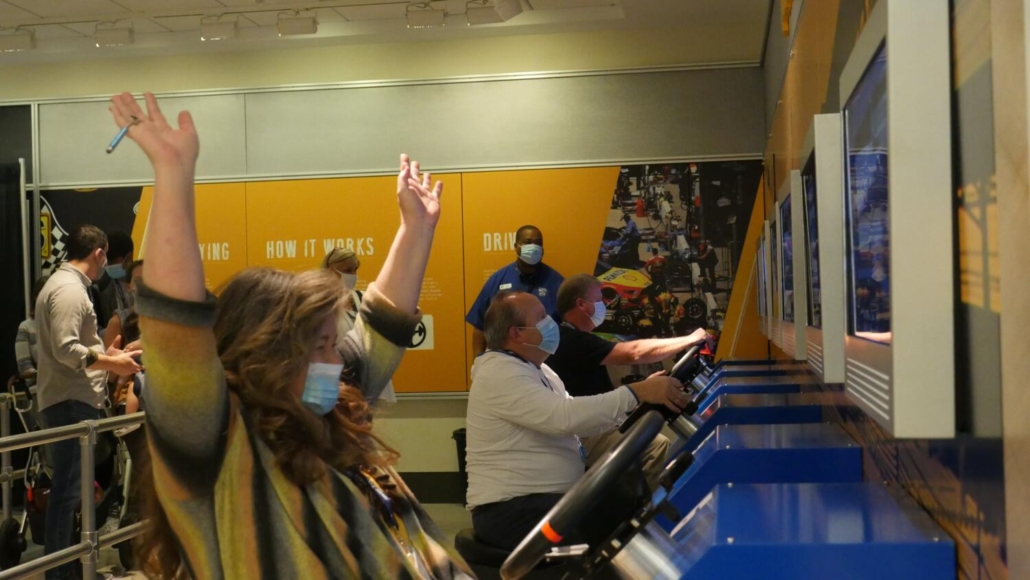
Do you have a need for speed? If you do, you may wish you would have tagged along with the Living Ed students this past Sunday. The NASCAR Hall of Fame is located in downtown Charlotte. Thankfully, it is only twenty minutes from the student’s residence—so they didn’t have to race to get there by 10:00 a.m. Mr. Jonathan McNair and several Living Ed teachers and their wives accompanied the students, providing some stiff competition for the races later in the day.
After the students registered for their I.D. cards, they made their way through the levels of the exhibits. They walked the ‘Glory Road’ exhibit and examined 18 cars from the 1920’s up to the 1990’s, handpicked by Dale Earnhardt Jr. These iconic stock cars were parked on a display track with banking gradually increasing to 33 degrees. Speedways use steep banking to apply centripetal force to the cars—this prevents them from being flung off the tracks due to lack of friction between the tires and the road.
At the Pit Crew Challenge, students and teachers teamed up and competed against each other to get their car jacked-up, gassed-up, and tires changed. Mr. Ryan Dawson, who teaches a class called “Living the Fruits of the Spirit,” joined the students with his wife and baby daughter. Mr. Dawson and his pit crew took first place on the leaderboard, finishing under nine seconds.
Finally, Mr. McNair led the group to the Racing Simulators. The students and teachers jumped into the driver’s seats of stock cars lined up underneath a huge video screen that projected the virtual race. The virtual track for the day was the oval Daytona International Speedway. The fastest lap-times and speeds were projected onto the leaderboard. DaQuan Rucker snared first place, at 193.790 mph, edging past German Roldan’s previous record at 192.642. Mr. Jerry Ruddlesden and Mr. McNair followed close behind.
As the group climbed into the vans and drove at normal speed back to the dorms, they geared up for the final push of the semester. Finals are looming and term projects are due soon. Deadlines are approaching and soon, unless the students shift into high gear, they will find themselves with a need for speed.

Juliette McNair is a student at Living Education Charlotte. She works in the Editorial Department transcribing sermons and proofreading transcripts. She also assists Living Education by writing Second Thoughts essays and Forum/Assembly Summaries for the website. Juliette recently graduated from SUNY Cobleskill in Upstate New York with an A.A.S in Horticulture, a B.T in Plant Science, and a minor in English with a writing focus. She loves playing soccer on the beach, getting up early to watch the sunrise, and playing piano with the lights out.
Forum Summary: Principles and Lessons to Prepare for a Future in God’s Work
/in LivingEd - CharlotteAuthor: Juliette McNair | Student, Living Education Charlotte 2020
Estimated reading time: 2 minutes.
Mr. Rand Millich has been a minister in God’s Church for over fifty years. He presently serves as the regional director of the U.S. Midwest. From 1963 to 1967, Mr. Millich attended Ambassador College. He noted, “I remember we had forums and assemblies presented at Ambassador College to broaden our education and horizons and prepare us for the future.”
Mr. Millich began by saying the Philadelphian Era was founded on three main pillars: Faithfulness to the Word of God, preaching the Gospel to the world, and a true understanding of God’s government (Revelation 3:7-8). These principles don’t just apply to one single era. He said, “These will be continuing defining aspects of God’s Work.” Mr. Millich gave us three lessons to apply in our lives.
First: “Base your life on the provable, unchangeable Word of God.” Mr. Millich quoted an Ambassador College motto that was stamped on the classroom center, “The Word of God is the foundation of knowledge.” Yet, as the Worldwide Church went off track, he said “Men of good stature —effective, powerful evangelists, got stuck on different issues.” They left the foundation of God’s Word.
The second lesson is “Don’t make rash life decisions.” Mr. Millich explained that many believed Jesus Christ was going to return in 1975. Some dipped into pension funds and others chose not to educate themselves. “There were some who married hastily, thinking that if Christ returned in ’75, they wouldn’t be married.” Unfortunately, some of these relationships ended in divorce. Mr. Millich encouraged the students to think carefully about their decisions. He said, “That decision might be with you longer than you thought.”
Third: “Count your opportunity at Living Education as special.” Not only do students have the opportunity to support God’s Work in various work studies, they can also learn from the examples around them at Headquarters. Mr. Millich recalled Mr. Armstrong’s example when he was in his class at Ambassador College. He said there was a telephone in the classroom so Mr. Armstrong could be reached in emergencies. It rang one day, and the students were silent as Mr. Armstrong received the news of President Kennedy’s assassination. After he hung up, he led the class in prayer.
Mr. Millich concluded, “I go back to the past for this reason: You have a similar opportunity today—these are the ‘good old days’ for you in your time. And they will prepare you for the opportunities God has for you in the future.”
This post is part of our new series of student-written content for LivingEd-Charlotte. These summaries cover topics originally presented by our faculty and guest speakers in our weekly Forum and Assembly. For more Assembly-related content check out our Second Thoughts posts.