Assembly Summary: The Benefits of Marriage

Author: Juliette McNair | Student, Living Education Charlotte 2020


Estimated reading time: 2 minutes, 15 seconds.

Mr. Wallace Smith, the Church’s executive editor, gave the Living Education assembly this week. Mr. Smith spoke about the benefits of marriage and encouraged the students to seek a godly, fulfilling marriage for their futures.

Sex is a blessing in marriage.

One obvious benefit is sex. One deception promoted by society is that two people must discover if they’re “sexually compatible” before they marry. Mr. Smith responded to this lie: “Only over time do you become compatible.” He recommended that young people prepare for marriage by “wiping clean from your mind any ideas about sex you’ve seen on a screen or anywhere else.” Only in marriage is “the stage set for sex to be the blessing it’s meant to be.”

In marriage, you are all in.

Another is commitment. Mr. Smith explained that our world has normalized a lack of commitment before and even during a marriage. But to God, it is a big deal. “The fact is that whatever is not according to God’s design is not normal.” A spouse should be someone who is all in and devoted to you for the long run, and there is a deep peace of mind that comes from knowing someone is that committed to you.

Marriage builds companionship.

Companionship is a third benefit. Contrary to popular belief, true companionship is built through journeying through life together—it doesn’t instantly occur with one perfect “soul-mate.” And after it is built, it will be utterly unique from all your other relationships. That uniqueness explains why it is so painful for someone to lose their spouse: “They’ve lost something irreplaceable. You can’t just replace a journey of 50 years.”

A godly marriage allows you to be vulnerable.

With companionship and commitment, marriage creates a safe place for vulnerability that one does not experience in other relationships. Marriage becomes a place where you are free to let down your guard, compared to how you might feel around others.

Other benefits of marriage Mr. Smith addressed included the blessing of children, for whom marriage is the God-designed environment, and design fulfillment—the satisfaction that comes from completing the picture God designed with man and woman at creation.

Ultimate Fulfillment

Yet, those who are not married can still achieve fulfillment through their relationship with God. In fact, Mr. Smith emphasized that even married individuals are ultimately only fulfilled by God and that expecting your husband or wife to fulfill you in a way only God can is a crushing burden not to be placed upon your spouse. But marriage is something young people should want in their future and be willing to pursue and prepare for. It is a source of many benefits and God uses it as a mechanism to reward His servants and to teach us about Himself.


This post is part of our new series of student-written content for LivingEd-Charlotte. These summaries cover topics originally presented by our faculty and guest speakers in our weekly Forum and Assembly. For more Assembly-related content check out our Second Thoughts posts.


Programme biblique pour enfants : niveau 3 – NT leçon 1 “La Parole”

Passage étudié : Jean 1


Asset-21@2x

Qui est Jésus-Christ et pourquoi devrions-nous L’adorer ? C’est probablement la question la plus importante qu’un être humain devrait se poser, car elle peut changer toute une vie ! Beaucoup de gens considèrent qu’ils connaissent la réponse à cette question très importante, et beaucoup d’autres n’y ont même jamais réfléchi. Pourtant, Dieu y répond dans la Sainte Bible. La réponse à cette question commence avant la Genèse… avant le commencement !

Asset-22@2x

Discussion :

  1. Qui existait déjà “au commencement” ?
  2. Que dit l’Évangile de Jean au sujet de “la Parole” ? Qui est Celui qui parla lorsque le monde fut créé ? Qui a créé le premier homme et la première femme ?
  3. À ton avis, que signifie la phrase : “Le monde ne l’a point connue”, ou “Le monde n’a point connu la Parole” ?
  4. Jean 1:14 dit que “la Parole a été faite chair, et elle a habité parmi nous”. Qui est devenu la Parole ?
  5. Pourquoi Jésus-Christ est-Il venu vivre sur la terre comme un simple être humain ?
Asset-23@2x

Mémorisation :

Jean 1:1

“Au commencement était la Parole, et la Parole était avec Dieu, et la Parole était Dieu.”


Programme biblique pour enfants : niveau 2 – NT leçon 1 “Une voix dans le désert”

Passage étudié : Jean 1


Asset-21@2x

Dès le début, Dieu a prévu un plan pour toute l’humanité. Le grand Être appelé “la Parole” a créé le monde, mais Dieu savait que les gens auraient besoin d’un Sauveur, à cause du péché. Ce Sauveur serait “la Parole” elle-même, envoyée en tant que Fils de Dieu pour sauver tous les êtres humains qui ont jamais vécu. Pour préparer les gens à la venue de Son Fils, Dieu choisit un messager spécial – un prophète – pour leur annoncer que Son propre Fils arrivera très bientôt avec un plan pour sauver l’humanité !

Asset-22@2x

Discussion :

  1. Qui est Jésus ?
  2. Qui était Jean-Baptiste pour certains Juifs ? Comment Jean-Baptiste se considérait-il ? (Ne confondez pas l’apôtre Jean et Jean-Baptiste ! L’apôtre Jean a écrit l’Évangile de Jean.)
  3. Pourquoi Jean-Baptiste baptisait-il les gens ? Que signifie se repentir ?
  4. Pourquoi Jean a-t-il baptisé Jésus, alors que nous savons qu’Il n’a jamais péché ? (Vous trouverez des précisions dans Matthieu 3.)
  5. Qu’est-ce qu’un disciple ? Peux-tu donner le nom d’un disciple de Jean-Baptiste qui est devenu ensuite un disciple de Jésus ?
  6. Quels sont les quatre hommes cités dans ce chapitre qui sont devenus les disciples de Jésus ? À ton avis, se connaissaient-ils entre eux ?
Asset-23@2x

Mémorisation :

Jean 1:29

“Le lendemain, [Jean] vit Jésus venant à lui, et il dit : Voici l’Agneau de Dieu, qui ôte le péché du monde.”


Programme biblique pour enfants : niveau 1 – NT leçon 1 “Élisabeth et Marie”

Passage étudié : Luc 1


Asset-21@2x

De nombreuses années ont passé depuis que le peuple juif est revenu dans son pays d’origine, après avoir été emmené en captivité. Mais le peuple n’est pas libre pour autant. La Judée est sous la domination des Romains dont l’empire s’étend sur tout le continent. Les Juifs attendent le Messie pour les délivrer des Romains, comme de nombreux prophètes de Dieu l’ont annoncé depuis des centaines d’années. Dans Son plan pour toute l’humanité, Dieu a prévu d’envoyer Son Fils comme le Messie. Il a également prévu d’envoyer un prophète pour préparer les gens à entendre le message du Messie.

L’histoire commence à Jérusalem où habite une femme, nommée Élisabeth, qui vit avec son mari Zacharie. Ils sont très âgés et ils n’ont pas d’enfants. Un jour, alors que Zacharie est dans le temple pour s’acquitter de ses fonctions de sacrificateur, un ange lui apparaît ! L’ange a un message spécial pour Zacharie et Élisabeth, au sujet du Messie à venir et de l’homme qui doit préparer le chemin pour Sa venue.

Asset-22@2x

Discussion :

  1. Quel message l’ange a-t-il apporté à Zacharie ? Comment Zacharie a-t-il réagi à ce message ?
  2. Comment Zacharie devait-il appeler son fils, selon l’ange Gabriel ? Qu’est-il arrivé à Zacharie lorsqu’il est sorti du temple ? Comment a-t-il communiqué à ses proches le nom de son fils ?
  3. Quel message l’ange a-t-il apporté à Marie ? Comment Marie a-t-elle répondu à ce message ?
  4. Comment Marie devait-elle appeler son fils ? Que signifie ce nom ?
  5. Que s’est-il passé lorsque Marie est allée rendre visite à sa cousine ?
Asset-23@2x

Mémorisation :

Luc 1 : 31

“Et voici, tu deviendras enceinte, et tu enfanteras un fils, et tu lui donneras le nom de Jésus.”


Student Life: A Need for Speed

Author: Juliette McNair | Student, Living Education Charlotte 2020


Do you have a need for speed? If you do, you may wish you would have tagged along with the Living Ed students this past Sunday. The NASCAR Hall of Fame is located in downtown Charlotte. Thankfully, it is only twenty minutes from the student’s residence—so they didn’t have to race to get there by 10:00 a.m. Mr. Jonathan McNair and several Living Ed teachers and their wives accompanied the students, providing some stiff competition for the races later in the day.

After the students registered for their I.D. cards, they made their way through the levels of the exhibits. They walked the ‘Glory Road’ exhibit and examined 18 cars from the 1920’s up to the 1990’s, handpicked by Dale Earnhardt Jr. These iconic stock cars were parked on a display track with banking gradually increasing to 33 degrees. Speedways use steep banking to apply centripetal force to the cars—this prevents them from being flung off the tracks due to lack of friction between the tires and the road.

At the Pit Crew Challenge, students and teachers teamed up and competed against each other to get their car jacked-up, gassed-up, and tires changed. Mr. Ryan Dawson, who teaches a class called “Living the Fruits of the Spirit,” joined the students with his wife and baby daughter. Mr. Dawson and his pit crew took first place on the leaderboard, finishing under nine seconds.

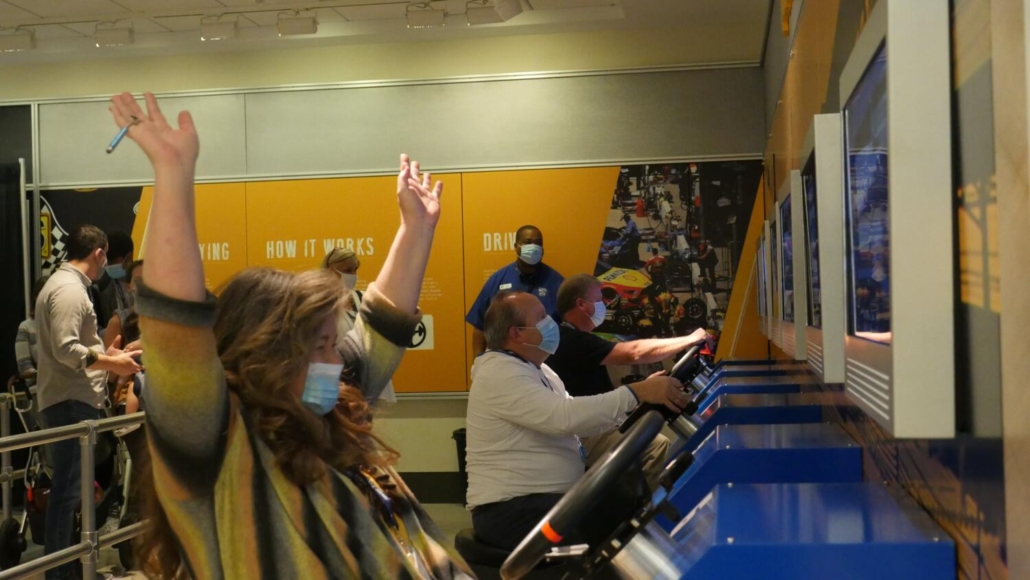
Finally, Mr. McNair led the group to the Racing Simulators. The students and teachers jumped into the driver’s seats of stock cars lined up underneath a huge video screen that projected the virtual race. The virtual track for the day was the oval Daytona International Speedway. The fastest lap-times and speeds were projected onto the leaderboard. DaQuan Rucker snared first place, at 193.790 mph, edging past German Roldan’s previous record at 192.642. Mr. Jerry Ruddlesden and Mr. McNair followed close behind.

As the group climbed into the vans and drove at normal speed back to the dorms, they geared up for the final push of the semester. Finals are looming and term projects are due soon. Deadlines are approaching and soon, unless the students shift into high gear, they will find themselves with a need for speed.


Juliette McNair headshot

Juliette McNair is a student at Living Education Charlotte. She works in the Editorial Department transcribing sermons and proofreading transcripts. She also assists Living Education by writing Second Thoughts essays and Forum/Assembly Summaries for the website. Juliette recently graduated from SUNY Cobleskill in Upstate New York with an A.A.S in Horticulture, a B.T in Plant Science, and a minor in English with a writing focus. She loves playing soccer on the beach, getting up early to watch the sunrise, and playing piano with the lights out.

Forum Summary: Principles and Lessons to Prepare for a Future in God’s Work

Author: Juliette McNair | Student, Living Education Charlotte 2020


Estimated reading time: 2 minutes.

Mr. Rand Millich has been a minister in God’s Church for over fifty years. He presently serves as the regional director of the U.S. Midwest. From 1963 to 1967, Mr. Millich attended Ambassador College. He noted, “I remember we had forums and assemblies presented at Ambassador College to broaden our education and horizons and prepare us for the future.”

Mr. Millich began by saying the Philadelphian Era was founded on three main pillars: Faithfulness to the Word of God, preaching the Gospel to the world, and a true understanding of God’s government (Revelation 3:7-8). These principles don’t just apply to one single era. He said, “These will be continuing defining aspects of God’s Work.” Mr. Millich gave us three lessons to apply in our lives.

First: “Base your life on the provable, unchangeable Word of God.” Mr. Millich quoted an Ambassador College motto that was stamped on the classroom center, “The Word of God is the foundation of knowledge.” Yet, as the Worldwide Church went off track, he said “Men of good stature —effective, powerful evangelists, got stuck on different issues.” They left the foundation of God’s Word.

The second lesson is “Don’t make rash life decisions.” Mr. Millich explained that many believed Jesus Christ was going to return in 1975. Some dipped into pension funds and others chose not to educate themselves. “There were some who married hastily, thinking that if Christ returned in ’75, they wouldn’t be married.” Unfortunately, some of these relationships ended in divorce. Mr. Millich encouraged the students to think carefully about their decisions. He said, “That decision might be with you longer than you thought.”

Third: “Count your opportunity at Living Education as special.” Not only do students have the opportunity to support God’s Work in various work studies, they can also learn from the examples around them at Headquarters. Mr. Millich recalled Mr. Armstrong’s example when he was in his class at Ambassador College. He said there was a telephone in the classroom so Mr. Armstrong could be reached in emergencies. It rang one day, and the students were silent as Mr. Armstrong received the news of President Kennedy’s assassination. After he hung up, he led the class in prayer.

Mr. Millich concluded, “I go back to the past for this reason: You have a similar opportunity today—these are the ‘good old days’ for you in your time. And they will prepare you for the opportunities God has for you in the future.”


This post is part of our new series of student-written content for LivingEd-Charlotte. These summaries cover topics originally presented by our faculty and guest speakers in our weekly Forum and Assembly. For more Assembly-related content check out our Second Thoughts posts.

Programa Bíblico para Niños – Nivel 3: Lección 13 “El Plan de Dios para la salvación”

Pasajes Destacados: 1 Pedro 1:19–20; Génesis 2:7–9, 15–17; Deuteronomio 16:16; Levítico 23:1–4


Asset-21@2x

Dios diseñó un plan mediante el cual tendría una familia con quien compartiría la eternidad. Entonces Él planeó crear a la humanidad a Su imagen, ponerlos en un entorno hermoso, y creó circunstancias en las que tendrían que elegir entre hacer lo correcto o lo incorrecto. Dios sabía que dar a la humanidad una agencia moral libre era la única forma cómo podrían desarrollar el carácter necesario para vivir en paz y armonía para siempre. También sabía que los seres humanos podrían elegir el camino equivocado, lo que causaría miseria y conduciría a la muerte. Dios no quería una familia que estuviera en confusión y miseria por toda la eternidad, así que antes de crear a la humanidad también diseñó un plan para salvarlos de la muerte eterna y traerlos dentro de Su familia. Él nos dio Sus Días Santos para enseñarnos sobre Su plan de salvación. Dios diseñó los Días Santos siguiendo las estaciones de cosecha en Judea, que incluyen la primavera, el verano temprano y el otoño. En las próximas lecciones discutiremos los Días Santos de primavera: la Pascua y los Días de los Panes sin Levadura, y lo que representan en el plan de salvación de Dios. Tenemos el privilegio de comprender y ser parte de este plan verdaderamente asombroso y admirable.

Asset-22@2x

Discusión:

  1. Discuta con sus hijos lo que significa ser un agente moral libre. A la humanidad no le ha sido dado el derecho de determinar qué está bien y qué está mal. Elegimos si haremos o no lo que es correcto, pero tal como Dios lo define.
  2. Explique a sus hijos que Dios hizo a los humanos físicos, de modo que, si se negaran a aprender a obedecerle, no recibirán un castigo de eterna tortura, sino que simplemente morirán una muerte física como lo hacen todos los humanos (Romanos 6:23; Apocalipsis 21:8).
  3. Ayude a sus hijos a comprender que su destino final es nacer en la familia de Dios como Sus hijos (Romanos 8:14–16; Hebreos 2:6–8; Salmos 82:6).
  4. Pregunte a sus hijos qué les gustaría hacer cuando se conviertan en seres espirituales en la familia de Dios. Comparta lo que usted espera hacer.
Asset-23@2x

Para Memorizar:

Romanos 5:10

“Porque si siendo enemigos, fuimos reconciliados con Dios por la muerte de su Hijo, mucho más, estando reconciliados, seremos salvos por su vida”.


Programa Bíblico para Niños – Nivel 2: Lección 13 “Nimrod el poderoso cazador”

Pasajes Destacados: Génesis 9:18–19; 10:1–8, 13–32; Hechos 17:26


Asset-21@2x

Dios salvó a ocho personas del diluvio que trajo sobre la Tierra: Noé y su esposa, sus hijos Sem, Cam y Jafet, y las esposas de sus hijos. Los hijos de Noé comenzaron a tener hijos, y sus familias se multiplicaron y formaron todas las naciones del mundo. Los nombres de sus descendientes (hijos, nietos, etc.) pueden ser encontrados en Génesis 10. Incluso cuando estas familias se convirtieron en tribus y naciones, la Tierra todavía estaba muy escasamente poblada. Uno de los hijos de Cam se llamaba Cus, y uno de los hijos de Cus se llamó Nimrod, quien era un poderoso cazador. La gente comenzó a confiar en Nimrod para su protección en lugar de confiar en el Dios Todopoderoso. Llamaron a Nimrod “vigoroso cazador delante del Eterno” (Génesis 10:9). La gente comenzó a idolatrarlo, y la mayoría de ellos pronto olvidaron las lecciones del Diluvio.

Asset-22@2x

Discusión:

  1. Explique a sus hijos que conocer los nombres de los pueblos antiguos y de las tierras en las que vivieron es importante porque nos ayuda a identificar a sus descendientes en la actualidad. Esto también nos ayuda a entender las profecías que los afectan.
  2. Discuta Hechos 17:26 con su hijo. Explíquele que Dios muestra qué partes de la Tierra la familia de Noé habría de heredar.
  3. Pida a sus hijos que se imaginen en la Tierra unos 100 años después del Diluvio. ¿Sería aterrador vivir en un área donde los animales salvajes superaban en número a los humanos? ¿Qué sería lo normal para hacer en esa situación? ¿Qué deberían haber hecho?
  4. Pregunte a sus hijos qué lecciones creen que la gente debió haber aprendido del Diluvio. Hablen sobre cómo la actitud de la gente hacia Nimrod demuestra que no aprendieron las lecciones del diluvio.
Asset-23@2x

Para Memorizar:

Génesis 11:9

“Por esto fue llamado el nombre de ella Babel, porque allí confundió el Eterno el lenguaje de toda la Tierra, y desde allí los esparció sobre la faz de toda la Tierra”.


Programa Bíblico para Niños – Nivel 1: Lección 13 “La Tierra antes del diluvio”

Pasaje Destacado: Génesis 6:1-12


Asset-21@2x

Antes del diluvio la gente en la Tierra se había vuelto muy malvada. De hecho, la Biblia dice que sus pensamientos todo el tiempo eran malvados. Las personas se hacían daño unas a otras, y el sufrimiento fue muy grande. Cuando Dios vio que las cosas se habían puesto demasiado mal, lamentó haber hecho al hombre. Fue doloroso para Él ver a las personas haciéndose daño de esa manera. Entonces Dios decidió destruir a toda la humanidad mediante una inundación que cubrió la Tierra. Dios, que es misericordioso, no quería destruir a las personas buenas y obedientes junto con los malvados. Entonces, buscó a alguien en la Tierra que fuese obediente a Él, y encontró a Noé.

Asset-22@2x

Discusión:

  1. Hable con sus hijos sobre lo que significa ser desobediente a Dios. Explíqueles que la desobediencia puede conducir a la “maldad” y cómo esta forma de vida lastima a las personas.
  2. Pida a sus hijos que se imaginen cómo sería si usted fuera la única persona buena en su barrio, y todas las demás personas fuesen malvadas. Recuérdeles que ¡solo quedaba una persona que realmente estaba obedeciendo a Dios!
  3. Pregunte a sus hijos cómo debió haberse sentido Dios al ver a todas las personas que Él creó siendo malvadas. Relaciónelo con una situación que han experimentado. (Ejemplo: “¿Cómo se siente mamá cuando ustedes son desobedientes y hacen cosas que no deberían estar haciendo?”)
  4. Aproveche esta oportunidad para explicar el período del juicio del Gran Trono Blanco (Apocalipsis 20:11). Un día, Dios dará a todos los que han vivido la oportunidad de obedecerle y seguirle, y ser bendecidos por su obediencia.
Asset-23@2x

Para Memorizar:

2 Pedro 2:5

“[Dios] no perdonó al mundo antiguo, sino que guardó a Noé, pregonero de justicia, con otras siete personas, trayendo el diluvio sobre el mundo de los impíos”.


Course Spotlight: Passover Interview with Mr. Gerald Weston

It’s always good to be prepared. With 101 days until Passover, now is a great time to go over the important meaning of this Holy Day, and to continue to thoroughly examine ourselves.

Check out the interview with LCG’s presiding evangelist Mr. Gerald Weston on the Passover below!

Course Spotlight From God’s Feast Days: Passover