Programa Bíblico para Niños – Nivel 1: Lección 17 “Las familias se convierten en naciones”

Pasajes Destacados: Génesis 8-10


Asset-21@2x

Con el Diluvio, Dios destruyó toda vida sobre la faz de la Tierra con excepción de Noé, su esposa, sus hijos Sem, Cam, Jafet y sus esposas, una pareja de cada animal inmundo y siete parejas de todos los animales limpios. Todos estos sobrevivieron en el arca. Después del Diluvio, Dios ordenó a Noé, a sus hijos y a los animales que se multiplicaran en la Tierra, y eso fue exactamente lo que hicieron. La gente vivía más tiempo y podían tener muchos hijos. Pronto las familias crecieron tanto que formaron naciones, las cuales se establecieron en sus propias tierras.

Asset-22@2x

Discusión:

  1. Ayude a sus hijos a identificar a las ocho personas que sobrevivieron al Diluvio.
  2. Discuta con sus hijos por qué Dios le dijo a Noé que metiera siete parejas de cada animal limpio en el arca.
  3. Ayude a sus hijos a visualizar cómo podría haber sido la Tierra después de unos años con tan poca gente y tantos animales que se multiplicaban muy rápidamente.
  4. Explique a sus hijos que, aunque su número aumentaba, las personas seguían unidos por el idioma y la cultura.
  5. Ayude a sus hijos a reconocer que después del Diluvio solo había ocho personas, y que hoy, unos 5 mil años después, hay casi ocho mil millones de personas, todas descendientes de Noé.
Asset-23@2x

Para Memorizar:

Génesis 11:6

“Y dijo el Eterno: He aquí el pueblo es uno, y todos éstos tienen un solo lenguaje; y han comenzado la obra, y nada les hará desistir ahora de lo que han pensado hacer”.


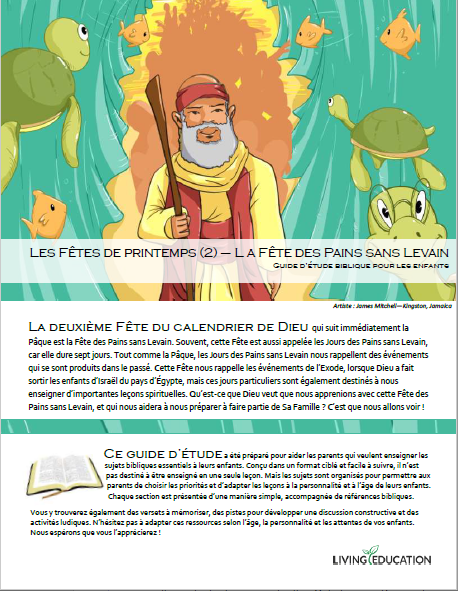
Les Fêtes de printemps (2) – La Fête des Pains sans Levain

Artiste : James Mitchell – Kingston, Jamaïque

La deuxième Fête du calendrier de Dieu

qui suit immédiatement la Pâque est la Fête des Pains sans Levain. Souvent, cette Fête est aussi appelée les Jours des Pains sans Levain, car elle dure sept jours. Tout comme la Pâque, les Jours des Pains sans Levain nous rappellent des événements qui se sont produits dans le passé. Cette Fête nous rappelle les événements de l’Exode, lorsque Dieu a fait sortir les enfants d’Israël du pays d’Égypte, mais ces jours particuliers sont également destinés à nous enseigner d’importantes leçons spirituelles. Qu’est-ce que Dieu veut que nous apprenions avec cette Fête des Pains sans Levain, et qui nous aidera à nous préparer à faire partie de Sa Famille ? C’est que nous allons voir !


Comment ça fonctionne :

Ce guide d’étude a été préparé pour aider les parents qui veulent enseigner les sujets bibliques essentiels à leurs enfants. Conçu dans un format ciblé et facile à suivre, il n’est pas destiné à être enseigné en une seule leçon. Mais les sujets sont organisés pour permettre aux parents de choisir les priorités et d’adapter les leçons à la personnalité et à l’âge de leurs enfants. Chaque section est présentée d’une manière simple, accompagnée de références bibliques.

Vous y trouverez également des versets à mémoriser, des pistes pour développer une discussion constructive et des activités ludiques. N’hésitez pas à adapter ces ressources selon l’âge, la personnalité et les attentes de vos enfants. Nous espérons que vous l’apprécierez !


Forum Summary: Hollywood’s Marxist Propaganda

Author: Juliette McNair | Student, Living Education Charlotte 2021


Estimated reading time: 4 minutes, 3 seconds.

Mr. Michael Brown pastors two congregations in Saskatchewan, Canada. He spoke to the students about communism and the influence of Marx’s ideologies on modern society. Mr. Armstrong called communism “worldwide psychological warfare.” In 1956, he wrote, “We are not fighting a single nation in a military war, but a gigantic worldwide, plain-clothes army, masquerading as a political party… [It will] weaken us from within… destroying our spiritual and religious life…” After World War II, Mr. Armstrong believed Russia would not attack the West militarily, but psychologically. Communism—or leftism—did not disappear with the dismantling of many communist governments in the twentieth century. As Mr. Armstrong predicted, communism simply took a new form.

What is Neo-Marxism?

Mr. Brown asked, “But what is Neo-Marxism—or leftism—and what is it we can do to protect ourselves?” He gave seven short points on Marxism, taken directly from the leftist “bible,” The Communist Manifesto—the third most assigned textbook in American universities.

First, communism “promotes change through radical action.” Marx believed the solution to historic class struggles in society was the violent overthrow of the rich. Another core goal of Marxism is the “doing away of private property.” Marx claimed that if the working man rebelled against the rich, all wealth would be handed over to the state, ushering in the dictatorship of the working man. Third, communism reflects Marx’s hate for families. Marx wrote about removing “the two bases of traditional marriage—the dependence rooted in private property, of the women on the man, and of the children on the parents.” He believed the traditional family model treated women and children like “oppressed factory workers.” Mr. Brown that communism dissolves distinct nationalities. “Marx believed the working man had no country.” Fifth, communism brings the destruction of all religion, truth, morality, and tradition. Marx wrote, “Communism abolishes eternal truths, it abolishes all religion, and all morality… [It] acts in contradiction to all past historical experience.” Finally, Marx aimed to bring world peace by establishing a utopian world via government. He believed revolution was justified by its results.

“Of all the arts, cinema is most important to us.”

– Vladimir Lenin

During Russia’s Bolshevik rule, Vladimir Lenin promoted his revolutionary agenda by equipping trains with propaganda movies, sending them throughout the country. Joseph Goebbels was Hitler’s Minister of Propaganda from 1933 to 1945. He controlled the German film industry during the Nazi period. In 1941, Goebbels commissioned the film I Accuse, in which a woman convinces her husband to poison her to end her suffering from multiple sclerosis. This film was designed to inspire sympathy for Aktion T4—a program that authorized certain physicians to euthanize patients. Hundreds of thousands of injured or sick people were murdered as a result.

“We all know who the first revolutionary was—an angel named Lucifer.” Today, Satan uses Marx’s ideas to tear down a nation’s belief structure, including the tradition of the family and a belief in God. Mr. Brown emphasized one of the major avenues for this psychological attack is the entertainment industry. Hollywood has weaponized Marx’s ideas to reshape people’s attitudes and pervert their morals. Genesis 19:1 describes the gates of Sodom. Mr. Brown asked, “What types of things do you think you would see at these gates? Today, those gates live in our pockets, our bedrooms, and our living rooms.”

Modern Gates of Sodom and Gomorrah

Christians are to “have their senses exercised to discern both good and evil” (Hebrews 5:23-24). Mr. Brown encouraged the students to analyze the entertainment they absorb for subtle narratives. For example, Rudy, “one of the ultimate underdog films of all time,” falsely portrays the authority figures in Rudy’s life as harsh and unmerciful. In Star Wars, the villains are authoritative and ordered, an evil father tries to destroy his son, and Luke is advised to trust in his feelings—not guidance from wise mentors. “So often in movies,” Mr. Brown said, “good qualities are given to the bad guys and bad qualities are given to the good guys.” Even seemingly innocent children’s movies, like Finding Nemo or Happy Feet, contain subtle, ungodly propaganda. “The audience begins to reshape their personal reality to reflect the reality of the characters and the narrative of the film. As we develop affection for the characters, it can lead to us being accepting of their wrong behaviors.”

What can we do to protect ourselves?

2 Corinthians 6:14 reads, “Do not be unequally yoked together with unbelievers. For what fellowship has righteousness with lawlessness?” Christians can accidentally fellowship with characters on a screen. Mr. Brown explained even virtual, evil company will corrupt good character (1 Corinthians 15:33). “Hollywood and the entertainment industry are the biggest propaganda tools in the world.” While God teaches blessings follow obedience and curses follow disobedience, the entertainment industry lies, showing curses for obedience and blessings for disobedience. Mr. Brown encouraged the students to replace the Hollywood propaganda in their life with wholesome pastimes that impart wisdom and knowledge.


This post is part of our new series of student-written content for LivingEd-Charlotte. These summaries cover topics originally presented by our faculty and guest speakers in our weekly Forum and Assembly. For more Assembly-related content check out our Second Thoughts posts.


Course Spotlight: Easter or Passover?

In some of our online courses, we have a “Student Thoughts” section where we ask a question to see what the students think. In our course on the Biblical Passover, we asked the question:

If you had to defend why you don’t keep Easter, and the reasons you keep the Passover to someone in the world, how would you explain your beliefs in a concise way while keeping in mind the principle from Matthew 10:16, “be wise as serpents, and harmless as doves.”?

Take a look at some of the responses below!


“I would politely explain that I kept the Feasts God instructed us to keep, as we were instructed in the pages of the Bible. This would give me an opportunity to explain my joy of finding the answer to what had always puzzled me even as a child since I could count — How I could not reconcile Friday crucifixion and Sunday morning as being three and one half days, and that I also found how rabbits and eggs sneaked into the picture…Depending on my listener’s reaction I would also add the prophecy Christ Himself gave of Jonah and the fish.”

-MS

“If I were confronted about why I keep the Passover instead of Easter, I would explain that I keep the Feasts and Holy Days that Christ and the Disciples kept in the New Testament. I would explain that Easter is not in the Bible and if it is, it is a mistranslation of the word Pascha which means Passover. Also God tells us that He will not accept pagan rituals in worship of Him and when people keep the traditions of Easter, they are not keeping God’s commandment to keep the Passover. They are in fact worshiping a fertility goddess called Eostre who’s origin is pagan. I would tell them to do some research on the origin of Easter.”

-AL

“My defense for observing Passover instead of Easter would be that mathematics rules out my observance of Easter. In Matthew 12:40, Jesus said, ‘For as Jonah was three days and three nights in the belly of the great fish, so will the Son of Man be three days and three nights in the heart of the earth.’ Easter keepers are saying that Jesus was in the heart of the earth only two nights and one day, which is only half of the time He stated would prove him to be the Messiah. Concisely stated, I observe Passover because I really do believe that Christ was the promised Messiah, who now sits at the right hand of the Father as our intercessor. Stated another way, if Easter depicts the actual time between Christ’s burial and His resurrection, we have no Savior!”

-RM

Assembly Summary: Build Your House

Author: Juliette McNair | Student, Living Education Charlotte 2021


Estimated reading time: 3 minutes, 38 seconds.

Mr. Lawdi Ferreira spoke to Living Ed students over a Webex video conference. Table Mountain—one of the Seven Natural Wonders of the World—towered above Cape Town in Mr. Ferreira’s virtual background. “I’m using this to attract you to come to Cape Town for the Feast.” Mr. Ferreira has three kids, and he pastors congregations in South Africa and Zimbabwe. He began, “I want to start off by telling a story of a builder.”

There was a master builder who decided to retire to enjoy a more relaxed life. But when he approached his boss about retiring, he was asked to build one more house as a personal favor. He agreed, and he began to build one last home. Yet his heart was not in his work, and he constructed the house poorly. When he finished, to his surprise, his boss handed him the keys to the house—it was a final gift to the builder.

“There is so much meaning in that story for you and me. You and I are building our spiritual houses right now.” Yet, Mr. Ferreira explained, God offers the help the students will need to build a strong spiritual life. 1 Corinthians 3:9-10 reads, “… you are God’s building… But let each one take heed how he builds on it.” Mr. Ferreira said, “I would like to give you three keys to help you build a strong spiritual house.

Build on the Right Foundation

Young people can be full of exciting dreams of what they want to do in their future. Mr. Ferreira called it “a wonderful time of life.” He advised the students to recognize this period as crucial—their future decisions hinge on the choices they make now. A Christian’s foundation should be Christ (1 Corinthians 3:11). Mr. Ferreira asked, “How do you ensure that you build on Christ?” He turned to Luke 6:46-48, where Christ defined the man who built his house on a rock as the man who heard and lived by His sayings. Mr. Ferreira encouraged the students to build their foundation by examining their choice of movies, music, games, social media, friends, conversation, and career choices and ask, Would Christ approve?

Don’t Compromise

When Mr. Ferreira was nineteen, he and a friend went to the U.K. to work and save for college. Yet every job he applied to required him to work on the Sabbath. His friend pushed him to compromise, and on their third day in London, he had only seven dollars left. That day, he found a job that would accommodate the Sabbath. “God was testing me to the end—but, interestingly, I never had that trial again there.” Learning not to compromise can be “an expensive lesson to learn.” Matthew 6:33 contains a Christian’s foremost mission—to seek the Kingdom—and nothing should compromise that goal. But, Mr. Ferreira emphasized, “God will give the outcome, just don’t compromise.”

Look Ahead to Your Future

The marshmallow test famously assesses a child’s ability to delay gratification: a child is told he can have one marshmallow now, or two later if he waits. Mr. Ferreira’s son was given this test. The teacher told him he could have two marshmallows if he waited until after a conversation. Later, Mr. Ferreira was told his son—while he didn’t hear a word of the conversation—waited and passed the test. “Our ability to sacrifice the present for the future is very crucial.” Human nature makes people “want what they want and want it now.” Just as Esau sold his birthright for some stew (Genesis 25:29-34), Christians can lose sight of what is truly valuable. “The world that Satan creates is very attractive,” like a cardboard box iced with frosting to appear like a cake. 2 Peter 2:15-21 speaks of Christians who return and entangle themselves with the sins of the world. “We shouldn’t pass by our eternal reward for a short-term reward Satan offers.”

“Make sure you build without regret.”

Mr. Ferreira quoted Annie Dillard: “The way you live your days is the way you live your life.” He exhorted the students to use the opportunity they have in the Church of God now to build a foundation, to stand up in obedience to God without compromise, and to keep their eyes focused on the future. “Yours and my life in God’s Kingdom will be a result of our decisions and attitudes today—it will be a result of how we build our house.”


This post is part of our new series of student-written content for LivingEd-Charlotte. These summaries cover topics originally presented by our faculty and guest speakers in our weekly Forum and Assembly. For more Assembly-related content check out our Second Thoughts posts.

Forum Summary: Africa

Author: Juliette McNair | Student, Living Education Charlotte 2021


Estimated reading time: 4 minutes, 45 seconds.

“Today, I’d like to enlarge your view of the world.” Mr. Peter Nathan, the Regional Director of Europe, Africa, and the U.K gave a Forum on the Work in Africa. Some may think of exotic wildlife or the Sahara when they think of this continent. But Mr. Nathan said, “Let me present to you a different view.” Africa represents twenty percent of the land area of the earth. “What does that mean to you and me?” This “continent of extremes” can fit the U.S.A, Japan, China, India, Mexico, and several European countries inside its borders. Mr. Nathan covered the three major spheres of operation for the Church in Africa.

Southern Africa

Mr. Nathan explained that southern Africa “can make you can feel like you’ve experienced the Kingdom of God ahead of time,” as some who have kept the Feast there can confirm. But it is also a region where an entire congregation can be incarcerated on the way home from services. Bordered by Zambia and Malawi in the north and the Cape in the south, this region was introduced to the World Tomorrow in the 60s, when it aired from stations in the Congo and Mozambique. The first baptizing tour in the region occurred in 1961, and an office in Johannesburg was set up in 1963. By the time Mr. Nathan was sent to the region in 1973, there were four congregations in Zimbabwe and six in South Africa, with members scattered around the region. Today, there are 190 members, eleven congregations, three regular Feast sites, and a summer Living Youth Program.

Eastern Africa

“We can focus on the center point: Lake Victoria.” Lake Victoria is the third largest body of freshwater in the world and is a major source of water for Egypt and eastern Africa. In 1975, Mr. Armstrong visited President Jomo Kenyatta of Kenya. From 1975 to the present, the Church has grown in Kenya, Tanzania, and Uganda. There are now 300-600 attendees, 29 congregations, and sixteen elders, with four Feast sites and an annual Living Youth Program in Kenya.

Central and Western Africa

In 1960, two radio stations in Sierra Leone and Nigeria projected Mr. Armstrong’s voice across central and western Africa. While the station in Nigeria brought a healthy response, the broadcast from Sierra Leone did not. Mr. Nathan shared a story: In 1961, a wealthy magistrate in Nigeria wrote to Pasadena asking, Please, come and baptize me and my nineteen wives. Several years later, this man was baptized. Ghana saw its first baptizing tour in 1971, and, two years later, after a civil war, a baptizing tour was conducted in Nigeria. In 1969, a man from eastern Ghana, after listening to the broadcast and studying the Church’s literature, started a congregation following the teachings of Mr. Armstrong. Today, this association has grown to include congregations in Togo, Benin, and Ghana, with an attendance of around 1,700. In 2019, LCG became aware of the group as it uses an identical name in the French language—Mr. Nathan said, “We’ll see what happens.”

Elders

Mr. Juvenal Karibwami speaks French, English, Romanian, and Swahili and serves as an elder in Burundi. In western Africa, Dr. Akin-Ogudeji serves as the area pastor. Mr. Urbain Hazoume, another non-employed elder, was educated in France. He runs a private school he established in Gabon, and his uncle is a king in Badagry, on the border of Nigeria and Benin. Mr. Jackstone Abok is retired and lives in Kenya on the shores of Lake Victoria. Mr. Nathan introduced two farmers from Tanzania who serve the Church: Mr. Ezekiel Mkama and Mr. Adonias Kando. In Nairobi, Mr. Peter Mutula serves as an elder. Mr. Ephraim Abok is the area pastor for western Kenya, while Mr. Simon Muthama is the area pastor for the rest of Kenya, Tanzania, and Uganda.

Opportunities and Challenges

In the 1950s, Andrew Dugger, “driven by the need to preach the Gospel throughout the world,” began teaching in Africa. Various Church of God Seventh Day Jerusalem congregations were established. Some of these congregations stayed faithful, not only to the Sabbath but to the Holy Days and other true doctrines. After the death of Andrew Dugger, many congregations, including Kenya, Rwanda, and Burundi were left without leadership. In the 90s, one of these congregations in Kenya contacted LCG. Mr. Nathan said, “Increasingly, we find people associated with Worldwide coming to us, because we are continuing to teach the truth they were once taught.”

A significant challenge to the Work in Africa is “the elephant in the room: Islam.” Mr. Nathan drew attention to the fact that he had not mentioned northern Africa. He explained there is little opportunity for the truth in this heavily Muslim region. This is why the Sierra Leone radio station broadcasting the World Tomorrow in the 60s didn’t bring much response. Islam dominates in the north, but, as the fastest-growing religion in Africa, it is fast spreading to the rest of the continent. “Islam is going to create a challenge as we go forward… We need to recognize that the time is short with some of these areas.” Other challenges for the Church in Africa include language translation, religion, travel dangers, and inconsistent technology infrastructure.

God Is Doing a Work

“We have lots of challenges, but God is doing a Work here.” Going forward, Mr. Nathan said Church literature could be translated into Swahili—there are 150 million Swahili speakers who can benefit from this project. The Work and the Church are alive and active in Africa, with hundreds of members spread across the southern, eastern, western, and central regions of the country. Mr. Nathan, with a long history of serving the Church in Africa, concluded, “Having been sent to Africa, I don’t seem to be able to get it out of my blood.”


This post is part of our new series of student-written content for LivingEd-Charlotte. These summaries cover topics originally presented by our faculty and guest speakers in our weekly Forum and Assembly. For more Assembly-related content check out our Second Thoughts posts.

Digging Deeper: Jesus’ Sermon at His Hometown Synagogue

Author: Mr. Kenneth Frank | Faculty in Theology, Living Education


Estimated Reading time: 7 min.

Did you know that Jesus was considered a member of his hometown synagogue congregation and was thereby invited to preach to them on a Sabbath?

I have never preached a sermon in my hometown, although I have done so in my home state. Paul spent several years preaching in his hometown of Tarsus, in today’s nation of Turkey. If you were invited to speak before your hometown congregation, what would you say to them? You may want to be complimentary and grateful to those who witnessed your life changes in their community. This Digging Deeper will explore the first-century Sabbath liturgy in a narrative only Luke records to better understand what happened when Jesus addressed His local congregation.

The Gospel According to Luke records this experience in Luke 4:16-30. It occurs near the beginning of Jesus’ Galilean ministry. This was Jesus’ first visit to the town of Nazareth, where He grew up, since His baptism by John the Baptist. It is important for our understanding of Jesus’ sermon to remember that the Gospels refer to this area as “Galilee of the Gentiles” in the first century. During Pax Romana, the era of “Roman peace”, Galilee was occupied by many non-Jews. Luke records this incident right after reporting Jesus’ temptation by Satan in the wilderness (Luke 4:1-13). However, John’s Gospel inserts His early Judean ministry following His baptism by John the Baptist and His temptation by the Devil. Following that, Luke briefly records Jesus being well-received when He taught in the Galilean synagogues (Luke 4:14-15). Jesus was both a preacher and a teacher, which are different means of communication. Teaching can be more effective than preaching because teachers can turn passive listeners into active participants. Jesus expected a response to His messages from the audience.

The First Century Synagogue

The word synagogue means “assembly.” Perhaps more than any other institution, the synagogue preserved the religion, culture, and special status of the Jewish people. These meeting places originated during the Babylonian captivity of the House of Judah and developed further during the time between the testaments (the Intertestamental Period). These buildings served as places of prayer and worship on the Sabbath. During the week they were transformed into law courts and schools. But on Sabbaths and at festivals they were places of scriptural instruction. Each synagogue was supervised by a board of elders or rulers. One lesser official was called a chazzan, somewhat equivalent to a deacon in Christian churches. The Holy Land offered synagogues not only for native Jews but also for diaspora Jews (those Jews originally from outside the Holy Land). It is estimated there were 480 such synagogues in Jerusalem alone.

In the standard synagogue layout, the main room provided a reading desk upon which scrolls of the Hebrew Bible were unfolded for reading. It was customary to read a portion of the Law and then a portion of the Prophets while standing, out of respect for God’s word. Following that, someone was invited to expound upon the texts for the day, usually based on the reading from the Prophets. Qualified men of the congregation were called upon by the rulers to sit in an assigned seat called “Moses Seat.” I refer you to my recent Digging Deeper article by this same title. Jesus was popularly considered a rabbi, or teacher – John 1:38, 49; 3:2; 6:25. Visiting rabbis were often invited to address the assembly, as was common for the Apostles Paul and Barnabas (Acts 13:13-16). Not only this, being a male member of this congregation entitled Jesus to be called upon to deliver the sermon for the day.

Order of service

Attendance was required for the Sabbaths and Feast days. The congregation faced the ark (chest or cabinet) housing the scripture scrolls in the front of the room. Men sat on one side of the room and women and children on the other or up in a balcony. Those who sat in the front near the reader’s desk were in the “chief seats,” mentioned by Jesus in the Gospels.  Following an opening prayer, the Seventh-day Adventist Bible Commentary, Vol. 5 reports a typical order of service as follows:

  1. Recitation of the shema – Deuteronomy 6:4-9 – known as “the creed of the Jews”. Part of this read: Deuteronomy 6:4-5 KJV  “Hear, O Israel: The LORD our God is one LORD :  (5)  And thou shalt love the LORD thy God with all thine heart, and with all thy soul, and with all thy might.”
  2. The parashah, or reading of the appointed section of the Law – anyone making the least mistake was immediately replaced by someone else.
  3. The haphtarah, or reading of the Prophets.
  4. The derashah, or “investigation, study” – a homily, discourse, or sermon usually given by a member of the congregation, usually based on the Prophets but also could be from the Law.
  5. The bendiction (blessing) – offered by the priest, if one was present. Otherwise, a prayer was offered to conclude. In some places singing of psalms was introduced into the service (Review and Herald Publishing Association, 1980, pp. 57-58).

Luke 4:16 affirms that Sabbath attendance was Jesus’ regular habit. Jesus’ and His apostles and believers always observed the seventh-day Sabbath throughout the New Testament. Following their Master’s example, Christians today regularly attend Sabbath and festival services. Jesus’ example also provides evidence that the seven-day cycle since Creation has not been lost since Christians need only go back to Jesus’ day to verify this. He is the Creator and Lord of the Sabbath (Mark 2:28). Time has not been “lost,” as some assert, since the first century. Jews would not have lost the cycle of days since that time either. They have meticulously recorded their weeks, months, and years for millennia to faithfully observe God’s sacred times. 

He stood up to read

After the synagogue service began with prayer and a reading from the Law, Jesus was invited to read the Prophets portion for the day. The scroll he was handed was that of Isaiah. Possibly, He chose that scroll for this occasion. He stood to read it out of respect for God’s word. In the time of Ezra, not only did Ezra stand to read but the audience did as well (Nehemiah 8:5). The words “to read” in Luke 4:16 imply that Jesus read aloud. He preached in other synagogues, but read only here in Nazareth, showing He was considered a member of this synagogue. The lesson for the day was only read in Hebrew, indicating Jesus knew Hebrew as well as Aramaic (the common language of first-century Jews in the Holy Land), and possibly Greek (the common language of the eastern Roman Empire).

The chazzan would take the scrolls from a cabinet (chest) called “the ark,” to hand to the President of the synagogue who then handed it to the reader for the day. Scrolls were animal skins of parchment on which the sacred words were written in ink. These parchments were rolled on two rollers, or spindles, and were unraveled from the right roller to the left. Unlike many modern languages, Hebrew is read from right to left. As Jesus unrolled the scroll, He read a portion from two passages of Isaiah: Isaiah 61:1-2; Isaiah 58:6. This combining of texts was commonly done in that time to join together passages with a similar theme. This was called gezerah shava, a “comparison of equals”, creating a composite text.

What Jesus read at first brought keen interest, then curiosity, then alarm, and finally hostility. What did Jesus say that brought about a mob action that threatened His very life? Watch for a future Digging Deeper in which I will annotate Luke’s summary of Jesus’ message to that congregation. In the meantime, I encourage you to read and study this entire account in Luke 4:16-30.


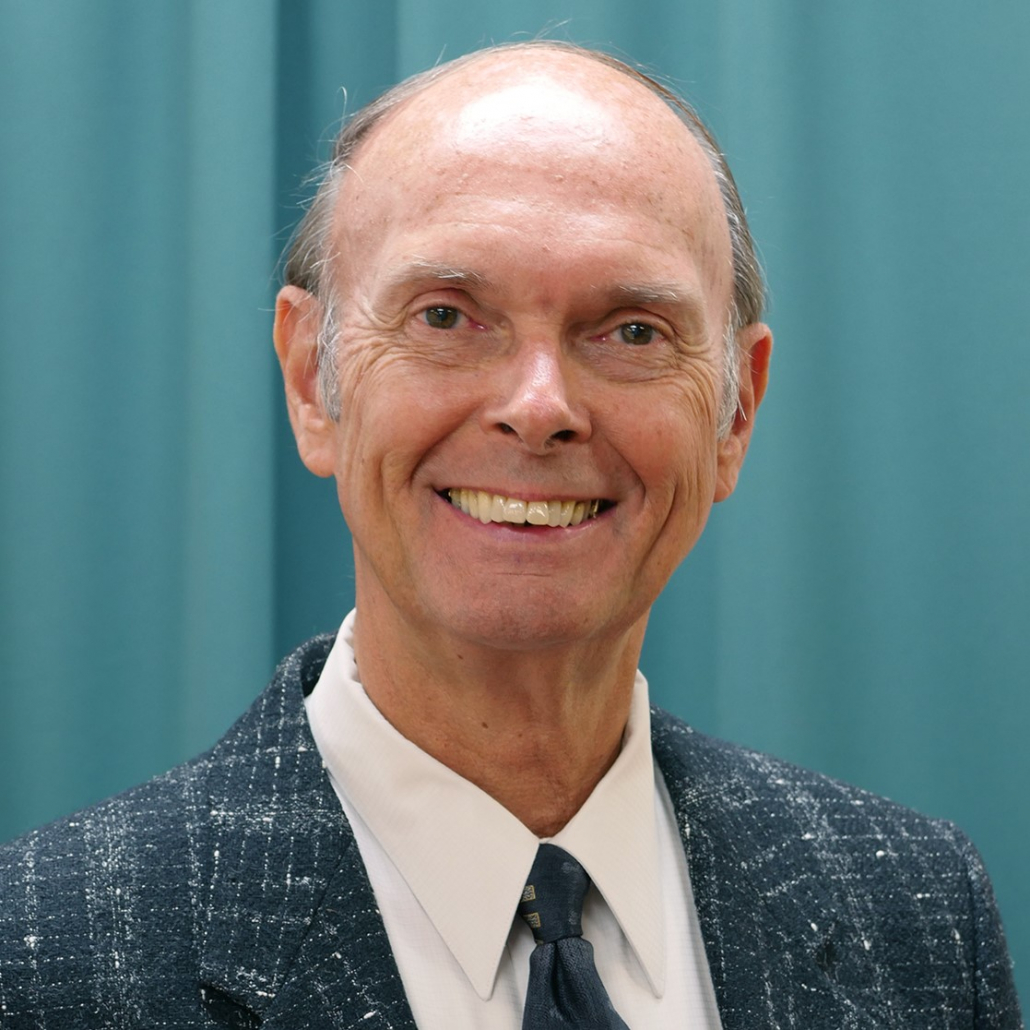
Kenneth Frank headshot

Kenneth Frank was born and raised in New Jersey, USA, and attended Ambassador College, graduating in 1973. He served in the Canadian ministry from 1973-1999, after which he returned to the USA to pastor churches in Maryland, Virginia, and North Carolina for 15 years. Having earned a BA degree from Ambassador College he later earned a MA degree from Grand Canyon University before being assigned to the Charlotte office to teach at Living University, now Living Education. Currently, he teaches the Survey of the Bible course to the on-campus students and writes the Digging Deeper column for our online Bible study program. He is married, has four children, and seven grandchildren.

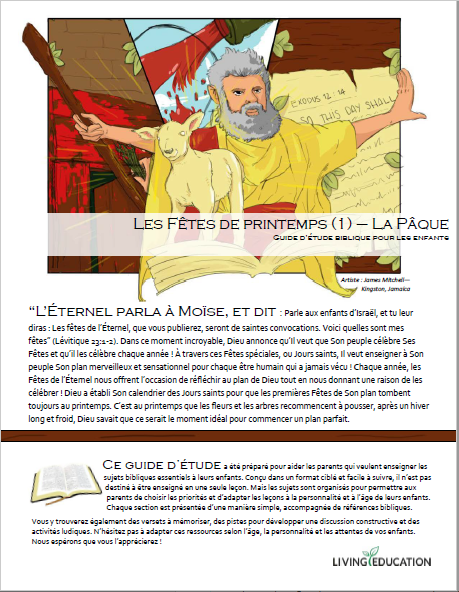
Les Fêtes de printemps (1) – La Pâque

Artiste : James Mitchell – Kingston, Jamaïque

“L’Éternel parla à Moïse, et dit :

Parle aux enfants d’Israël, et tu leur diras : Les fêtes de l’Éternel, que vous publierez, seront de saintes convocations. Voici quelles sont mes fêtes” (Lévitique 23:1-2). Dans ce moment incroyable, Dieu annonce qu’Il veut que Son peuple célèbre Ses Fêtes et qu’il les célèbre chaque année ! À travers ces Fêtes spéciales, ou Jours saints, Il veut enseigner à Son peuple Son plan merveilleux et sensationnel pour chaque être humain qui a jamais vécu ! Chaque année, les Fêtes de l’Éternel nous offrent l’occasion de réfléchir au plan de Dieu tout en nous donnant une raison de les célébrer ! Dieu a établi Son calendrier des Jours saints pour que les premières Fêtes de Son plan tombent toujours au printemps. C’est au printemps que les fleurs et les arbres recommencent à pousser, après un hiver long et froid, Dieu savait que ce serait le moment idéal pour commencer un plan parfait.


Comment ça fonctionne :

Ce guide d’étude a été préparé pour aider les parents qui veulent enseigner les sujets bibliques essentiels à leurs enfants. Conçu dans un format ciblé et facile à suivre, il n’est pas destiné à être enseigné en une seule leçon. Mais les sujets sont organisés pour permettre aux parents de choisir les priorités et d’adapter les leçons à la personnalité et à l’âge de leurs enfants. Chaque section est présentée d’une manière simple, accompagnée de références bibliques.

Vous y trouverez également des versets à mémoriser, des pistes pour développer une discussion constructive et des activités ludiques. N’hésitez pas à adapter ces ressources selon l’âge, la personnalité et les attentes de vos enfants. Nous espérons que vous l’apprécierez !


Course Spotlight: How Did Jesus Die?

In the Church of God, we have long understood, quite correctly, that most texts of Matthew’s Gospel now omit a key line depicting a soldier spearing the crucified Christ and thus killing Him violently. Yet, even what is present in the rest of the Gospel accounts may in fact reveal more than we might at first notice. Could some of the answer be lost in translation?

Course Spotlight From The Life, Ministry, and Teachings of Jesus Christ: (Unit 4) Passover to the Resurrection

Assembly Summary: Achieving Godly Success

Author: Juliette McNair | Student, Living Education Charlotte 2021


Estimated reading time: 3 minutes, 50 seconds.

Mr. Richard Ames graduated from Rensselaer Polytechnic Institute (RPI) with a civil engineering degree. He joined the National Guard and was later transferred to Fort Gordon near Augusta, Georgia, where he trained as a cryptologist and communications specialist. Later, he continued working as a surveyor. Mr. Ames said, “I knew that was not what I wanted to do.” He applied to Yale and got a scholarship for a one-year graduate course in transportation and traffic engineering. In 1961, Mr. Ames worked as a transportation engineer at the Southeastern Virginia Regional Planning Commission in Norfolk, Virginia. In the fall of 1961, Mr. Ames attended his first Feast of Tabernacles at Big Sandy.

“The motivation to do the best I could…”

While in the National Guard, Mr. Ames learned a valuable lesson from a good friend. “My friend set a good example, and his positive attitude of trying to do the best he could gave me the motivation to do the best I could.” Mr. Ames began the Assembly by handing out the reprint series, “Achieving Godly Success.” He said, “Today, I will talk briefly about true success.” Years ago, a young man told Mr. Ames, “I don’t need to know the seven laws of success, I’m already successful.” Mr. Ames remarked it was this very attitude that identified the young man’s lack of success—success is physical and spiritual.

The Seven Laws of Success

“Set the right goal.” To achieve physical and spiritual success, a person must define the success they want by setting spiritual and physical goals.  Mr. Ames deeply desired to visit Jerusalem. Seventeen years after he first set this goal, after Israel had captured control of Jerusalem in the 60s, he and his wife were given the opportunity to visit the city. Mr. Ames quoted Psalm 37:4: “Delight yourself also in the LORD, and He shall give you the desires of your heart.”

“Educate and prepare yourself.” Mr. Ames, who has had nine and a half years of higher education at RPI, Yale, Stephen F. Austin State University, and Ambassador College, warned the students to be careful with the knowledge promoted at universities. Instead, he said to recognize “the fear of the LORD is the beginning of wisdom, and the knowledge of the Holy One is understanding” (Proverbs 9:10). He said, “You students at Living-Ed are fulfilling this law right now.”

“Maintain good health.” While there are many facets to being healthy, Mr. Ames said the most important principle is building a positive attitude. A positive attitude is not just passive—it goes beyond passivity to proactivity. The purpose behind maintaining good health is found in 1 Corinthians 6:19-20, “your body is the temple of the Holy Spirit… glorify God in your body and in your spirit, which are God’s.” 

“And the fourth law of success is—drive!” Like the ant which “provides her supplies in the summer, and gathers her food in the harvest,” Mr. Ames explained that, sometimes, one tiny step must be taken at a time. “You have to prod yourself.” At almost 85 years of age, Mr. Ames said, while he might have to take a nap more often than he used to, he still drives himself every day.

“Apply resourcefulness.” Whether it’s a health crisis or challenges that come on the way to achieving one’s goals, resourcefulness is key. “When you have these challenges, you have to ask, ‘What are the resources I have?’” One valuable resource is advice. “Without counsel, plans go awry, but in the multitude of counselors they are established” (Proverbs 15:22).

“Persevere toward your goal.” Mr. Ames said, “I came to a crossroads in my life when I flunked two engineering classes at RPI.” But instead of giving up, Mr. Ames went back, retook the classes he failed, and graduated with his degree. Hebrews 12:1 reads, “Let us run with endurance the race that is set before us….” To successfully run the race of life, Christians must practice perseverance.

“Seek God’s continual counsel.” “Trust in the LORD… In all your ways acknowledge Him, and He shall direct your paths” (Proverbs 3:5-6). Mr. Ames emphasized, “In all your ways.” If a Christian remains close to God every day, through prayer and study, Mr. Ames said, “You are acknowledging Him every day.”

Success In This Lifetime and Beyond

“How many of you right now—before I say them—can repeat all seven laws of success?” Most of the students raised their hands—a Christian Living project from last semester on the seven laws of success geared them for Mr. Ames’ question. Mr. Ames concluded, “Thank God that you’re building a solid foundation for godly success for this lifetime and beyond.”


This post is part of our new series of student-written content for LivingEd-Charlotte. These summaries cover topics originally presented by our faculty and guest speakers in our weekly Forum and Assembly. For more Assembly-related content check out our Second Thoughts posts.