
Second Thoughts: One Hundred Billion Eternities

Author: Thomas White | Editorial Staff, Living Church of God


We’re often told to think about the “big picture” of Christ’s return and the soon-coming eternal Kingdom of God. But when you’re young, even the small picture seems absolutely enormous.

Learning to drive a car is terrifying when you’ve previously only driven—and crashed—a Mario Kart. Getting married is unbelievably, mind-breakingly immense when the whole of your existence has been not married. Young adults doing their best to meaningfully visualize eternity will probably be about as successful as preschoolers trying to ponder the theory of relativity, and I say that as a young adult.

Mr. Phil Sena’s recent assembly—delivered via the internet, due to this virus you may have heard of—addressed how difficult it can be, as a teenager or young adult, to focus your life on the Kingdom of God while also… you know, managing all of the really important, earthly milestones young people naturally have to deal with. Because you have to finish school. You have to get a job. You’d really, really like to marry someone and have children, and then you have to make sure you don’t neglect that spouse or those children. And in the midst of all of this, you have to remember how temporary everything is—even though right now it’s legitimately quite important—so you have to keep talking to God. You have to keep pondering His ways and commands. You have to keep fasting, you have to keep spending time with the Bible, you have to keep examining yourself.

Your Part of the Picture

That really is a big picture, and it’s legitimately difficult to keep up with everything. But it’s also a tiny picture—because it’s only about you. When you’re trying really hard not to make a physical mess of your life, and doing your best not to make a spiritual mess of it, either, it can be all too easy to miss the fact that you’re just one person. Yes, God cares so very deeply about you, and you should never, ever forget that, but even your eternity is just one eternity. 

You know what’s bigger than an eternity? Read the title again.

According to that nifty little internet we’re all using to maintain some semblance of normality these days, it’s estimated that around 100 billion people have lived on Earth up to this point. And hey, you’re one of them! Congratulations. That means the Kingdom of God is 0.000000001 percent about you. That’s how big a part of the picture your one eternity is.

Their Part

As Mr. Sena profoundly emphasized, the world needs God’s Kingdom. It’s about so much more than your personal salvation or mine, and it’s even about so much more than the collective saints of God being transformed in the first resurrection. It’s about rescuing everyone in the entire history of the world. It’s about redeeming not just our time, but the whole of time itself. It’s about one hundred billion eternities.

That’s a big picture. And if our first thought of the Kingdom is usually, “Oh boy, I sure hope I make it there,” we’re forgetting 99.999999999 percent of that picture. We should never stop striving to enter God’s Family, because that’s literally the entire point of human existence (Ecclesiastes 12:13), but when we’re trying to think of the big picture, let’s at least remind ourselves that the vast majority of that picture isn’t about us—and let’s thank God for the fact that regardless of any one of us, the Kingdom will come, creating an unfathomably joyful universe of one hundred billion eternities. 


Thomas White headshot

Thomas White was one of the onsite Living Education students for the 2018-2019 semesters. He also has a Bachelor’s Degree in English. Thomas currently works as an Editorial Assistant for the Living Church of God. According to his wife, he eats pizza in entirely the wrong way.

Young Singles Virtual Weekend

Living Education is sponsoring a “Young Singles Virtual Weekend” involving a number of online get-togethers on April 10th and 11th. Register now!

Recommended Reads: The Temple: Its Ministry and Services as they were at the time of Jesus Christ

Jerusalem’s temple represented not only the glory of Israel’s past but the splendor of its future, when the Messiah would come and reign over God’s people. To recapture the essence of the temple’s significance, both in the life of Israel and in the life and theology of the early Christians….

Digging Deeper: The Prophetess Anna

Author: Mr. Kenneth Frank | Faculty, Living Education


Estimated Reading Time: 3 min.

Did you know that one of the people who welcomed Jesus and his adoptive father and mother in the temple on the day of Jesus’ presentation was an old prophetess who spent her time there in fastings and prayers?

Luke 2:36-38 informs us that her name was Anna and that her father was Phanuel of the tribe of Asher. The gift of prophecy was given at times to devout women as well as men. Several prophetesses are listed in both Testaments of our Bible such as Miriam, Deborah, Isaiah’s wife, Huldah, and the four virgin daughters of Philip. Some suggest her deceased husband may have been a prophet. Concerning her office as prophetess, Matthew Henry’s Commentary wrote, “Perhaps no more is meant than that she was one who had understanding in the scriptures above other women, and made it her business to instruct the younger women in the things of God.”

There is a difference of opinion about her age based on the text. Some claim she had been a widow for 84 years after a short marriage of seven years. This would make her well over 100 years old! Others suggest she was then 84 having been widowed many years after a brief marriage of only seven years. The statement that she departed not from the temple likely means either that she had been provided a living space in the temple complex or out-buildings or that she continually spent her time there in worship.

The name Anna in our Greek New Testament is a transliteration of the Hebrew name Channah, meaning “grace.” It is the same name as the Old Testament heroine, Hannah, the mother of Samuel. Being of the tribe of Asher would probably have made Anna a Galilean, as were 11 of Jesus’ 12 apostles. The tribe of Asher in the Old Testament was originally part of the House of Israel that was later carried into captivity hundreds of miles east and north by the mighty empire of Assyria. The bulk of the House of Israel never returned to the Promised Land. Nonetheless, small numbers found their way back to their ancestral home through the many centuries following captivity. The International Bible Encyclopedia article about Anna reports that “Tradition says that the tribe of Asher was noted for the beauty and talent of its women, who for these gifts, were qualified for royal and high-priestly marriage.”

The centuries since the captivities of the Houses of Israel and Judah made them long for the redemption and consolation of Israel through a coming Messiah prophesied by several of God’s spokesmen in the Hebrew Bible. This hope sustained Anna in her temple devotions for decades. She, and a just and devout man named Simeon (Luke 2:25-35), were delighted witnesses in the temple to Jesus’ birth. They were rewarded for their faithfulness by personally viewing the One who would provide spiritual deliverance to Israel and all humanity. Learning the news that the Messiah had arrived, Anna as a prophetess understood its significance and shared it with others who also looked for redemption in Jerusalem and Israel. Her brief account attests to the covenant loyalty of God’s devout people through the centuries. Their example should encourage us to trust Jesus’ promise to return!


Kenneth Frank headshot

Kenneth Frank was born and raised in New Jersey, USA, and attended Ambassador College, graduating in 1973. He served in the Canadian ministry from 1973-1999, after which he returned to the USA to pastor churches in Maryland, Virginia, and North Carolina for 15 years. Having earned a BA degree from Ambassador College he later earned a MA degree from Grand Canyon University before being assigned to the Charlotte office to teach at Living University, now Living Education. Currently, he teaches the Survey of the Bible course to the on-campus students and writes the Digging Deeper column for our online Bible study program. He is married, has four children, and seven grandchildren.

Digging Deeper: A Cause to Pause

Author: Mr. Kenneth Frank | Faculty, Living Education


Estimated Reading Time: 2 min.

Did you know that one of the greatest nations of antiquity suffered not just one pestilence but a series of ten plagues in succession?

That nation was Egypt. This harrowing account is recorded in chapters 1-12 of the Book of Exodus in the Holy Bible. Jews and Christians alike reflect on the meaning of the original Exodus and Passover stories in springtime. For Christians, this reflection includes meditation on the significance of Jesus’ death on the cross as our Passover Lamb (1 Cor 5:7; John 1:29) to provide us an exodus from sin, Satan’s society, and self.

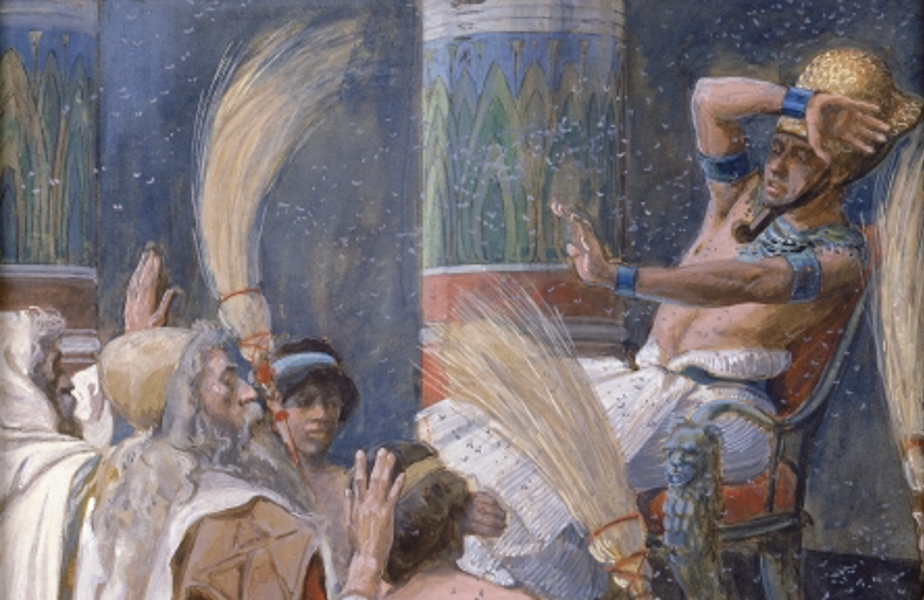
The coronavirus COVID-19 pandemic is motivating people around the earth to consider the meaning of this frightening and deadly experience. Perhaps over several months, Egypt suffered plagues of blood, frogs, lice or gnats, flies, murrain, boils, hail, locusts, darkness, and the death of its firstborn. The plague of murrain on the animals was a pestilence (Ex 9:3, 14). Amos 4:10 referred to Egypt’s plagues as a pestilence. A working definition of pestilence is a contagious and destructive disease that is a calamity, a scourge, and an epidemic or pandemic. Today the world is reeling from one pestilence but imagine if it had to respond to ten in a row!

This story is one of the greatest epics of biblical history and literature.

The plagues on Egypt were God’s judgment upon a God-defying pharaoh and his people who had confined, enslaved and mistreated the Israelites for hundreds of years. God had given fair warning, through the preaching of his servant, Moses, to the proud Egyptians about the onset of these plagues if they refused to set His people free. By these afflictions, God released, rescued and redeemed His people from servitude to be His very own special people led by Moses, whose own birth narrative relates to the suffering of his people. God accomplished His will through this historic tragedy. It marked the beginning of the Israelites’ long journey to the Promised Land.

plague flies

The desolating plague of our own time will accomplish God’s purpose in something we may not yet understand. The key to understanding this experience is humbling ourselves in repentance to receive God’s reprieve when He deems we are genuinely establishing godly standards (2 Ch 7:13-14). In the meantime, Christians need to consider and follow the apostle Paul’s example while under arrest in Rome: “… so now also Christ shall be magnified in my body, whether it be by life, or by death” (Phil 1:20). May God have mercy on us as we sincerely turn to Him in our time of need (Heb 4:16).


Kenneth Frank headshot

Kenneth Frank was born and raised in New Jersey, USA, and attended Ambassador College, graduating in 1973. He served in the Canadian ministry from 1973-1999, after which he returned to the USA to pastor churches in Maryland, Virginia, and North Carolina for 15 years. Having earned a BA degree from Ambassador College he later earned a MA degree from Grand Canyon University before being assigned to the Charlotte office to teach at Living University, now Living Education. Currently, he teaches the Survey of the Bible course to the on-campus students and writes the Digging Deeper column for our online Bible study program. He is married, has four children, and seven grandchildren.

Digging Deeper: The Legacy of a King

Author: Mr. Kenneth Frank | Faculty, Living Education


Estimated Reading Time: 3 min.

Did you know that the captivity of the House of Judah was largely blamed on the actions of one of its kings?

For hundreds of years, God had sent prophet after prophet to warn his people to repent of their evil but to no avail. The entire nation was apostate from God. However, it was the regime of one of its kings that was the final straw. 2 Kings 21:4 and Jeremiah 15:4 describe Judah’s removal from its homeland into captivity for the “sins of Manasseh…for the innocent blood that he shed…which the LORD would not pardon.” Not only was there an entire tribe of the northern House of Israel named Manasseh, but the thirteenth king of the House of Judah bore this name as well.

King Manasseh was the son of one of the House of Judah’s most righteous kings, Hezekiah. Hezekiah had cleansed the southern tribes of idolatry and repaired and reopened the Temple with proper sacrifices before restoring the festivals of Passover and the Days of Unleavened Bread that had been neglected many years. Later in life, Hezekiah was told by the prophet Isaiah to get his house in order for he would soon die after contracting a disease. Hezekiah appealed to God who extended his life 15 years. During that time he begat a son who became his successor: Manasseh.

Hezekiah was not a perfect king, but Manasseh seemed to go to all lengths to undo his father’s reforms and go well beyond what any other king had committed in evil. Manasseh reigned the longest of Old Testament Israelite kings – 55 years. His evil reign is declared worse than that of the heathen who occupied the Holy Land before Israel conquered it (2 Kings 21:9). Manasseh even made some of his children “pass through the fire” (burning them alive) in sacrifice to a heathen god.

Manasseh’s wickedness is detailed in 2 Kings 21 and 2 Chronicles 33. But only the account in 2 Chronicles tells the “rest of the story.” He was eventually hauled away in shackles into captivity by the Assyrians, perhaps even with a hook in his nose or lip as he walked hundreds of miles to the city of Babylon. Remarkably, while in captivity he came to himself, like the Prodigal Son, in this far-off land and appealed to God’s mercy who not only arranged for his release from captivity but even returned him to his throne in Jerusalem (2 Chronicles 33:12-13). After his resuming power, he implemented a massive reform program to turn the nation back to God; however, the consequences of his earlier wickedness could never be fully reversed before the final captivity of the nation.

This story declares the graciousness of our God that even as wicked a person as Manasseh could be forgiven and restored! This account should encourage all of us to appreciate and draw closer to the God who is merciful and gracious, slow to anger and who will abundantly pardon through the sacrifice of His own Son, Jesus Christ. We must never take His grace for granted but we can continue to count on it if we genuinely repent of our sin and change our ways.


Kenneth Frank headshot

Kenneth Frank was born and raised in New Jersey, USA, and attended Ambassador College, graduating in 1973. He served in the Canadian ministry from 1973-1999, after which he returned to the USA to pastor churches in Maryland, Virginia, and North Carolina for 15 years. Having earned a BA degree from Ambassador College he later earned a MA degree from Grand Canyon University before being assigned to the Charlotte office to teach at Living University, now Living Education. Currently, he teaches the Survey of the Bible course to the on-campus students and writes the Digging Deeper column for our online Bible study program. He is married, has four children, and seven grandchildren.

Student Visit to the NASCAR Hall of Fame

On Sunday, March 1st, the Living Education Students visited one of the most renowned sites in Charlotte – the NASCAR Hall of Fame! This fascinating part of Americana is showcased with full-size cars, displays recounting the history of the car-racing craze, going back to the days of Prohibition. As visitors, we learned about some of the early organizers of the racing circuit that is now big business throughout the US. We also took the opportunity to try our hand at racing in real stock cars simulators. One of the other highlights was having a go at a quick tire change in a simulated “pit” stop. It was a fascinating field trip!