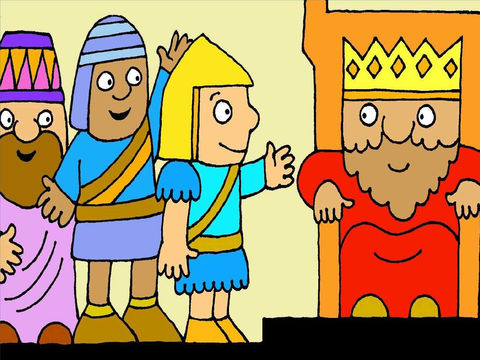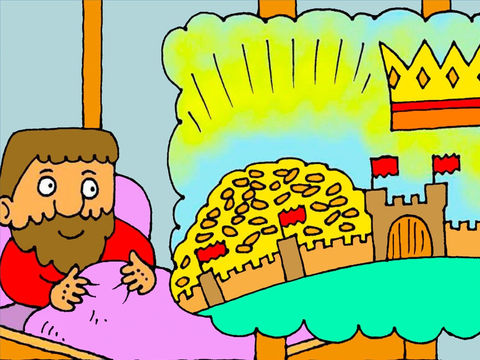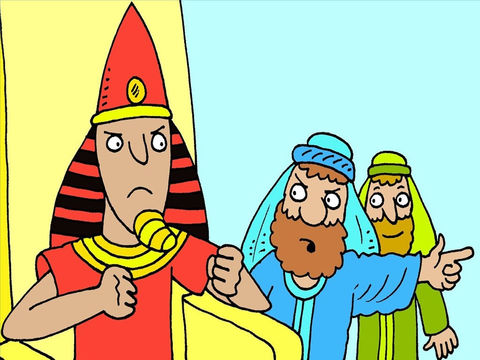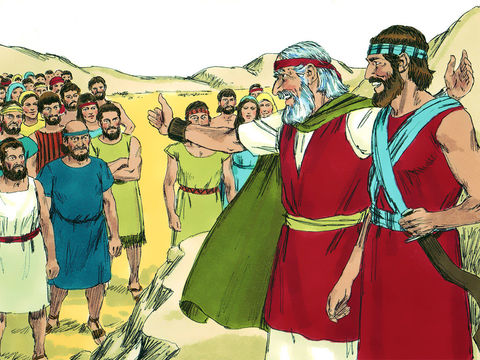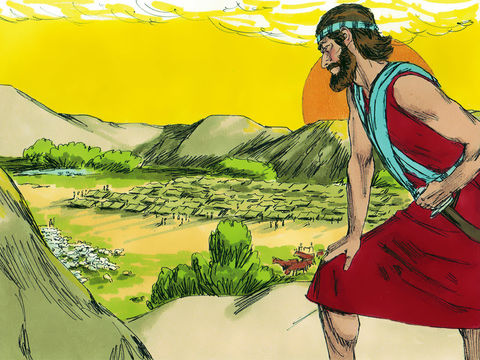
There was a man named Haman who was part of the king’s court. Haman was an Agagite which means he was an Amalekite; the Amalekites were enemies of the Jews. Haman hated all Jews, but he especially hated Mordecai. Haman came up with a plot to kill all the Jews. He told King Ahasuerus that the Jews had different laws and that they did not obey the king’s laws. Haman said the Jews did not deserve to live, and the king agreed. What they both didn’t realize was that the new queen of Persia was also a Jew.
Discuss:
Richard Gunther (www.lambsongs.co.nz) | FreeBibleImages.org
Why did Haman especially hate Mordecai?
What reason did Haman give the king for destroying all the Jews throughout the kingdom?
How did Haman decide what day the Jews should die? What day was chosen?
What did Mordecai do when he heard about the proclamation to kill the Jews?
What did Mordecai ask Queen Esther to do to help her people? How did Queen Esther respond to Mordecai’s request?
Memory Challenge:
Esther 4:14
“For if you remain completely silent at this time, relief and deliverance will arise for the Jews from another place, but you and your father’s house will perish. Yet who knows whether you have come to the kingdom for such a time as this?”
https://www.lcgeducation.org/wp-content/uploads/2020/05/41uJ6cGAprL._SX323_BO1204203200_.jpg499325Jonathan McNairhttps://www.lcgeducation.org/wp-content/uploads/2021/02/logo_basic-website-300x94.pngJonathan McNair2020-05-13 06:45:002020-11-06 13:11:34Recommended Reads: Economics in One Lesson
Author: Mr. Kenneth Frank | Faculty, Living Education
Estimated Reading Time:5 min.
Did you know that Jesus’ story about the widow who deposited two mites (smallest of Roman coins) into the Temple treasury may have suffered from clerical abuse?
Throughout the centuries, people have admired the self-sacrificing widow who gave all she had to God. However, you may have wondered: “Why did she have only two mites to give?” There is a backstory that could explain why she was so destitute. This story has a piercing message for religious leaders.
The Temple treasury was in the court of the women in Jesus’ day. Albert Barnes’ Notes on the Bible explains: “In that court there were fixed a number of places or coffers, made with a large open mouth in the shape of a trumpet, for the purpose of receiving the offerings of the people; and the money thus contributed was devoted to the service of the temple – to incense, sacrifices, etc.” Luke 21:4 records that this widow contributed all she had: two mites (Greek lepta). A mite (lepton) denoted a small coin of brass, the smallest in use among the Jews. In today’s US currency, a mite is estimated at about 1/8th of a cent! Editor J.R. Dummelow in A Commentary on the Holy Bible explains why she gave both instead of only one: “The widow offered two, because the rabbis forbade a single lepton to be placed in the almschest.”
The account of the destitute widow is found in two of our four gospels (Mark 12:41-44; Luke 21:1-4). Many have read these verses and understood the primary lesson being the widow’s sacrificial generosity. However, there is a background to this story that explains the widow’s extreme poverty (penury Luke 21:4). That background is also given in two of the four gospels (Mark 12:38-40; Luke 20:45-47). In each case, Jesus rebuked the scribes; however, notice in particular the words that they “devour widows’ houses.” Bullinger in his Companion Bible explained, “Being occupied in making wills and conveyances of property, they abused their office.” Albert Barnes in his Notes on the Bible added: “This they did under pretence of counseling them in the knowledge of the law and in the management of their estates. They took advantage of their ignorance and their unprotected state, and either extorted large sums for their counsel, or perverted the property to their own use.”
Another abuse is explained in WordPictures in the New Testament by A.T. Robertson, “They inveigled widows into giving their homes to the temple and took it for themselves.” Vincent’s Word Studies goes even further, “People often left their whole fortune to the temple, and a good deal of the temple-money went, in the end, to the Scribes and Pharisees. The Scribes were universally employed in making wills and conveyances of property. They may have abused their influence with widows.” The Pulpit Commentary by Exell explained the scribes’ influence over women: “Josephus specially alludes to the influence which certain of the Pharisees had acquired over women as directors of the conscience.”
David Guzik in his Enduring Word Commentary explained the widows’ poverty: “In that day, a Jewish teacher could not be paid for teaching – but he could receive gifts. Apparently, many scribes used flattery and manipulation to get big gifts from those who could least afford to give them – such as widows.” The scribes were highly respected in their society whether they deserved it or not. Jesus explained that at least some were less than honorable in their teachings that encouraged people to financially support them generously. Guzik continues: “The Jews of Jesus’ day taught that teachers were to be respected almost as God; they said that they deserved more honor and respect than any other people in life did. They taught that the greatest act someone could do is give money to a teacher. Of course, it was the teachers themselves who taught this!”
Jesus commended this widow for giving more in proportion to the treasury than all the wealthier donors who gave of their abundance (literally, “superabundance”). According to the Cambridge Bible for Schools and Colleges, “These rich men do not seem to have been observing the injunctions both sacred and Talmudic to give secretly, Mat. 6:4; Mat. 6:18.” By contrast, Jesus warned in His Sermon on the Mount against a loud, public display of one’s generosity: “Therefore when thou doest thine alms, do not sound a trumpet before thee, as the hypocrites do in the synagogues and in the streets, that they may have glory of men. Verily I say unto you, They have their reward (Matthew 6:2).” Jesus’ words “do not sound a trumpet before thee” are explained by The Jamieson, Fausset and Brown Commentary: “The expression is to be taken figuratively for blazoning it, Hence, our expression to ‘trumpet.'” These religious hypocrites did all they could to create an ostentatious display when they contributed to the treasury.
No wonder Jesus denounced such hypocrites. Albert Barnes in his Notes on the Bible declared, “If there is any sin of special enormity, it is that of taking advantage of the circumstances of the poor, the needy, and the helpless, to wrong them out of the pittance on which they depend for the support of their families; and as God is the friend of the widow and the fatherless, it may be expected that such will be visited with heavy condemnation.”These sobering words warn every religious leader against uncaring fund-raising from impoverished donors, especially if the leader’s income depends on it. We all will be wise to remember these words of the Psalms, “Sing unto God, sing praises to his name: extol him that rideth upon the heavens by his name JAH, and rejoice before him. A father of the fatherless, and a judge of the widows, is God in his holy habitation (Psalm 68:4-5).”
Kenneth Frank was born and raised in New Jersey, USA, and attended Ambassador College, graduating in 1973. He served in the Canadian ministry from 1973-1999, after which he returned to the USA to pastor churches in Maryland, Virginia, and North Carolina for 15 years. Having earned a BA degree from Ambassador College he later earned a MA degree from Grand Canyon University before being assigned to the Charlotte office to teach at Living University, now Living Education. Currently, he teaches the Survey of the Bible course to the on-campus students and writes the Digging Deeper column for our online Bible study program. He is married, has four children, and seven grandchildren.
https://www.lcgeducation.org/wp-content/uploads/2020/05/widows-mite-wiki-commons.png414974Jonathan McNairhttps://www.lcgeducation.org/wp-content/uploads/2021/02/logo_basic-website-300x94.pngJonathan McNair2020-05-12 10:04:002021-08-12 17:28:07Digging Deeper: Why could the widow give only two mites?
Author: Thomas White | Editorial Staff, Living Church of God
Much of this world sees commitment as extremely dangerous. And for the most part, it’s not wrong about that.
Commitment is dangerous—just ask anyone who ever shelled out cash for tattoo removal. The Scriptures actually warn against throwing promises around—even ones with the purest intentions—because we humans are neither omnipotent nor omniscient, and might very well realize later that a commitment we made was unnecessary, foolish, or even sinful (Matthew 5:33-37; James 5:12).
A poorly-placed commitment can indeed create a nightmare of consequences, and because they recognize that, most people are understandably terrified of commitment in general. “If I commit,” they think, “I might regret it.”
Things We Can’t
Mr. Gerald Weston’s final Assembly for Living Education’s 2019-2020 year was focused upon the need to remain committed to God and His way of life. And because of the veil they’re under, most in the world find that entire concept absolutely horrifying. “Tying yourself down to a religion for life?! You’re going to regret that.”
To them, we’re binding ourselves to a restrictive way of living that keeps us from variety. Because of the commitment we’ve made, we can’t… insert one of a thousand things here. We can’t try all the foods they try. We can’t see all the movies they see. We can’t do all the things they do with all the people they do them with. We can’t, we can’t, we can’t.
Things We Can
And again—they’re not wrong. There’s a lot that a servant of God can’t. But what the world doesn’t see, what it’s simply not able to see, is the vast amount of things we can.
We can talk daily to Someone who is genuinely and wholeheartedly listening to us. We can read His heartfelt, wise responses to what we tell Him. We can take a day, every single week, to cast our usual burdens completely aside. We can feel the gratitude and satisfaction that come from improving ourselves with our Coach’s help. We can sincerely ask forgiveness and know that we’ll receive it.
We can have a wonderful relationship with our Father—no matter who our parents are. We can marry without the looming possibility of divorce hanging over us. We can live without puzzling over what morality is—we can know it, and know that we know it. We can feel the love of Someone who would literally rather die than live without us. We can have unshakeable confidence that death is not the end, but just a pause. We can look forward to one day being far, far beyond human.
And that’s not even a thousandth of what we can because of our commitment to the only One who deserves commitment. Commitment to the God of the Scriptures will never turn out to be a bad idea in hindsight. We’ll never find ourselves outgrowing Him, never discover fine print that He tried to hide from us, and never be burdened with the realization that it would have been better to commit to some other way of life. We’ll all make many stupid decisions as the days and years pass, but if we’re doing our best to sincerely follow Him, we will never, ever look back and say, “I really shouldn’t have tied myself down to God.” Those in the world don’t think we have the abundant life, but that’s only because they confuse “abundant” for “unhinged.” Yes, there’s a lot a servant of God can’t do—but none of it’s worth doing. If we’ve committed to Him, we’ve made the safest commitment possible, and we can rejoice in the knowledge that we’ll never regret it.
Thomas White was one of the onsite Living Education students for the 2018-2019 semesters. He also has a Bachelor’s Degree in English. Thomas currently works as an Editorial Assistant for the Living Church of God. According to his wife, he eats pizza in entirely the wrong way.
https://www.lcgeducation.org/wp-content/uploads/2020/05/mark-duffel-U5y077qrMdI-unsplash.jpg10711500Jonathan McNairhttps://www.lcgeducation.org/wp-content/uploads/2021/02/logo_basic-website-300x94.pngJonathan McNair2020-05-12 09:37:192021-09-03 13:56:46Second Thoughts: We’ll Never Regret It
After the declaration of Cyrus the Great many of the Jews who had been carried away as captives by the Babylonians, returned from captivity to Jerusalem. Under the new Medo-Persian empire some Jews, like the man named Mordecai, chose to stay in the land. Mordecai was raising Hadassah (Esther), a very beautiful young woman who had been orphaned. During this time, Queen Vashti had refused the king’s command to come to him, and King Ahasuerus was searching the kingdom for a queen to replace her.
Why was King Ahasuerus angry with Queen Vashti? What did his advisors tell him to do about it?
Why do you think Esther was chosen to join the other young women in the palace? What special treatment was Esther given by Hegai, the custodian of the women?
How did the King honor Esther as his chosen queen?
Why do you think Mordecai told Esther not to reveal her Jewish identity?
What did Mordecai do to save the king’s life?
Memory Challenge:
Esther 2:17
The king loved Esther more than all the other women, and she obtained grace and favor in his sight more than all the virgins; so he set the royal crown upon her head and made her queen instead of Vashti.
The nation of Judah refused to repent of their sins, so God allowed the Jews to be carried away as captives to Babylon. Some of the first to be taken to Babylon were noblemen and their families; Daniel was most likely taken captive with this group. When they arrived in Babylon, Daniel was selected to be among the young men who would be taught the language, literature, and culture of the Babylonians. Even though he was a captive, Daniel was determined to live according to God’s laws which were certainly not practiced by the Babylonians. The first test came when Daniel’s first plate of food was set before him.
Rebekah Ross | Living Education
Discuss:
Who was the king of Babylon when Daniel was taken captive?
Why do you think Daniel did not want to eat the king’s delicacies? What did Daniel propose that he eat instead? Has there ever been a time when you have had to courageously stand up for your desire to follow God?
What position did King Nebuchadnezzar give to Daniel? How did he get the position? What can we learn from this in relation to Proverbs 22:29?
When the astrologers and magicians could not reveal to the king his dream, what did the king command be done to all the wise men? What did Daniel do when he heard about the proclamation?
Who revealed to Daniel the dream and its meaning? What is important about Nebuchadnezzar’s dream?
Memory Challenge:
Daniel 2:20-22
Daniel answered and said:
“Blessed be the name of God forever and ever, For wisdom and might are His.
https://www.lcgeducation.org/wp-content/uploads/2020/05/51krovKY6L.jpg500326Jonathan McNairhttps://www.lcgeducation.org/wp-content/uploads/2021/02/logo_basic-website-300x94.pngJonathan McNair2020-05-06 10:18:262020-11-06 13:11:46Recommended Reads: The Book That Made Your World
Author: Thomas White | Editorial Staff, Living Church of God
“Boy, things sure were better in the ’50s, weren’t they? People really took the Bible seriously back then, in the great Christian nations…
Sure, the Jim Crow stuff was a bit of a shame, and it was a pretty nightmarish time to be alive if you suffered from mental illness, I suppose—but seriously, weren’t the ’50s great?”
“How ‘bout those 1700s? Those founding fathers, they knew what righteousness was. They went to church every Sunday, you know. Yes, yes, you might be hanged if you kept the Sabbath in New England, and you could usually get away with murdering someone as long as you called it a ‘duel,’ but hey—at least people didn’t watch TV so much! Weren’t the 1700s great?”
“Wow, do I ever miss Egypt. We had everything we needed—all we could eat, and since we worked it all off, we never got fat. Yeah, Pharaoh could be a bit of a hardcase, but at least the Egyptians were better than these horrible Canaanites we’re up against now. Weren’t the Egypt days great?”
No. They weren’t.
Not from Wisdom
In his recent Assembly message, Mr. Mario Hernandez passionately warned against looking backward, longing for the way things used to be, because as soon as we do that, we’re no longer seeking first the Kingdom of God. We were created with eyes incapable of moving independently from each other, positioned at the front of our head—we can turn that head to look behind us, or we can keep it where it is and look ahead of us, but we can’t do both. Looking behind cancels out looking ahead.
Solomon had something to say about that: “Do not say, ‘Why were the earlier days better than these days?’ For it is not from wisdom that you inquire this” (Ecclesiastes 7:10, Modern English Version). I also like the simplicity in how the New Living Translation paraphrases it: “Don’t long for ‘the good old days.’ This is not wise.”
Of course, we’re all guilty of this on some level. Have you ever wished you were a blissfully ignorant ten-year-old again? I have. And it’s just as much of a mistake to think of the modern era as any better than “the earlier days,” since modern generations are definitely guilty of many atrocities that past generations were not—and Scripture is pretty clear that society is on a perpetually downward spiral (2 Timothy 3:1-5).
But do we ever catch ourselves comparing the Kingdom of God to some “enlightened” nation of history? Because that’s really quite insulting to the Kingdom, actually. Every single era of human history has belonged to Satan, and had his influence all over it—so when we look back fondly at any one of those eras, we’re essentially saying, “You know, I miss how Satan’s world used to be. His influence was once far more agreeable. It was still a world blinded by sin, but at least the sin didn’t offend me quite so much as it does now. Wasn’t spiritual Egypt great?”
Beyond All Comparison
We humans thrive on comparison. In many ways, it’s how we visualize reality, and that’s not a bad thing at all. I use analogies ad nauseam, so I certainly don’t consider myself exempt.
But even when I’m tempted to think that the Kingdom will be “Like the garden of Eden,” I’m forgetting that “Eye has not seen, nor ear heard, nor have entered into the heart of man the things which God has prepared for those who love Him” (1 Corinthians 2:9). The “heart of man” includes the hearts of Adam and Eve. Even after experiencing harmony with God before human sin ever entered the world, they still could not even fathom the beauty of the coming Kingdom.
Tomorrow’s world is impossibly wonderful. Let’s not insult it by longing for yesterday’s.
Thomas White was one of the onsite Living Education students for the 2018-2019 semesters. He also has a Bachelor’s Degree in English. Thomas currently works as an Editorial Assistant for the Living Church of God. According to his wife, he eats pizza in entirely the wrong way.
https://www.lcgeducation.org/wp-content/uploads/2020/05/museums-victoria-4klKI9u0p9I-unsplash.jpg10021500Jonathan McNairhttps://www.lcgeducation.org/wp-content/uploads/2021/02/logo_basic-website-300x94.pngJonathan McNair2020-05-04 17:26:442021-09-03 13:55:44Second Thoughts: “Weren’t the Egypt days great?”