
Children’s Bible Program – Level 3: Lesson 8 “The Two Trees”

Featured Passage: Genesis 2–3:6; 1 John 2:16


God created the first man and woman, Adam and Eve, and placed them in a beautiful garden filled with beautiful plants and trees. However, God placed two trees that had special significance in the midst of the garden, and He gave Adam special instructions about them. The name of one tree was the tree of life and the name of the other was the tree of the knowledge of good and evil. God told Adam that he could eat of the tree of life, but he was not to eat of the tree of the knowledge of good and evil because in the day he ate of it, he would die. The instructions about the trees and the consequences for disobedience were clearly stated. God gave mankind free will to choose, but He wants us to choose to do as He says. The two trees were used to test whether mankind would obey God.


Discuss:

  • Remind your child that these were literal trees in a literal garden even though they symbolized choosing the way that leads to life or the way to death.
  • Discuss the implications for the way of “knowledge of good and evil”. How do we see “good and evil” played out in our society today?
  • Examine Eve’s excuse for disobeying God. Note how the lust of the eyes and the pride of life played a part in her decision.
  • God often tests His people with trying or tempting situations. Ask your child why they think God does this. Be sure to inject that making choices builds character.
  • Discuss the two trees – that there are always two choices, God’s way and the wrong way. Note that both trees looked good but only one was good.


Memory Challenge:

Deuteronomy 30:1920

“I call heaven and earth as witnesses today against you, that I have set before you life and death, blessing and cursing; therefore choose life, that both you and your descendants may live; that you may love the LORD your God, that you may obey His voice, and that you may cling to Him, for He is your life and the length of your days….”

Children’s Bible Program – Level 1: Lesson 9 “Cain the Farmer and Abel the Shepherd”

Featured Passage: Genesis 4:1–2


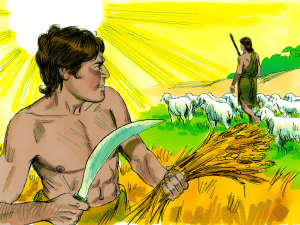
In the process of time, Adam and Eve started their family. Their firstborn son was named Cain, and their second son was named Abel. The two brothers had different occupationsCain was a farmer and Abel was a shepherd. They also had very different personalities. God has designed mankind so that people are individuals with different personalities, talents and abilities. God doesn’t want everyone to be the same; He loves variety!  Both farmers and shepherds are necessary and noble occupations. God wanted Cain and Abel to use their talents to serve Him and their family, and He wants us to do the same today. In this lesson, we will discuss the first two brothers, Cain and Abel.


Discuss:

  • Ask your child the names of Adam’s and Eve’s first and second sons.
  • Talk about the agrarian lifestyle with beautiful pastures, animals grazing, and fields of wheat. Paint a word picture that your child can visualize.
  • Ask your child what they think it would be like to be a farmer or a shepherd.
  • Discuss the fact that Cain and Abel were brothers who grew up together. Ask your child what it is (would be) like to have a brother.
  • Remind your child that God has given people different talents and abilities and that everyone is needed. God loves everyone.


Memory Challenge: 

Luke 10:27

“So he answered and said, ‘You shall love the LORD your God with all your heart, with all your soul, with all your strength, and with all your mind,’ and ‘your neighbor as yourself.’”


Children’s Bible Program – Level 3: Lesson 9 “Abram”

Featured Passage: Genesis 11:10–32; 12:1–4; Hebrews 11:8–10


After the flood, the earth began to be repopulated by Noah’s sons Shem, Ham, and Japheth. Abram was born 292 years after the flood, the youngest son of Terah, who was of Shem’s lineage. An interesting fact is that Noah and Shem were still alive during Abram’s lifetime. Abram was born in the city of Ur. He married his half-sister Sarai. His father Terah left Ur for Canaan and took his family, including Abram, with him. They stopped in Haran where Terah died, and perhaps Abram would have remained there. However, God spoke to Abram and told him to leave his family and go to an undisclosed place. God promised to make Abram a great nation and his name great. He promised to bless those who blessed Abram and curse those who cursed him, and that all nations would be blessed through his seed. Abram believed God, and without hesitation, he left Haran.


Discuss:

  • Explain to your child that marriage between relatives was common in the earlier years after the flood. Remember, everyone was closely related initially. However, God forbade such relationships later (Leviticus 18:618).
  • Point out that God’s promises to Abram were conditional. He first had to obey God.  Remind them that obedience must always come first.
  • Abram was already quite wealthy; he had servants and animals. He was comfortable where he was. Ask your child if they could see themselves leaving the comfort of home to embrace the unknown? Point out that Abram had a very difficult choice to make, but he did it without hesitation.
  • Explain that the promise to bless all nations through his seed is stating that the Messiah would come from Abram’s lineage. Clearly God taught Abram the gospel of the Kingdom of God.


Memory Challenge:

Genesis 18:19

“For I have known him, in order that he may command his children and his household after him, that they keep the way of the LORD, to do righteousness and justice, that the LORD may bring to Abraham what He has spoken to him.”


Children’s Bible Program – Level 2: Lesson 9 “Noah Finds Grace”

Featured Passage: Genesis 5-6; 7:1; Proverbs 3:34; Hebrews 11:6–7


Adam chose the way of the knowledge of good and evil, and all his progeny followed the same path. The world became totally corrupt; life was filled with violence and all manner of evil continually. Things were so bad that God regretted He had made mankind. Because of their wickedness, God decided to send a flood over the earth to destroy all humanity along with all the animals. Yet in all this darkness, there was one man who alone continued to serve the Eternal God; his name was Noah. Noah walked with God just as his ancestor Enoch had done, and God gave grace to Noah. He told Noah of His plan and instructed him to build an ark so that he and his family would be saved. Noah immediately began to do as God had said. God spared him because Noah put God first in his life. God always rewards those who diligently seek Him.


Discuss:

  • Help your child imagine what it would be like to live during Noah’s generation. He was the only person in the entire world trying to live God’s way.  
  • Ask your child if they have been in a situation where they were the only person in the group who practiced God’s way of life. How did they feel?
  • Explain to your child what the phrase “perfect in his generations” means. No human being has lived a perfect life except Jesus Christ. The Hebrew word for perfect can also be translated blameless which is how the word is rendered in many Bible translations. Talk about what it means to be blameless (pleasing God and keeping His laws as a way of life, but also being willing to repent in humility when we sin).
  • Discuss what it means to walk with God. Use Amos 3:3 as a starting point for the discussion.
  • Ask your child to look up the word grace in the dictionary. How does the definition apply to God and Noah? Why did God select Noah to receive His grace? If God gives grace to the humble, what does that say about Noah? Ask what it means to be humble. Can they give an example of acts of humility within their family interactions?


Memory Challenge:

Genesis 6:9

“This is the genealogy of Noah. Noah was a just man, perfect in his generations. Noah walked with God.”


Children’s Bible Program – Level 1: Lesson 10 “Cain and Abel Offer Sacrifices to God”

Featured Passage: Genesis 4:3–5, Hebrews 11:4


Cain and Abel were sons of Adam and Eve. As the brothers grew, God talked to them and taught them, just as He did to their parents. Cain and Abel were learning that they were supposed to obey God and love God. In this lesson, we will see how we must put God first in all we do. We must have a good attitude towards God and show it by doing what He tells us to do.


Discuss:

  • Help your child understand that Cain and Abel were coming before the Creator to offer gifts to Him and that only the very best is suitable to offer God.
  • Explain how Abel’s righteous attitude was reflected in his offering to God; Abel gave the best he had.
  • Explain that God loved Cain, but his offering was not pleasing to God.
  • Ask your child what Cain’s attitude was toward God and his brother when he was corrected.
  • Ask your child what might be an action that would come from a bad attitude.


Memory Challenge:

Genesis 4:45

“The LORD respected Abel and his offering, but He did not respect Cain and his offering. And Cain was very angry, and his countenance fell.”


Children’s Bible Program – Level 3: Lesson 10 “”From Abram to Abraham: Promises of Blessings”

Featured Passage: Genesis 12:1–20; 14:1–24; 17:1–27; Galatians 3:29


Abram left Haran and headed for Canaan at 75 years of age. The life that God had called him to was filled with adventure. Sarai was Abram’s wife. Because of Sarai’s beauty, Abram found himself in trouble with the Pharaoh of Egypt and later with Abimelech king of Gerar. But God intervened to save them. When Abram’s nephew Lot was kidnapped in a war, Abram put together an army from his own servants and rescued Lot. Throughout life’s adventures, Abram never lost sight of what was important. He obeyed God and walked with Him. God promised that Abram’s children would be greatly blessed, but Abram asked God how the promises could be fulfilled when he had no heirs. At the age of 99, God again appeared to Abram and promised that he would be a father of many nations. God changed Abram’s name to Abraham to reflect His promise. He also changed Sarai’s name to Sarah. God let Abraham know that Ishmael, Abram’s son through Hagar, was not the promised heir and that he and Sarah would have a son whose name would be Isaac. Isaac would be the son of promise, because God promised that he would be born.


Discuss:

  • Talk with your child about some of Abraham’s adventures. God delivered him from them all. Remind them that nothing is too difficult for God!
  • Explain that God always keeps His promises, though sometimes we have to wait for a long time. He teaches us patience. Explain that Abraham and Sarah learned patience by waiting a long time to have their son, Isaac.
  • Explain to your child that true Christians, no matter what race they are, are considered by God to be Abraham’s spiritual children because they obey God just as he obeyed God.


Memory Challenge: 

Galatians 3:29

“And if you are Christ’s, then you are Abraham’s seed, and heirs according to the promise.”


Children’s Bible Program – Level 2: Lesson 10 “Noah and His Family are Delivered”

Featured Passage: Genesis 7:1–16; Hebrews 11:7; 2 Peter 2:5, 9


Noah was a man who obeyed God and was faithful to Him. Noah had faith that God would do what He promised. God told Noah how to build a very large boat, called an “ark.”  Noah built it just like God told him to. Noah and his three sons, Shem, Ham, and Japheth, worked on building the ark for about one hundred years. While the people made fun of Noah for building an ark, Noah would tell people that God was not pleased with their disobedience to Him. He warned them to repent and obey God. But the people did not listen. God told Noah to bring seven male and female pairs of clean animals and birds into the ark. And He also said to bring one male and female of the unclean animals to repopulate the earth after the flood. The animals came to the ark two by two, and Noah saved them. When the rains came, only Noah, Shem, Ham, Japheth and their wiveseight peoplebelieved God and were saved.


Discuss:

  • Explain to your child that people lived longer before the flood than they do today; so, taking one hundred years to build an ark is not unrealistic. (See Genesis 5.)
  • Some Christian groups wrongly believe that dinosaurs were aboard the ark because they think the earth is only 6,000 years old. Help your child see that there is a large time gap between Genesis 1:1 and Genesis 1:2. God created the earth in perfection, not in chaos (Isaiah 45:18). Satan’s rebellion caused devastation, and a restoration of the earth is described in Genesis 1.
  • Many people think that laws concerning clean and unclean foods were only part of the Old Covenant. Point out to your child that Genesis 7 shows that Noah knew that there were clean and unclean animals, which was a long time before the Old Covenant and the time of Moses.
  • Explain that Noah was a “preacher of righteousness” (2 Peter 2:5).  Righteousness just means obeying God and keeping His commandments (see Psalm 119:172). Ask, is the Living Church of God teaching people to be righteous today as well?


Memory Challenge:

2 Peter 2:5

“[God] did not spare the ancient world, but saved Noah, one of eight people, a preacher of righteousness, bringing in the flood on the world of the ungodly…”


Children’s Bible Program – Level 1: Lesson 11 “Cain’s Anger Turns to Murder”

Sweeting Publishing | FreeBibleimages.org

Author: Janth English

Read Together: Cain became very angry when his offering was not accepted and Abel’s offering was. He would not stop being angry, and he blamed Abel for Cain’s getting into trouble. Cain let his anger grow and grow, and as a result, he even began to hate his brother. That led to him murdering Abel. God says we must love each other as much as we love ourselves (Luke 10:27). And God says we should not even hate an enemy, but love them (Matthew 5:44). In this lesson, we will see how anger can grow and turn into hatred if we let it. And hatred can lead to murder. But God wants us to respect others and have self-control. That leads to peace!

Read Together: Genesis 4:4-8; 1 John 3:1112, 15; Proverbs 16:32

Discuss:

  • Ask your child what Cain’s attitude was like.
  • Explain the advice God gave to Cain to correct the situation. (God told Cain to do the right thing and learn to control himself (Genesis 4:7).
  • Ask how Adam and Eve must have felt when they learned Abel was dead. Discuss how sin affects everyone.
  • Talk to your child about respect, treating others the way you want to be treated, having self-control, and learning to resolve conflicts. Show how things could have been different if Cain had shown respect and exercised self-control. He could have tried to resolve the conflict with his brother.
  • Explain that God desires all people to live in peace, and that takes respecting other people and having self-control.

Review memorization.

Luke 10:27  “So he answered and said, ‘You shall love the LORD your God with all your heart, with all your soul, with all your strength, and with all your mind,’ and ‘your neighbor as yourself.’”


Printable PDF – L1.11

Recommended Reads: Irresistible

Children’s Bible Program – Level 1: Lesson 12 “God Punishes Cain”

Sweeting Publishing | FreeBibleimages.org

Author: Janth English

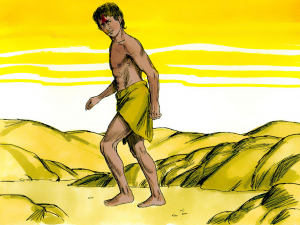
Read Together: When God accepted Abel’s offering but did not accept Cain’s, Cain got very angry. He got so mad that he killed his brother! He became the first murderer in the human family. God knew that Abel was dead and came to talk to Cain about murdering his brother. God asked Cain where his brother was. Instead of admitting what he had done, Cain tried to hide what he had done from God and was not sorry for his actions. He replied to God, saying, “Am I my brother’s keeper?” This lesson will show the idea of cause and effect. It will show that certain things happen because of our actions, when we don’t obey God. It will also show that everyone must love his neighbor.


Read Together:

Genesis 4:9–16; Luke 10:27

 Discuss:

  • Explain to your child that God, who knows everything, knew Cain had killed Abel. Cain couldn’t hide it from God, and neither can we hide our mistakes or sins from God.
  • Ask your child what Cain’s attitude was when God asked about Abel.
  • Discuss with your child Cain’s punishment. He was sent away from God and the community. Why would God send Cain away from the others?
  • Help your child understand that thinking bad things can lead to bad actions.
  • Ask your child how following the law to “love your neighbor” could have changed Cain’s life.

 Review memorization:

Luke 10:27 “So he answered and said, ‘You shall love the LORD your God with all your heart, with all your soul, with all your strength, and with all your mind,’ and ‘your neighbor as yourself.’”

More to Do!

These activities are optional, but some children may find them enjoyable.

  • Show love for your neighbors by creating cards for the widows, widowers, or other older members in the congregation.
  • Help your child to plan a good deed to do for someone in the family.
  • Your child may like to sing along with this cute song Thank You God.

Printable PDF – L1.11

Printable PDF – L1.9-L.12