Children’s Bible Program – Level 2: Lesson 27 “Jacob’s Wives and Sons”

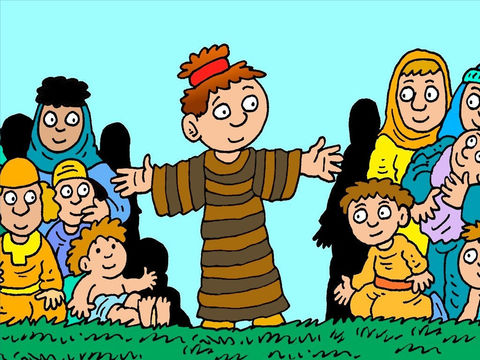
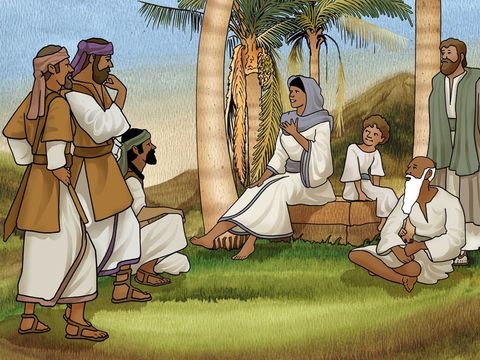
Read Together: Jacob arrived in Padan Aram, and began looking for his uncle Laban. Instead, he met Laban’s beautiful daughter, Rachel. Jacob fell in love with Rachel and desperately wanted her as his wife. Laban agreed to give her in marriage to Jacob. But, in return, he demanded that Jacob work for him for seven years. Jacob agreed and served Laban, tending his flocks. When the time for the wedding came, Laban prepared a feast. At the end of the feast, when it was finally time for Jacob to be with beautiful Rachel, Laban tricked him! Instead of Rachel, Laban presented Leah, the older sister, to Jacob. Jacob was furious! He had married the wrong woman! Devious Laban suggested a solution. If only Jacob would work for another seven years for him, he would let him marry Rachel too! Reluctantly, Jacob agreed. But having two wives caused lots of problems for years to come. Jacob continued working for Laban for many years. He eventually became father to eleven sons and one daughter. As he grew older, he finally decided it was time to take his growing family and move back to Canaan.
Richard Gunther (www.lambsongs.con.nz) | FreeBibleImages.org

Read Together:  Genesis 29; 30:1–27

Discuss:

  • Ask your child how they think Jacob felt to be tricked by his uncle. What lessons do you think he might have learned?
  • Help your child to recall the names of Jacob’s sons.
  • Names have meanings. Discuss with your child the meaning of the names given Jacob’s sons. Give a hint of how some of the names portray their future roles. Explain how your child was named and its meaning.
  • Remind your child that God’s intent is for marriage to be between one man and one woman. Jacob’s example shows that anything else causes problems.

Review Memorization:

Genesis 27:29 “Let peoples serve you, and nations bow down to you. Be master over your brethren and let your mother’s sons bow down to you. Cursed be everyone who curses you, and blessed be those who bless you.”

Bonus Memory Verse! Genesis 29:20 “So Jacob served seven years for Rachel, and they seemed only a few days to him because of the love he had for her.”


Children’s Bible Program – Level 3: Lesson 26 “Deborah the Prophetess – Judge of Israel”

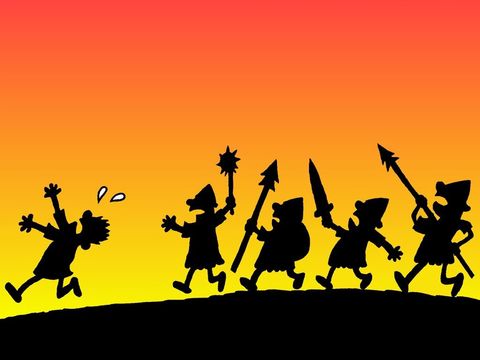
Read Together:  In Judges 4, we read that God chose a woman, Deborah, to judge Israel for a period of time. She was well prepared when God called her to be a prophetess and a judge because she knew God’s laws and was wise in their execution.  God told Deborah to send for Barak and tell him to fight against their oppressors – Jabin, king of Canaan and Sisera, the commander of his army. Barak responded that he would only go if Deborah went with him. Though Deborah knew women did not normally fight in war she agreed to go, but Barak would have to sacrifice the glory of the victory to a woman. God gave them the battle plan which they executed with precision. Barak along with ten thousand troops from Napthali and Zebulun soon had Sisera and his troops on the run. They killed them all, but Sisera escaped from the battle to the tent of Jael, a woman whom he thought was an ally. While Sisera slept, she drove a tent peg through his head, and Jael became the heroine of the battle instead of Barak just as Deborah had said. This marked the end of Jabin’s oppression, and Israel had peace for forty years. Yet after all this, Israel again turned to her evil ways.

John Paul Stanley/ YoMinistry.com | FreeBibleImages.org

Read Together:  Judges 4:1 – 6:1

Discuss:

  • Discuss with your child the role of a prophet(ess) and the role of a judge.  What is the role of women in the Church government structure? (See Ephesians 4:11.)
  • Speculate with your child why God might have called a woman to judge Israel at that time.  Perhaps she was the best qualified. Remember, God is not a respecter of persons (Romans 2:11).
  • Point out to your child that Deborah is not the only prophetess referred to in the scriptures(See Exodus 15:20; 2 Kings 22:14; Isaiah 8:3; Luke 2:36).
  • Ask your child why they feel Barak wanted Deborah to go with him to war. Was Barak’s bravery in question? Remember, Barak is listed in the faith chapter of Hebrews 11
  • Explain to your child that those born into the family of God are neither male nor female (Galatians 3:28).  Everyone will have equal opportunity to serve in the Kingdom of God and and be rewarded based on your works (Matthew 16:27).

Review Memorization:

Judges 21:25  “In those days there was no king in Israel; everyone did what was right in his own eyes.”

Children’s Bible Program – Level 2: Lesson 26 “Jacob Flees to Padan Aram”

Sweet Publishing | FreeBibleImages.org

Read Together:  Esau despised Jacob for tricking him, and Rebekah, their mother, discovered his plot to kill him. Rebekah advised Jacob to go to her brother Laban’s home and stay there until Esau had calmed down. Now Isaac and Rebekah were not pleased that Esau had taken Hittite women as wives, so Isaac told Jacob to take a wife from his uncle’s daughters in Padan Aram. Jacob set out from Canaan to the land of Haran with nothing but his staff. On his way, Jacob stopped for the night, and he had a very strange dream while sleeping under the stars. He dreamed there was a ladder that reached from heaven to the earth with angels going up and down. God spoke to him in the dream and gave Jacob the same promises that He had made to Abraham and Isaac. God promised to give him the land of Canaan and to multiply his descendants.  God promised to be with him and to bring him back safely to the land. Jacob was filled with awe! He anointed the stone where he slept and called the place Bethel, which means house of God. For his part of the covenant, Jacob promised to obey God and to tithe to Him. Jacob completed his journey, arriving at his uncle Laban’s home in Padan Aram.

Read Together:  Genesis 27:41-46; 28:1-22; 29:1-13

Discuss:

  • Esau was very angry with Jacob and thought to kill him.  Discuss with your child how thoughts become actions, and we must learn to control our thoughts.  One strategy is to replace bad thoughts with good ones; we can also pray for anyone we may have bad thoughts about. How could Esau apply this?
  • Explain to your child that most dreams do not have any meaning; they are just dreams. Jacob’s dream was special and God caused him to understand that.
  • Discuss with your child what a tithe is.
  • Remind your child that Haran is the place where Abraham and Sarah lived before their sojourn in Canaan; it is near modern day Syria. Laban was Rebekah’s brother, but he was also the son of Abraham’s nephew Bethuel.
  • Point out to your child that Bethel is an important place in biblical history and that we will hear more of it in future Bible studies.

Review Memorization:

Genesis 27:29 “Let peoples serve you, and nations bow down to you. Be master over your brethren and let your mother’s sons bow down to you. Cursed be everyone who curses you, and blessed be those who bless you.”

Second Thoughts: Be Creative, Not Original

By Thomas White | Student at LivingEd-Charlotte

“How small is your life? How narrow is your experience? How far have you exercised your creativity?”

Mr. Jonathan McNair | Student Assembly May 2, 2019
Photo by Jonathan Francisca on Unsplash

Some of the most creative people I know don’t think they’re creative at all, and this has always baffled me. “How can you think you’re not creative?” I say. “You just drew a gorgeous beach scene on this white pair of shoes.” As Mr. McNair brought out in his assembly this week, we as human beings, having been made in God’s image, are naturally creative. Creating is literally the first thing we read about God doing, right there in Genesis 1.

There are different levels and types of creativity, sure, but to call any human being – including yourself – “uncreative” is to utter a total falsehood, because if you’re made in God’s image, you’re creative. As far as I can see, the main reason why some people consider themselves “uncreative” is that they confuse creativity with originality, and these are two hugely different things.

“God is a God of Creativity … He used man, and built man, to have within us the passion and the desire to create, just like God.”

Mistaking originality for creativity, my friend who drew the beach scene on the pair of shoes can think she’s uncreative because, “Well, beaches weren’t my idea. Shoes weren’t my idea. I just took a thing that existed and put it on another thing that existed.” I’m affected by this, too, and I’m sure an immense number of creative people are. Every time I sit down to write creatively, I’m almost paralyzed by the selfish desire to write something totally new, something like nothing anyone has ever read.  It’s crazy, isn’t it?

Even King Solomon, who wrote something like one bazillion songs and sayings, also wrote, “what has been done is what will be done, and there is nothing new under the sun” (Ecclesiastes 1:9). No one could ever accuse Solomon of being uncreative, but even he admitted that originality was out of his reach. That didn’t stop him from writing those songs and sayings though. He didn’t let the elusiveness of originality keep him from pursuing a passion to create, a passion that, as Mr. McNair said, comes directly from God, the Master Creator.

“If you’re willing to put out the effort to learn the rules, to learn the principles, to gain the experience, you’ll be able to exercise creativity in your life.”

Photo by Kelly Sikkema on Unsplash

The problem with wanting to be “original” is that, as Solomon said, it’s practically impossible, and this fact discourages us from pursuing our creative passions to the extent that we could. If we can, we should forget all that, and just create. Don’t worry about being original, because as Mr. McNair concluded, the best way to be creative is to use previously established patterns to achieve success. We should start small and allow ourselves to be empowered and inspired by others, whether they are on our team, or are those that came before us.

Creativity can be exercised in any area in which we may have skillsets—music, writing, artwork, scientific inquiry, structural design, culinary arts, interior design, clothing design—you name it. Whatever our roles, whatever we like doing, chances are, we can use the opportunities we are given to fuel our imaginations and get creative. We might not create something totally unlike anything that’s been created before, but lest we forget, the creation in Genesis was actually a recreation. It had already been done, and God did it again with a new spin. And He saw that it was good.


Thomas White headshot

Thomas White was one of the onsite Living Education students for the 2018-2019 semesters. He also has a Bachelor’s Degree in English. Thomas currently works as an Editorial Assistant for the Living Church of God. According to his wife, he eats pizza in entirely the wrong way.

Blowing Rock Family Weekend | 2019

Children’s Bible Program – Level 3: Lesson 25 “The Time of the Judges”

by Janth English

Read Together: God chose Moses to bring Israel out of Egyptian slavery and to the Promised Land. He then chose Joshua to lead the people into that land and divide their inheritance among the tribes. God chose judges, or leaders, to teach the people His laws and to judge matters that came up according to those laws. Israel was obedient to God for as long as Joshua and the elders that he trained lived. However, after the generation who saw God’s works in the wilderness died, the people began to turn away from God. They wanted to be like the peoples around them, copying their ways and customs. To punish the Israelites for their disobedience, God sent these nations against them. Time after time, Israel suffered under the cruel hand of their enemies. When they cried out to God for relief, he mercifully sent a judge to save them. After a few years of peace, Israel would forget the God who saved them and return to their foreign idols. Again, God would remove His protection and the neighboring nations would invade the land of Israel. For many generations, the people of Israel followed their own rebellious heart, doing what was right in their own eyes.  

Richard Gunther: gunther.net.nz | FreeBibleImages.org

Read Together:  Exodus 3:6-10; Deuteronomy 31:7; 1 Samuel 12:12; Judges 2:6-23, 21:25

Discuss:  

  • Discuss with your child God’s criteria for leadership positions (See Exodus 18:21 and Titus 1:7-8). God’s standards have not changed, and they will not change. Remind your child that they are training now for future leadership positions.
  • Discuss with your child Israel’s desire to be like the people around them.  Do we sometimes fall into the same trap? What was the result for Israel? What would be the result for us if we do the same thing?
  • Point out to your child how God showed mercy to Israel time and again.  Help them to see that God’s mercy is forever.
  • Discuss with your child the consequences of everyone doing what they think is right. What happens when my thoughts and your thoughts are not in agreement? What happens in society when there are no absolute standards?

Review Memorization.

Judges 21:25 “In those days there was no king in Israel; everyone did what was right in his own eyes.”


Children’s Bible Program – Level 2: Lesson 25 “Jacob and Esau”

By Janth English

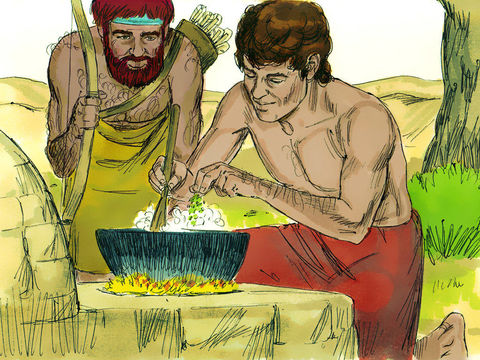
Read Together:  Isaac and Rebekah lived many years before they had children, but God finally blessed them with twin sons, Jacob and Esau. They were twins, but never were two people more different. Esau was hairy, but Jacob had smooth skin. Esau was a skillful hunter, but Jacob was a mild-mannered shepherd. One day Jacob was cooking lentil stew when Esau came from the fields. He had been hunting and was very hungry. Jacob offered his brother some stew in return for his “birthright blessing”. Esau agreed. Jacob seems quite devious, talking his brother out of his birthright. Remember this, however; Esau cared more about his hunger than his birthright. Many years later, an elderly Isaac decided it was time to bestow a final blessing upon each of his sons. His plan was to give the greater blessing to Esau and a lesser blessing on Jacob, because Esau was his favorite son. Since Rebekah’s favorite son was Jacob, she hatched a plot that would have the greater blessing go to him! This lesson’s reading reveals what happened when their plan unfolded. Though the Bible reveals how weak and deceitful people can be, God’s purpose to establish a nation is still revealed. We’ll learn more about that later.

Sweet Publishing | FreeBibleImages.org

Read Together:  Genesis 25:19-34; 27:1-41

Discuss:

  • Discuss with your child the ethics of this situation. Since God had chosen Jacob to inherit the promises He made to Abraham and Isaac, was it wrong for Jacob and his mother to use trickery in getting them?
  • Discuss with your child the fact that Isaac intended to give the blessings to Esau. Think of a few ways that God could have prevented Isaac from giving the blessings to Esau. Can any human cause God’s plans to fail (Isaiah 46:9-10)?
  • Jacob was his mother’s favorite son and Esau his father’s. Ask your child what happens in a family when individual members are shown favoritism.
  • Help your child understand that God chooses individuals for His purpose at His time. Explain that God did not choose Jacob because he was somehow “better” than Esau. This principle applies to those who are called now as well.

Review Memorization Genesis 27:29 “Let peoples serve you, and nations bow down to you. Be master over your brethren and let your mother’s sons bow down to you. Cursed be everyone who curses you, and blessed be those who bless you.”


Children’s Bible Program – Level 3: Lesson 24 “The Wave Sheaf—First of the Firstfruits”

Read Together: Unleavened Bread always occurred during the barley harvest which was the first of the grain harvests in Israel. God told the Israelites to perform the “wave sheaf” offering each year during the Days of Unleavened Bread. The priests went to the fields as the Sabbath during Unleavened Bread was ending. As the sun was setting, they cut a sheaf of barley and saved it for the ceremony the next day. On the first day of the week, after the Sabbath at about 9:00 am, the priests waved the sheaf of barley as an offering before God. The day when the Wave Sheaf was offered is not a holy day, but it is a ceremony packed full of meaning for Christians. Our Savior, Jesus Christ, was crucified on Passover in 31CE, which was a Wednesday. He was resurrected from the dead exactly three days and three nights later, which was at the end of the Sabbath during the Days of Unleavened Bread, the same time that the grain was cut. The next day, as the priests waved the sheaf before God, Christ ascended to His Father in heaven to offer Himself as the true Wave Sheaf offering. Jesus Christ fulfilled the meaning pictured by the wave sheaf; He became the first of God’s spiritual harvest, the “First of the firstfruits”. He is the firstborn of many brethren. Christ has the preeminence in all things. He is proof that we too can be firstfruits and be born into God’s family as His very own children.

Read Together: Leviticus 23:9–14; Matthew 12:40; John 20:1, 9, 15–17; 1 Corinthians 15:20–23; Romans 8:29–30.

Discuss:

  • Discuss what the Bible says about the “wave sheaf” in Lev 23.
  • Help your child to create a time chart of the events during the Days of Unleavened Bread in 31 CE. Start with Jesus and the disciples keeping the Passover the Tuesday evening before the crucifixion and ending with His ascension to the Father on Sunday. Count three days and three nights. Christ was in the grave during this time. The chart will help show that He could not have been crucified on Friday and resurrected on Sunday at sunrise as most professing Christians believe. Note that Christ was not in the tomb when Mary Magdalene got there while it was still dark (the sun had not risen).
  • Explain to your child in words he/she can understand that a Christian’s hope is in the resurrection. Our destiny, his/her destiny, is to be born as a spirit being into God’s family.

Review Memorization.

Romans 5:10  “For if when we were enemies we were reconciled to God through the death of His son, much more, having been reconciled, we shall be saved by His life.”

Children’s Bible Program – Level 2: Lesson 24 “Eating Unleavened Bread—Putting on Righteousness”

Read Together: God told ancient Israel that they were to put out all leavening from their homes, and He also instructed them to eat unleavened bread for seven days. The first and seventh days were to be holy convocations.God’s people continue to observe the Feast of Unleavened Bread by eating unleavened bread for seven days and celebrating the first and seventh days as Holy Days. These days have important meanings in God’s plan for mankind. Passover commemorates Christ’s sacrifice in payment of our sins. The Days of Unleavened Bread picture our effort to put sin out of our lives and replace it with living according to God’s ways. We don’t just avoid doing bad things. We must fill our lives wit good actions, just like our elder brother Jesus Christ.

Read Together:  Exodus 12:14–17; Leviticus 23:6–8; Ephesians 4:22–24; John 6:47–51; Galatians 2:20; 2 Timothy 3:16–17; Philippians 1:6; Hebrews 12:2

  • Discuss with your child the biblical meaning of righteousness. Read and discuss Psalm 119:172 together.
  • Remind your child that the Feast of Unleavened Bread is the only one that has two Holy Days and that Passover is a separate feast but it is not a Sabbath.
  • Ask your child to summarize the meaning of the Passover and Days of Unleavened Bread, the first two steps in God’s plan of salvation.

Discuss:

Review Memorization.

1 Corinthians 5:7  “Therefore purge out the old leaven, that you may be a new lump, since you truly are unleavened. For indeed Christ, our Passover, was sacrificed for us.”

Second Thoughts: It’s for the Kids

Author: Thomas White | Student at LivingEd-Charlotte

“…the Father’s throne is ultimately going to be here on this earth. We look that far out in the future…but for that to be possible, we know that billions of human beings must come up and be taught His way of life, and for them to have the opportunity to become our younger brothers and sisters.” ~ Mr. Ron Poole

Student Assembly | April 11, 2019

Why do teachers work so hard? Almost all of them will be honest about the fact that they generally don’t get paid much. Whatever level of education they may be involved in, ask any of your best teachers why they put forth so much effort, and I’m willing to bet that most of them would answer with something like, “It’s for the kids. It’s all for the kids.”

This week, Mr. Ron Poole’s assembly reminded me that the future Kingdom we’re striving to reach as unborn children of God, that’s also “for the kids.” It’s our reward, but it’s not only our reward, and I can often undersell it by thinking of it as such. We’re not just running to finish a race, we’re also educating ourselves to try to get a job, the job of a teacher. And one of the bests reasons to be a teacher is to do it for the kids.

“We can see that God has work for us to do. God has a job that He wants us to be able to take care of. He is going to put us to work…but only if we’re ready. It’s only if we’re ready that He will be able to use us.”

As fully born members of the God Family, we’re going to be responsible for the education of untold billions of people, as Mr. Poole poignantly illustrated. How do we make that real to us? How do we motivate ourselves to strive toward that job? “Billions of people” sounds like something out of a statistics class, and I have a very complicated relationship with math, so when I think of being a teacher in the Millennium and Great White Throne Judgment, I focus on three people. One of them is a close family member outside God’s Church, a member I love deeply. Another is someone I knew in college, whose life had been irrevocably damaged by a terrible upbringing. The third is my best childhood friend, a principled and noble individual, who nevertheless was always missing the Truth that would bring his life to a new level.  When I think of those people, I am exceedingly motivated to become a teacher, the kind of teacher who heals and enriches his students. Those are my “kids” I want to do it for. Who are yours?  

“Would our resumes, starting in chronological order, show that we are growing in the grace and the knowledge of our Lord and Savior, Jesus Christ?”

Whoever your “kids” are, keep them in mind as this life gets hard, because as Mr. Poole said, we’re building our applications for the ultimate teaching position with every decision we make, every opportunity from God that we take advantage of. When we desire something with every ounce of our being, we make sacrifices for it, sometimes painful ones, but the result is always worth the striving. Applying to become one of God’s Teachers is long and arduous, but in our most paralyzing moments of weakness, it might be most helpful to remember that we’re doing it for the kids.


Thomas White headshot

Thomas White was one of the onsite Living Education students for the 2018-2019 semesters. He also has a Bachelor’s Degree in English. Thomas currently works as an Editorial Assistant for the Living Church of God. According to his wife, he eats pizza in entirely the wrong way.