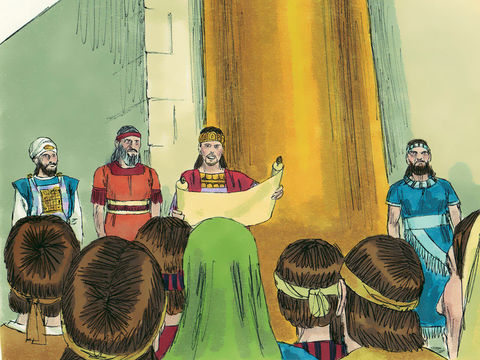
After King Uzziah died, several more kings ruled the land. Some of them were very good, and some of them were very wicked, and caused the people of Judah to sin against God. A king named Amon, who was a very wicked man, only ruled for two years before God allowed him to die. His little eight year old son, Josiah was crowned as king after him. Despite having Amon for a father, Josiah was a good king. By the time he was sixteen years old he was determined to get rid of all the idols so that the people would have to worship the true God. He also wanted to repair the beautiful temple of God to be used once again for the right purposes. One day when some men were cleaning out the temple, they found an old book that had been forgotten and decided to show it to the young king.
Discuss:
Sweet Publishing | FreeBibleImages.org
How old was Josiah when he became king? Does a person have to be a certain age to begin to follow God?
What did Josiah do to get rid of the pagan idols in the land? Which of God’s commandments was Josiah following when he got rid of the idols in Judah?
What was the book that was found in the temple? What did King Josiah do when they read it to him? Why was he so sad?
What feast did King Josiah have all the people in Judah keep? What do you think that Passover was like for the people in Judah?
Memory Challenge:
2 Chronicles 34:31
Then the king stood in his place and made a covenant before the Lord, to follow the Lord, and to keep His commandments and His testimonies and His statutes with all his heart and all his soul, to perform the words of the covenant that were written in this book.
Due to the travel restrictions and an ongoing quarantine policy in Israel, we regret to announce that our Israel Dig and Tour is cancelled for the 2020 summer. We look forward to resuming the program again in the summer of 2021
https://www.lcgeducation.org/wp-content/uploads/2019/11/6JS_3614.jpg6831024Jonathan McNairhttps://www.lcgeducation.org/wp-content/uploads/2021/02/logo_basic-website-300x94.pngJonathan McNair2020-05-28 10:11:492020-05-28 10:14:08Israel Dig and Tour Cancelled
Los reinos vegetal, animal y humano son clasificaciones de seres vivos en nuestro mundo material. El mundo espiritual también tiene seres vivos, y el reino angélico tiene diferentes clasificaciones de ángeles. Sin embargo, hay un Reino por encima de todos los demás, sea material o espiritual: El Reino de Dios. Dios está en un nivel de existencia que es difícil de entender para los humanos. Dios tiene vida inherente y es eterno. Dios fue, es y siempre será. Dios es el Creador de todas las cosas, sean espirituales o materiales, por lo tanto, Dios está por encima de todas las cosas. Como Dios creó y controla todas las cosas, no está limitado ni por las leyes físicas, ni por el tiempo, ni por el espacio.
Es por eso que Dios pudo evitar que el Sol se ocultara para Josué, y pudo devolver el Sol diez grados para Ezequías. También, por eso fue que Jesucristo pudo caminar sobre el agua y calmar el mar rugiente. La buena noticia es que el Reino de Dios es una familia, y todo ser humano que haya existido, tiene el potencial de ser miembro la familia de Dios. ¡Naciste para ser parte de la familia de Dios!
Discusión:
Hable con sus hijos sobre la grandeza de Dios, su poder y majestad. Señale algunos ejemplos y pídales que también den ejemplos.
Explique el hecho de que Dios no está sujeto a las leyes de la física (como la gravedad, el magnetismo, el movimiento de los planetas, etc.), lo que significa que puede hacer cosas milagrosas. Describa algunos milagros mencionados en la Biblia que desafían las leyes físicas.
Explique que Dios nos está ofreciendo vida eterna en su familia como hijos suyos. Seremos miembros de la familia de Dios (1 Juan 3:2).
Nuestra herencia es el universo entero. Quizás todos tengan su propia galaxia. Pregunte a sus hijos qué harían para heredar el universo. ¿Qué daría a cambio de la vida eterna? ¡Nada!
Memorizar y revisar:
Colosenses 1:16-17
“Porque en él fueron creadas todas las cosas, las que hay en los cielos y las que hay en la tierra, visibles e invisibles; sean tronos, sean dominios, sean principados, sean potestades; todo fue creado por medio de él y para él. Y él es antes de todas las cosas, y todas las cosas en él subsisten”.
https://www.lcgeducation.org/wp-content/uploads/2018/10/nasa-45069-unsplash.jpg15001430lcgadminhttps://www.lcgeducation.org/wp-content/uploads/2021/02/logo_basic-website-300x94.pnglcgadmin2020-05-28 07:10:142020-05-29 16:32:02Programa Bíblico para Niños – Nivel 3: Lección 1 “El Reino de Dios”
Pasaje Destacado: Juan 1:1–3; Génesis 1:26–27; Juan 4:24; Juan 3:16; Salmos 90:2; Colosenses 1:16-17; Isaías 46:9-10; 1Juan 4: 8
Es muy importante entender quién y qué es Dios. Podemos saber esto solo si Dios decide revelárnoslo, y lo ha hecho, por medio de la Biblia. ¿Cómo era cuando no existía nada físico? En esa era prehistórica, había dos seres espirituales eternos, poderosos, llamados Dios y el Verbo. Juntos, Dios y el Verbo planearon y diseñaron todo lo visible y lo invisible: Las huestes angélicas, las estrellas y los planetas, las plantas, los animales, y el hombre. El Verbo, fue quien se convirtió en Jesucristo, y Dios creó todas las cosas por medio de Él. Dios no es una “fuerza” mágica. No, ¡Dios es real! Él tiene forma y figura. Podemos saber cómo es Dios porque nos hizo a su imagen y semejanza. Dios es totalmente sabio, todo lo conoce, es todopoderoso y muy amoroso. Por su Espíritu, Él puede ver lo que está ocurriendo ¡en todas partes! Pero si queremos saber quién es realmente Dios, debemos conocer Su carácter
Dios es bueno, misericordioso, amoroso y lleno de compasión. Todo lo que Dios hace está motivado por el amor. Dios es amor.
Discusión:
Ayude a sus hijos a comprender que hay dos seres en la Familia Dios, Dios y el Verbo, a quienes ahora llamamos el Padre y el Hijo, Jesucristo.
Explique que Dios quiere que cada ser humano nazca en la Familia de Dios.
Explique que el Espíritu de Dios no es una persona separada, sino el poder con el cual Dios hace todo lo que hace.
Pida a sus hijos que describan qué piensan sobre cómo era la relación entre Dios y el Verbo antes de la creación.
Imagine con sus hijos acerca de cómo será cuando sean seres divinos. ¿Qué harán? ¿Qué parte del universo visitarían?
Memorizar y revisar:
Ayude a sus hijos a memorizar el siguiente versículo:
Isaías 46:9–10 “Acordaos de las cosas pasadas desde los tiempos antiguos; porque yo soy Dios, y no hay otro Dios, y nada hay semejante a mí, que anuncio lo por venir desde el principio, y desde la antigüedad lo que aún no era hecho; que digo: Mi consejo permanecerá, y haré todo lo que quiero”.
https://www.lcgeducation.org/wp-content/uploads/2018/10/vinicius-henrique-495773-unsplash.jpg15001162lcgadminhttps://www.lcgeducation.org/wp-content/uploads/2021/02/logo_basic-website-300x94.pnglcgadmin2020-05-28 07:07:442020-05-29 16:31:08Programa Bíblico para Niños – Nivel 2: Lección 1 “¿Quién es Dios?”
Pasaje Destacado: Génesis 1:1; Juan 1:1–3; Job 38:4–7 [“hijos de Dios” se refiere aquí a los ángeles]; Hebreos 1:10; Deuteronomio 10:14.
La semana de la creación (en realidad, como veremos en una lección posterior, debe llamarse la semana de la “recreación”), es una importante enseñanza de la Biblia y de la Iglesia de Dios. Ahora bien, antes de esta semana de la recreación registrada en el primer capítulo del Génesis, hubo un momento en que solo existía Dios, dos seres a quienes ahora conocemos como Dios el Padre y el Verbo, quien posteriormente se hizo carne y es llamado Jesucristo. Dios se propuso expandir su familia. Primero creó seres espirituales que conocemos como los ángeles. Después, Dios comenzó a crear el universo físico. ¡La habilidad creativa de Dios es realmente asombrosa!
Todo el universo, todo lo visible y lo invisible, fue creado para los futuros hijos e hijas de Dios Todopoderoso.
Discusión:
Haga que estos versículos cobren vida haciendo preguntas a sus hijos sobre cómo debe haber sido antes de que Dios y Jesucristo (el Verbo) le dieran inicio a la creación.
Explique que Jesucristo tuvo un nombre diferente antes de hacerse hombre (el “Verbo”) y que Él más tarde nació como el Hijo de Dios y se le dio un nuevo nombre, Jesucristo. Si bien es cierto que Jesucristo es Dios, ahora nos referimos al que lo engendró como a Dios como “el Padre”.
Hablen acerca de cómo Dios y Jesucristo querían una familia e hicieron la creación para que la disfrutaran. Originalmente, eran solo ellos dos, y querían una familia mucho más grande.
Ayude a sus hijos a comprender que Dios es el Creador y que solo Dios puede crear a partir de su Santo Espíritu. ¡Incluso cuando creamos una silla de madera, Dios fue quien creó la madera!
Explique a sus hijos que Dios creó a los ángeles antes de crear el universo físico.
Pregunte a sus hijos qué cosas disfrutan más de la creación de Dios. Ayúdeles a entender, de una manera sencilla, que Dios creó todas estas cosas para nosotros.
Memorizar y revisar:
Ayude a sus hijos a memorizar los días de la semana de la creación:
Día 1 – Dios separa la luz de las tinieblas.
Día 2 – El cielo y las nubes son separados de las aguas de abajo.
Dia 3 – La Tierra seca es separada de los mares. Las plantas son creadas.
Día 4 – El Sol, la Luna y las estrellas son designados para iluminar la Tierra, separar el día de la noche y para señalar las estaciones.
Día 5 – Creación de las aves y los peces.
Día 6 – Creación de los animales terrestres y el hombre.
https://www.lcgeducation.org/wp-content/uploads/2020/05/guillermo-ferla-M_EgSITHrKA-unsplash.jpg9941500lcgadminhttps://www.lcgeducation.org/wp-content/uploads/2021/02/logo_basic-website-300x94.pnglcgadmin2020-05-27 10:03:252020-05-29 16:30:44Programa Bíblico para Niños – Nivel 1: Lección 1 “Antes de que comenzara el tiempo”
Author: Mr. Kenneth Frank | Faculty, Living Education
Estimated Reading Time:6 min.
Did you know that God has provided humankind two revelations of His character and plan?
Christians are familiar with His written revelation called the Holy Bible. But what many do not realize is that long before a written record was provided for His people, God revealed Himself another way. This one has been available to all people, believers or non-believers alike no matter what language they speak. Throughout the centuries, avid Bible students have referred to these as “God’s Two Books.” Matthew Henry’s Commentary on the Whole Bible on Psalm 19 explains: “There are two excellent books which the great God has published for the instruction and edification of the children of men; this psalm treats of them both, and recommends them both to our diligent study. I. The book of the creatures, in which we may easily read the power and godhead of the Creator (Psalm 19:1-6). II. The book of the scriptures, which makes known to us the will of God concerning our duty. He shows the excellency and usefulness of that book (Psalm 19:7-11) and then teaches us how to improve it [our duty] (Psalm 19:12-14).” Both of these books reveal the glory of God!
Psalm 19 provides us a description of both of these revelations of God. The first one is creation itself, covered in Psalm 19:1-6. God has provided a theology through the natural world. By definition, theology is the study of God. Theologians have referred to this as “general revelation,” “natural revelation” or “natural theology.” The second revelation is described in Psalm 19:7-14, commonly called “special revelation,” “written revelation” or “supernatural theology.” All believers want to know more about the God they serve. They need to be diligent Bible students. However, they may be missing out on an entire second revelation because of a misunderstanding that there is today a war between science and religion. There is no such war between true science and biblical religion. God is the greatest scientist. Many famous human scientists have been dedicated Bible students such as Louis Pasteur, Isaac Newton, Johann Kepler, Isaac Newton, Michael Faraday, and Francis Bacon (The Henry Morris Study Bible, Appendix 7). God’s word holds us accountable for knowing God through what he has created. Notice Romans 1:19-20 (KJV throughout): “Because that which may be known of God is manifest in them; for God hath shewed it unto them. For the invisible things of him from the creation of the world are clearly seen, being understood by the things that are made, even his eternal power and Godhead; so that they are without excuse.”
During the COVID-19 coronavirus pandemic, many people worldwide have been sheltering at home or are quarantined under orders from civic officials. A report from a recent newsletter from the NPR radio program, Living On Earth, stated that “Americans spend more time inside than some whales spend time underwater. In many ways, we are an indoor species.” This study by Joe Allen, who is Director of the Healthy Buildings Program and Assistant Professor at Harvard’s T. H. Chan School of Public Health stated that “By the time we reach 80 years old, we will have spent 72 years of our lives indoors. However, these homes, offices, schools, and hospitals often lack fresh air and have an outsized impact on our wellbeing, health, creativity, and focus.”
After several weeks of this seclusion, many are now experiencing cabin fever with detrimental psychological effects. One of the most often recommended remedies from mental health experts has been to get outdoors, even onto one’s property or (if with safe distancing) to a local park. Indoors we are surrounded by things that humans have made. But outdoors, we are surrounded by what the Creator has made, much of which we often take for granted. Go outside and notice the blue sky, white clouds, and the various flora and fauna of our world. On a clear night, admire the astral bodies – even through common light pollution in many urban areas. Allow your mind to reflect on the biggest questions of life: Who are we?, How did we get here?, Where are we going?, What is wrong with the world?, and How may it be redeemed? By doing so, we free our minds even temporarily from our constant mundane concerns and pause to admire all that God has made for us to inherit once His redemption plan culminates.
Psalm 19:7-9 describes an even greater revelation: God’s sacred word contained in the Holy Bible. In these few verses, God describes His word with six titles, six attributes, and six effects. As beautiful as are the manifestations of God’s glory seen in the heavens, still more beautiful and more magnificent is God’s sacred word. These descriptions deserve our closer, personal study as we approach Pentecost, which commemorates God’s giving His law (Exodus 20) and His Holy Spirit (Acts 2.) Putting these into graphic form would look like this:
Titles for God’s Word
Attributes of God’s Word
Effects of God’s Word
law (Torah Hebrew word often translated “law” but more fully referring to “instruction,” “teaching,” or “doctrine”)
perfect
converting the soul
testimony
sure
making wise the simple
statutes
right
rejoicing the heart
commandment
pure
enlightening the eyes
fear
clean
enduring forever
judgments
true
righteous altogether
Psalm 19:11-14 reach into our innermost beings to challenge us to deal with known and unknown sins. It assures us that keeping God’s word provides a great reward (v. 11). Then v. 12 asks God to cleanse us from secret faults – things we may try to hide from God or even sins of which we are yet unaware. The spiritual lessons of the Days of Unleavened Bread challenge us to continue this cleansing process. We need God to show us where we are yet falling short of his grace (Romans 3:23). Then in v. 13 we consider the extremely dangerous presumptuous sins – sins that people commit deliberately. Only God can thoroughly cleanse us of secret faults and keep us from presumptuous sins (vv. 12-13). Living by God’s Two Books then enables us to pray sincerely, “Let the words of my mouth, and the meditation of my heart, be acceptable in thy sight, O LORD, my strength, and my redeemer (Psalm 19:14).”
Kenneth Frank was born and raised in New Jersey, USA, and attended Ambassador College, graduating in 1973. He served in the Canadian ministry from 1973-1999, after which he returned to the USA to pastor churches in Maryland, Virginia, and North Carolina for 15 years. Having earned a BA degree from Ambassador College he later earned a MA degree from Grand Canyon University before being assigned to the Charlotte office to teach at Living University, now Living Education. Currently, he teaches the Survey of the Bible course to the on-campus students and writes the Digging Deeper column for our online Bible study program. He is married, has four children, and seven grandchildren.
https://www.lcgeducation.org/wp-content/uploads/2020/05/aaron-burden-535Npq1wFG8-unsplash.jpg11251500Jonathan McNairhttps://www.lcgeducation.org/wp-content/uploads/2021/02/logo_basic-website-300x94.pngJonathan McNair2020-05-26 09:32:262021-08-12 17:27:36Digging Deeper: God’s Two Books
https://www.lcgeducation.org/wp-content/uploads/2020/05/41uJ6cGAprL._SX323_BO1204203200_.jpg499325Jonathan McNairhttps://www.lcgeducation.org/wp-content/uploads/2021/02/logo_basic-website-300x94.pngJonathan McNair2020-05-13 06:45:002020-11-06 13:11:34Recommended Reads: Economics in One Lesson