Posts

Children’s Bible Program – Level 1: Lesson 11 “Cain’s Anger Turns to Murder”

Sweeting Publishing | FreeBibleimages.org

Author: Janth English

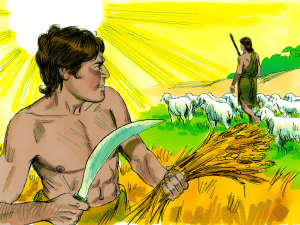
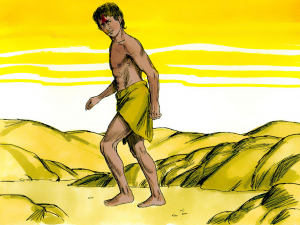
Read Together: Cain became very angry when his offering was not accepted and Abel’s offering was. He would not stop being angry, and he blamed Abel for Cain’s getting into trouble. Cain let his anger grow and grow, and as a result, he even began to hate his brother. That led to him murdering Abel. God says we must love each other as much as we love ourselves (Luke 10:27). And God says we should not even hate an enemy, but love them (Matthew 5:44). In this lesson, we will see how anger can grow and turn into hatred if we let it. And hatred can lead to murder. But God wants us to respect others and have self-control. That leads to peace!

Read Together: Genesis 4:4-8; 1 John 3:1112, 15; Proverbs 16:32

Discuss:

  • Ask your child what Cain’s attitude was like.
  • Explain the advice God gave to Cain to correct the situation. (God told Cain to do the right thing and learn to control himself (Genesis 4:7).
  • Ask how Adam and Eve must have felt when they learned Abel was dead. Discuss how sin affects everyone.
  • Talk to your child about respect, treating others the way you want to be treated, having self-control, and learning to resolve conflicts. Show how things could have been different if Cain had shown respect and exercised self-control. He could have tried to resolve the conflict with his brother.
  • Explain that God desires all people to live in peace, and that takes respecting other people and having self-control.

Review memorization.

Luke 10:27  “So he answered and said, ‘You shall love the LORD your God with all your heart, with all your soul, with all your strength, and with all your mind,’ and ‘your neighbor as yourself.’”

Printable PDF – L1.11

Children’s Bible Program – Level 1: Lesson 12 “God Punishes Cain”

Sweeting Publishing | FreeBibleimages.org

Author: Janth English

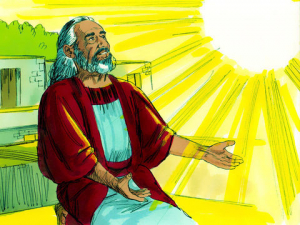
Read Together: When God accepted Abel’s offering but did not accept Cain’s, Cain got very angry. He got so mad that he killed his brother! He became the first murderer in the human family. God knew that Abel was dead and came to talk to Cain about murdering his brother. God asked Cain where his brother was. Instead of admitting what he had done, Cain tried to hide what he had done from God and was not sorry for his actions. He replied to God, saying, “Am I my brother’s keeper?” This lesson will show the idea of cause and effect. It will show that certain things happen because of our actions, when we don’t obey God. It will also show that everyone must love his neighbor.


Read Together:

Genesis 4:9–16; Luke 10:27

 Discuss:

  • Explain to your child that God, who knows everything, knew Cain had killed Abel. Cain couldn’t hide it from God, and neither can we hide our mistakes or sins from God.
  • Ask your child what Cain’s attitude was when God asked about Abel.
  • Discuss with your child Cain’s punishment. He was sent away from God and the community. Why would God send Cain away from the others?
  • Help your child understand that thinking bad things can lead to bad actions.
  • Ask your child how following the law to “love your neighbor” could have changed Cain’s life.

 Review memorization:

Luke 10:27 “So he answered and said, ‘You shall love the LORD your God with all your heart, with all your soul, with all your strength, and with all your mind,’ and ‘your neighbor as yourself.’”
More to Do!

These activities are optional, but some children may find them enjoyable.

  • Show love for your neighbors by creating cards for the widows, widowers, or other older members in the congregation.
  • Help your child to plan a good deed to do for someone in the family.
  • Your child may like to sing along with this cute song Thank You God.

Printable PDF – L1.11

Printable PDF – L1.9-L.12

Children’s Bible Program – Level 1: Lesson 13 “The Earth Before the Flood”

Sweet Publishing | FreeBibleImages.org

Author: Janth English

Read Together: The people on the earth had become very wicked before the flood. In fact, the Bible says that they were thinking bad thoughts all the time! People were hurting other people, and the suffering was very great. When He saw how bad things were, God was sorry that He made man.  It was painful for Him to see people treating each other that way. He decided to destroy all the wicked people by sending a flood to cover the earth. God who is merciful did not want to destroy the good and obedient people with the wicked. So, He looked for someone on the earth who was obedient to Him, and He found Noah.

Read Together: Genesis 6:1–12

Discuss:

  • Talk to your child about what it means to be disobedient to God. Explain to them that disobedience can lead to “wickedness” and how this way of life hurts people.
  • Ask your child to picture what it would be like if you were the only people in your neighborhood who were being good, and all the other people were naughty. Remind them that only one person was left who was really obeying God!
  • Ask your child how God must have felt to see all the people he created being bad. Relate it to a situation they have experienced. (Example: “How does Mom feel when you are naughty and doing things you shouldn’t be doing?”)
  • Take this opportunity to explain the Great White Throne Judgment period (Revelation 20:11). One day, God will give everyone who has ever lived a chance to obey and follow Him, and be blessed for obedience.

Review Memorization:

2 Peter 2:5 “And [God] did not spare the ancient world, but saved Noah, one of eight people, a preacher of righteousness, bringing in the flood on the world of the ungodly.”

Printable PDF – L1.13

Children’s Bible Program – Level 1: Lesson 14 “Noah Finds Grace”

By Janth English 

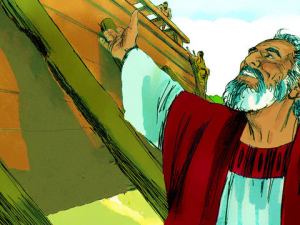
Read Together: There was one man during this wicked age (the time before the flood) who continued to follow God’s laws. His name was Noah, and Noah was a just man. That means he tried to treat everyone fairly, as the Bible teaches us to do, and just like we want to be treated in turn. He followed the example of his great-grandfather Enoch, who had also walked with God. “Walking with God” means that Enoch and Noah loved God and obeyed Him. God says that He shows His servants when He is going to send destruction on people because of their sins (Amos 3:7). Noah was a faithful servant of God, and God told Noah that He planned to destroy the earth with a flood, but would save Noah and his family because of his obedience to God.

Read Together: Genesis 5:21–32; 6:8–10; 13–14

Discuss:

  • Explain to your child that people lived very long lives before the Flood.
  • Ask your child how Noah must have felt living in such a wicked society.
  • What do you think about God being merciful to Noah and his family and saving them from the flood? Do you think they were happy about that?
  • Help your child understand that to be righteous means to keep God’s commandments in faith (Psalm 119:172), and that we too can be righteous.
  • Discuss with your child what it means to “walk with God.”

Review Memorization:

2 Peter 2:5 “And [God] did not spare the ancient world, but saved Noah, one of eight people, a preacher of righteousness, bringing in the flood on the world of the ungodly.”

Printable PDF – L1.14

Children’s Bible Program – Level 1: Lesson 15 “Noah, the Ark, and the Flood”

Sweet Publishing | FreeBibleImages.org

By Janth English

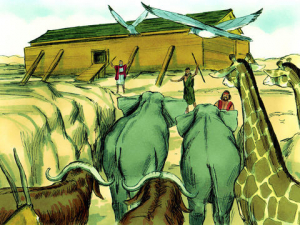
Read Together: Following God’s instructions, Noah immediately began to build an ark to save his family and the land animals from destruction. Noah and his sons, Shem, Ham, and Japheth, may have worked on building the ark for many years. While the people surely made fun of him for building a boat on dry land, Noah warned them to repent and obey God so that they too could escape the coming Flood. No one but his family listened to Noah. In the end, there were only eight people that entered the ark: Noah, Shem, Ham, Japheth, and their wives. God sent seven pairs of every clean animal to the ark, males and females, so He could preserve their lives. He also sent two of every unclean animal, a male and a female, as well as seven pairs of birds, males and females, for Noah to keep in the ark. After Noah, his family, and all the animals were inside, God sealed the door to the ark. After seven days, it began to rain. The waters from under the earth gushed up and the rain from heaven poured down, for forty days and forty nights! The water was so high that it covered the mountains! Only those on the ark survived.

Read Together: Genesis 6:13–22; 7:1–20; 2 Peter 2:5

Discuss:

  • Ask your child why God destroyed all land animals, birds, and human beings. Ask why God spared Noah and his family.
  • Ask your child how many people were aboard the ark and who they were.
  • Explain to your child that during the time that he was building the ark, Noah was warning the people about the coming Flood. God was giving them an opportunity to repent and be saved. Emphasize God’s mercy in wanting the people to be saved.
  • Explain to your child what makes animals “clean” or “unclean.” Why did God tell Noah to take more clean animals on the ark than unclean? You may want to use this as an opportunity to talk about God’s dietary laws in Leviticus.

Review Memorization.

2 Peter 2:5 “And [God] did not spare the ancient world, but saved Noah, one of eight people, a preacher of righteousness, bringing in the flood on the world of the ungodly.”

Printable PDF – L1.15

Children’s Bible Program – Level 1: Lesson 16 “The Rainbow Covenant”


Sweet Publishing | FreeBibleImages.org

By Janth English

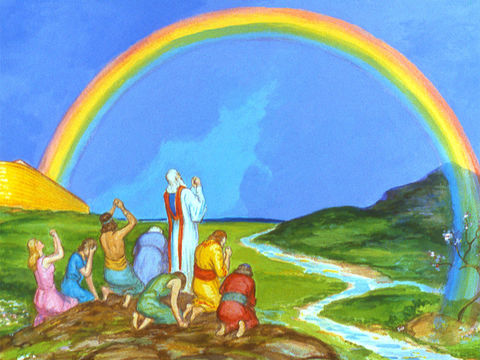
Read Together: After the Flood was over, the ark came to rest on top of the mountains of Ararat. These mountains are in the country called Turkey today. Noah, his family, and the animals remained aboard the ark for more than a year. Wow! It took a long time before the earth was dry enough for them to live on it. After they left the ark, God told Noah, Shem, Ham, and Japheth that He wanted them to have big families and fill the earth with more people. God also made a new covenant with all living creatures that He would never again destroy the earth with a flood. The sign God gave of this new covenant was the rainbow.

Read Together: Genesis 8:1–22; 9:1, 11–19.

Discuss:

  • Ask your child, by way of review, what was the Flood? Why did God bring the Flood on humanity?
  • Ask your child, what was the promise God made after the Flood was over? What was the sign of that promise?
  • Ask your child if he or she has ever seen a rainbow. What does it look like? How would he or she describe it?
  • Discuss God’s command to Noah and his sons to “be fruitful and multiply.” Why did God ask them to have lots of children? Were there any people other than Noah and his family alive after the Flood?
  • Explain that every living human being today is descended from Noah and his sons.

Review Memorization:

2 Peter 2:5 “And (God) did not spare the ancient world, but saved Noah, one of eight people, a preacher of righteousness, bringing in the flood on the world of the ungodly.”


More to Do!

These activities are optional, but some children may find them enjoyable.

  • Your child might be interested in comparing the size of the ark with modern structures. This  website had some interesting comparisons.
  • There are several Noah’s ark crafts available on Pinterest that your child might enjoy.
  • There are several videos on YouTube of the Noah’s ark replica in Kentucky. This Noah’s Ark Encounter video is short but it does mention the dimensions.

Printable PDF – L1.16

Printable PDF – L1.13-L1.16

Children’s Bible Program – Level 1: Lesson 17 “Families Grew into Nations”

Sweet Publishing | FreeBibleImages.org

by Janth English

Read Together:  God destroyed every human being on the face of the earth with the exception of 8 people – Noah and his sons, Shem, Ham, Japheth, and their wives.  A pair of every unclean animal and seven pairs of all clean animals survived with Noah and his family on the ark. After the flood, God commanded Noah, his sons, and the animals to multiply on the earth, and that is exactly what they did.  People lived longer so they were able to have many children. Soon families grew so big that they formed nations, and the nations were all separated into their own lands.

Read Together: Genesis 8:15-17; 9:1-2; 10:1-7, 19-22, 30-32

Discuss:

  • Help your child to identify the eight people that survived the flood.
  • Discuss with your child why God told Noah to take seven of every clean animal on the ark.
  • Help your child visualize what the earth might have been like after a few years with so few people and so many animals which were multiplying very quickly.
  • Explain to your student that though their numbers were increasing, the people were still united by language and culture.
  • Help your child recognize that after the flood there were only eight people, and today, about 5 thousand years later, there are almost eight billion people all of whom are descended from Noah.

Review Memorization:

Genesis 11:6  “And the Lord said, ‘Indeed the people are one and they all have one language, and this is what they begin to do; now nothing that they propose to do will be withheld from them.’”

Printable PDF – L1.17

Children’s Bible Program – Level 1: Lesson 18 “Nimrod”

Read Together: After the flood, people began to raise families, and gradually moved further and further away from where the ark had come to rest. The Bible tells us about the families of Shem, Ham, and Japheth, and how they began to populate the earth. We read about one man who became famous as a great hunter. This man’s name was Nimrod, and he was the grandson of Ham, one of Noah’s three sons. As his fame grew, he was idolized by many. In fact, some people began to look to Nimrod instead of God for protection and leadership. They called him “the mighty hunter before [“instead of” or “in place of”] the Lord” (Genesis 10:9). Remember, God had commanded the sons of Noah to fill the earth (Genesis 9:1). But proud Nimrod rebelled against God, building cities and a kingdom. One of the cities he built was the famous Babel, where the people began to build a giant tower, reaching into the sky.

Read Together:  Genesis 10:6, 8-12

Discuss:

  • Help your child to understand that the people were looking to Nimrod as their provider and protector and not looking to God.  Remind your child that God is our ultimate provider and protector.
  • Nimrod was setting up a kingdom for himself to make himself the ruler over the people. You may want to take this opportunity to explain that in God’s government, men do not choose to be in charge themselves. God selects the leaders.
  • Explain to your child that moving people into cities as Nimrod did was not what God intended. Imagine and discuss what cities may be like in the wonderful world tomorrow and how they will be much different than the cities of Nimrod or of today
  • Help your child to understand that Nimrod was leading the people away from God.


Review Memorization:

Genesis 11:6  “And the LORD said, ‘Indeed the people are one and they all have one language, and this is what they begin to do; now nothing that they propose to do will be withheld from them.’”

Printable PDF – L1.18

Children’s Bible Program – Level 1: Lesson 19 “The Tower of Babel”

Sweet Publishing | FreeBibleImages.org

By Janth English

Read Together: Babel, the first city that Nimrod built, was the beginning of his kingdom. The people all spoke the same language, so it was easy for them to share ideas and work together. But instead of working together for good, they began to rebel against God. Even though God had commanded them to fill the earth with their families, the people refused. With Nimrod as the leader, the people built a huge tower in the city of Babel. The city they built, with its towering fortress, made the people very proud of themselves and what they had done. They were so proud that they believed they could defy God. But the people did not know the amazing miracle that would happen next.

Read Together:  Genesis 10:9–10; 11:1–4

Discuss:

  • Explain to your child that Noah and Shem could tell the people about the flood and what happened before the flood. (According to the genealogies contained in the Bible, they were still alive during the time that Nimrod built Babel.)
  • The people knew what they were doing was wrong. Noah was a preacher of righteousness (2 Peter 2:5), and he would have continued to preach after the flood. Explain to your son or daughter that the people were being disobedient and wanted to do things their own way, regardless of what God said.
  • Help your child to understand that there is never a time when we can rebel against God. Still, when we do something wrong, we can ask God to forgive us, and He will. God loves us, and we can rely on Him to provide for us and protect us.

Review Memorization.

Genesis 11:4 “Then they said, ‘Come, let us build ourselves a city, with a tower that reaches to the heavens, so that we may make a name for ourselves; otherwise we will be scattered over the face of the whole earth.’

Children’s Bible Program – Level 1: Lesson 20 “God Confuses the Language”

Sweet Publishing | FreeBibleImages.org

By Janth English and LivingEd Staff

Read Together: God came down to see what the people were doing at Babel. When He saw the city and the tower He was not pleased with what the people were doing. God saw how mankind was working together to rebel against Him, and decided to confuse their language so that the people could not communicate with each other. The word “Babel” means confusion, and there was plenty of confusion when suddenly the people working together could no longer understand one another. The work on the tower and the city soon stopped. God separated the people’s languages by families. People naturally came together with those they could understand, and began to move into the lands that God had given them. The tower no longer exists, but to this day, Babel remains a symbol of mankind’s rebellion against God.

Read Together: Genesis 11:5–9; Zephaniah 3:9

Discuss:

  • Discuss the meaning of Genesis 11:6 with your child. God has given mankind brilliant minds. We are to use our knowledge and abilities to serve and worship God.
  • Ask your child Imagine you are playing with your friend when suddenly they start saying things that don’t make any sense! You try to ask them to tell you what they mean, but you realize they can’t understand what you are saying either!”  This is what happened to everyone when God confused the languages at the tower of Babel.
  • Point out to your child that being able to communicate with others is an important part of life. God wants people to understand one another.  This is why He will restore a pure language to mankind in the Millennium (Zephaniah 3:9). This would be a good opportunity to talk about what it might be like in the Kingdom when everyone in the world can communicate with and understand everyone else.

Review Memorization:

Genesis 11:7 “Come, let Us go down and there confuse their language, that they may not understand one another’s speech.”