Digging Deeper: Paul and Rome

Author: Mr. Kenneth Frank | Faculty, Living Education


Estimated Reading Time: 2 min.

Did you know that, unlike most of his epistles, Paul wrote the Epistle to the Romans during his third evangelistic journey before he ever visited the city of Rome?

House churches had developed in the Roman Empire’s capital city possibly beginning with observant Jews who had traveled to Jerusalem for Pentecost and had returned as Christians (Acts 2:10). During the persecution of Acts 8:1, some Christians may have fled to Rome. Other Christians may have migrated there for business or personal reasons. Somehow congregations had formed among believers. Paul had wanted to visit them even before he wrote them but was prevented doing so more than once (Romans 1:11-15). One reason he wrote this letter was to introduce himself and prepare them for his coming after he delivered a gift from churches in Greece to Judean Christians enduring drought and famine. However, he did not arrive in Rome until about three years after writing them due to his arrest in Jerusalem. While there, Jesus informed him he would indeed stand before Caesar in Rome just as he had testified in Jerusalem (Acts 23:11; 27:24).

Paul believed his work on the eastern side of the Roman Mediterranean world had been accomplished sufficiently (Rom 15:22-23). He wanted to preach in the capital city as he had in scores of other cities and towns during his various evangelistic journeys. Long before Horace Greeley made his proverbial admonition to “Go west young man,” Paul wanted to travel west to visit the brethren and churches in Rome to solidify them in the faith as well as to disseminate the faith to other parts of the empire from its capital. Rome was a city of one to four million people, about half of whom were slaves. The conclusion of his Epistle to the Romans greets many people Paul knew there including relatives (Romans 16:13), but there were many more yet-unknown brethren Paul intended to meet and serve.

Paul did indeed travel to Rome but not in the way he had planned. He arrived as a prisoner who of necessity had appealed to Caesar, employing the right of every Roman citizen to a fair trial. He spent about two years in Rome under a form of house arrest but afterward evidently was released and traveled further to spread the gospel, perhaps even to Spain as he had planned (Rom 15:24, 28). Finally, tradition states he was rearrested, returned to Rome for retrial and was beheaded. Paul’s testimony in Rome was sealed in his blood.

Kenneth Frank headshot

Kenneth Frank was born and raised in New Jersey, USA, and attended Ambassador College, graduating in 1973. He served in the Canadian ministry from 1973-1999, after which he returned to the USA to pastor churches in Maryland, Virginia, and North Carolina for 15 years. Having earned a BA degree from Ambassador College he later earned a MA degree from Grand Canyon University before being assigned to the Charlotte office to teach at Living University, now Living Education. Currently, he teaches the Survey of the Bible course to the on-campus students and writes the Digging Deeper column for our online Bible study program. He is married, has four children, and seven grandchildren.

Second Thoughts: Leaving Stephen Behind

Author: Thomas White | Living Church of God, Editorial Department


“And the witnesses laid down their clothes at the feet of a young man named Saul. And they stoned Stephen as he was calling on God and saying, ‘Lord Jesus, receive my spirit.’ Then he knelt down and cried out with a loud voice, ‘Lord, do not charge them with this sin.’ And when he had said this, he fell asleep. Now Saul was consenting to his death” (Acts 7:58-8:1).

Dr. Douglas Winnail’s recent assembly addressed the uncomfortable truth that what you do when you’re young will affect the rest of your life. People in many walks of life need that warning, and like most warnings, we need it when we haven’t done anything yet.

But what if you’ve already consented to Stephen’s death?

Wonderings

I wonder how many times Saul saw Stephen’s face in his dreams. I wonder if he ever woke up in a cold sweat while being taught by Christ Himself in the wilderness, hearing “Lord, do not charge them with this sin” reverberate through his mind. I wonder how much he felt as though he were haunted by Stephen’s death.

I wonder if he ever knelt before Christ during those years of training and said, “Depart from me, for I am a sinful man, O Lord! I let them kill him, I wanted them to, and I don’t know how to make up for it. I’ll never be able to forget what I’ve done, and I don’t know how You can, either. I’m tainted, Lord—Your work deserves better. Your people deserve better.”

And I wonder if he heard something like, “I did not come to call the righteous, but sinners, to repentance. I do not condemn you—go and sin no more.”

Going

When we read in John 8:11 of Christ saying that to the woman caught in adultery, we pay needed attention to the first part, “Neither do I condemn you,” and the third part, “sin no more.” But it was only very recently that I even noticed the second part: “go.”

Only a writer inspired by God could pack so much into a single word. “Sin no more,” our Savior says, but also, “Go. Move forward. Don’t stay here in your mind, wallowing in this time and place, letting the memories of your sin hold you captive. Leave Stephen behind.”

Saul had to, and we have to. Whatever we’ve done, however grievously we’ve disobeyed our Savior, the response he expects of us is to ask His forgiveness, believe Him when He says He does not condemn us, go, and sin no more. And it has to be in that order: If we’re going to leave Stephen behind, we have to first believe and accept that Christ does not condemn us, and if we’re going to “sin no more,” we have to first leave Stephen behind—because we’re almost never more vulnerable to future sin than when our minds are enveloped in past sin.

I doubt Saul ever truly forgot about what he did to Stephen, but I don’t believe he remained haunted by it. In fact, we know he didn’t, because the same man who consented to Stephen’s death—but also, in a very real way, an entirely different man—said, “one thing I do, forgetting those things which are behind and reaching forward to those things which are ahead, I press toward the goal for the prize of the upward call of God in Christ Jesus” (Philippians 3:13-14).

It’s true—what you do when you’re young affects the rest of your life. But it doesn’t have to rule it.


Thomas White headshot

Thomas White was one of the onsite Living Education students for the 2018-2019 semesters. He also has a Bachelor’s Degree in English. Thomas currently works as an Editorial Assistant for the Living Church of God. According to his wife, he eats pizza in entirely the wrong way.

Wheat or Tares?

Sea of Galilee

KEY FEATURES

The Sea of Galilee is also called the Sea of Tiberias or Lake of Gennesaret. It was commonly known in the Old Testament as the Sea of Kinnereth. Nearly 700 feet below sea level, “the lake” is the largest freshwater bank in the region.
Geographically, the sea is 8 miles wide and about 12 miles long, north to south. Located near the Golan Heights, it is Israel’s primary source of drinking water. The heart-shaped feature forms a circular arc which connects the flow of the Jordan River and provides much of the water supply and a well-stocked variety of fish.
Some major towns at its shores include Bethsaida, Capernaum, and Tiberias.

THE TIME OF CHRIST

During the first century, Christ spent much of His time around the Sea of Galilee. He healed the sick and cast out demons near the Sea of Galilee. He also ate breakfast with His disciples on the shore of the Sea of Galilee after His resurrection. The Sea of Galilee played a pivotal role in the 3 1/2 year ministry of Jesus Christ.

Sabbath Day’s Journey

From Acts of the Apostles: The Church Begins (Unit 1) – Learn More

jur’-ni (sabbatou hodos):

Used only in Acts 1:12, where it designates the distance from Jerusalem to the Mount of Olives, to which Jesus led His disciples on the day of His ascension. The expression comes from rabbinical usage to indicate the distance a Jew might travel on the Sabbath without transgressing the Law, the command against working on that day being interpreted as including travel (see Exodus 16:27-30). The limit set by the rabbis to the Sabbath day’s journey was 2,000 cubits from one’s house or domicile, which was derived from the statement found in Joshua 3:4 that this was the distance between the ark and the people on their march, this being assumed to be the distance between the tents of the people and the tabernacle during the sojourn in the wilderness. Hence, it must have been allowable to travel thus far to attend the worship of the tabernacle. We do not know when this assumption in regard to the Sabbath day’s journey was made, but it seems to have been in force in the time of Christ. The distance of the Mount of Olives from Jerusalem is stated in Josephus (Ant., XX, viii, 6) to have been five stadia or furlongs and in BJ, V, ii, 3, six stadia, the discrepancy being explained by supposing a different point of departure. This would make the distance of the Sabbath day’s journey from 1,000 to 1,200 yards, the first agreeing very closely with the 2,000 cubits. The rabbis, however, invented a way of increasing this distance without technically infringing the Law, by depositing some food at the 2,000-cubit limit, before the Sabbath, and declaring that spot a temporary domicile. They might then proceed 2,000 cubits from this point without transgressing the Law.

And in some cases even this intricacy of preparation was unnecessary. If, for instance, the approach of the Sabbath found one on his journey, the traveler might select some tree or some stone wall at a distance of 2,000 paces and mentally declare this to be his residence for the Sabbath, in which case he was permitted to go the 2,000 paces to the selected tree or wall and also 2,000 paces beyond, but in such a case he must do the work thoroughly and must say:

“Let my Sabbath residence be at the trunk of that tree,” for if he merely said: “Let my Sabbath residence be under that tree,” this would not be sufficient, because the, expression would be too general and indefinite (Tractate `Erubhin 4:7).

Other schemes for extending the distance have been devised, such as regarding the quarter of the town in which one dwells, or the whole town itself, as the domicile, thus allowing one to proceed from any part of the town to a point 2,000 cubits beyond its utmost limits. This was most probably the case with walled towns, at least, and boundary stones have been found in the vicinity of Gaza with inscriptions supposed to mark these limits. The 2,000-cubit limits around the Levitical cities (Numbers 35:5) may have suggested the limit of the Sabbath day’s journey also. The term came to be used as a designation of distance which must have been more or less definite.

H. Porter

Copyright Statement
These files are public domain.Bibliography Information
Orr, James, M.A., D.D. General Editor. “Entry for ‘SABBATH DAY’S JOURNEY'”. “International Standard Bible Encyclopedia”. 1915.  

Acts Challenge

Recommended Reads: Do Hard Things

Cities of the Book of Acts

Galilee

Acts 1:11 – Messengers after ascension: “Men of Galilee”

Acts 2:7 – During Pentecost, “Aren’t they Galileans?”

Acts 5:37 – Gamaliel mentions “Judas the Galilean” who rose up for a time, had some followers, who then scattered.

Jerusalem

Acts 1:1-8:3 – Starting point for the way. Events in chapters 1-7 occur in Jerusalem: Ascension, Pentecost, healings, Stephen’s ministry and death.

Acts 11:2-18 – Peter returns to Jerusalem and tells the brothers what happened in Caesarea.

Acts 12:1-19 – Herod kills James, imprisons Peter. Peter escapes and goes to Caesarea.

Acts 12:25 – After completing their mission (in Antioch), Barnabas and Saul return to Jerusalem with John Mark.

Acts 15:1-2 – Brothers from Judea came to Antioch teaching circumcision. Barnabas and Paul chosen to go to Jerusalem to discuss issue with them.

Acts 15:4-39 – Jerusalem council. Barnabas and Paul separate. Barnabas with Mark to Cyprus, Paul with Silas to Syria and Cilicia.

Acts 18:22 – Paul goes from Kenchreae to Ephesos to Caesarea (boat), then Jerusalem to Antioch (overland).

Acts 19:21-22 – Paul’s travel plans while in Ephesos: travel through Macedonia and Achaia, then back to Jerusalem, then on to Rome.

Acts 20:16 – Paul had decided to sail past Ephesos and meet the elders in Miletus because he didn’t want to spend time in Asia and was eager to get to Jerusalem for Pentecost.

Acts 20:22 – Paul tells the Ephesian elders in Miletus that he is on his way to Jerusalem.

Acts 21:15-23:22 – Paul in Jerusalem. Trials.

Acts 26:4-11 – In his defense in Caesarea, Paul tells of his persecution of Christians in Jerusalem.

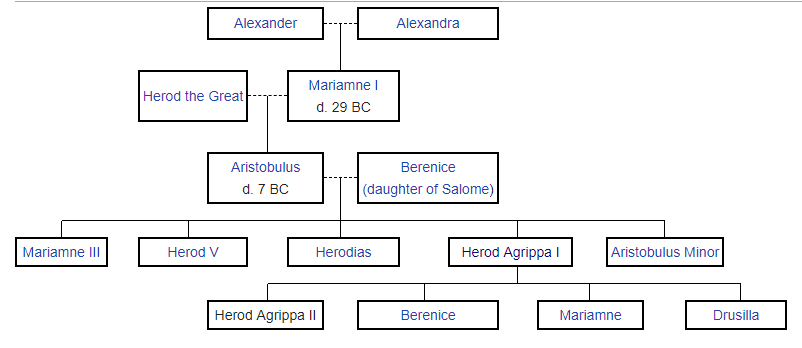
Profile of Herod Agrippa II

Paul’s Encounter with King Agrippa

Apostle Paul On Trial by Nikolai Bodarevsky, 1875. Agrippa and Berenice are both seated on thrones.

“Agrippa said to Paul, ‘You may now speak for yourself.’ Paul lifted his hand and started to talk, ‘King Agrippa, the Jews have said many things against me. I am happy to be able to tell you my side of the story. You know all about the Jewish ways and problems. So I ask you to listen to me until I have finished. ‘All the Jews know about my life from the time I was a boy until now. I lived among my own people in Jerusalem. If they would tell what they know, they would say that I lived the life of a proud religious law-keeper. I was in the group of proud religious law-keepers who tried to obey every law (Acts 26:1-5).“

King Agrippa

A “seat of Moses” carved from basalt found in the ruins of the third-fourth-century C.E. synagogue at Chorazin. 

Born        27/28

Died        c. 92 or 100AD

Full name
Marcus Julius Agrippa

Dynasty        Herodian dynasty

Father         Herod Agrippa I

Mother        Cyprus

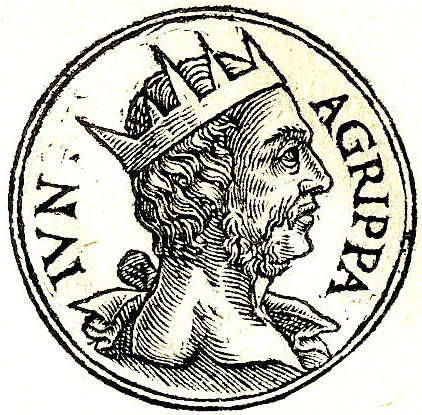
Herod Agrippa II was born in the year 28, and according to a statement that is not uncontradicted (Photius, “Bibliotheca,” cod. 33), it is said that he died in the year 100. He was educated in Rome, where he saw much of the court life that had been so harmful to his father. It proved just as detrimental to him, for he reached maturity just at the time that Messalina and Agrippina dared to flaunt the most fearful depths of profligacy in public. On the sudden death of his father, the emperor Claudius desired him to enter into the full inheritance of all his rights and titles, but upon the advice of court favorites he refrained from doing so. Once again Judea was handed over to the care of procurators, and for the time being the young man was detained at court. Here he had the opportunity of being helpful to his coreligionists from time to time (Josephus, “Ant.” xv. 11, § 4; xx. 1, § 2) and of acquiring proficiency in all the arts of courtly flattery.

Succeeds Herod II. On the death of Herod II., Agrippa succeeded in having the former’s post promised him. In the year 50, without regard to the rights of the heir to the throne, he had himself appointed (“B. J.” ii. 12, § 1; “Ant.” xx. 5, § 2; 9, § 7) to the principality of Chalcis by the emperor, and also to the supervisorship of the Temple at Jerusalem, which carried with it the right of nominating the high priest. Within three years—possibly before he left Rome to assume the dignity of his office—the emperor presented him with larger territory in exchange for Chalcis, giving him the tetrarchy of his great-uncle Philip—over which Agrippa’s father had also ruled—together with that of Lysanias (Abilene), and the district of Varus (“Ant.” xx. 7, § 1; “B. J.” ii. 12, § 8). Nero, when he became emperor, added to this territory, giving him considerable tracts of Galilee and Perea.