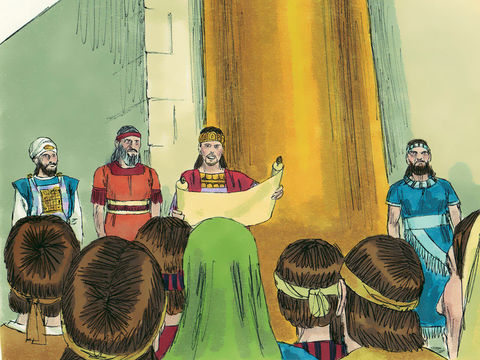
After King Uzziah died, several more kings ruled the land. Some of them were very good, and some of them were very wicked, and caused the people of Judah to sin against God. A king named Amon, who was a very wicked man, only ruled for two years before God allowed him to die. His little eight year old son, Josiah was crowned as king after him. Despite having Amon for a father, Josiah was a good king. By the time he was sixteen years old he was determined to get rid of all the idols so that the people would have to worship the true God. He also wanted to repair the beautiful temple of God to be used once again for the right purposes. One day when some men were cleaning out the temple, they found an old book that had been forgotten and decided to show it to the young king.
Discuss:
Sweet Publishing | FreeBibleImages.org
How old was Josiah when he became king? Does a person have to be a certain age to begin to follow God?
What did Josiah do to get rid of the pagan idols in the land? Which of God’s commandments was Josiah following when he got rid of the idols in Judah?
What was the book that was found in the temple? What did King Josiah do when they read it to him? Why was he so sad?
What feast did King Josiah have all the people in Judah keep? What do you think that Passover was like for the people in Judah?
Memory Challenge:
2 Chronicles 34:31
Then the king stood in his place and made a covenant before the Lord, to follow the Lord, and to keep His commandments and His testimonies and His statutes with all his heart and all his soul, to perform the words of the covenant that were written in this book.
Due to the travel restrictions and an ongoing quarantine policy in Israel, we regret to announce that our Israel Dig and Tour is cancelled for the 2020 summer. We look forward to resuming the program again in the summer of 2021
https://www.lcgeducation.org/wp-content/uploads/2019/11/6JS_3614.jpg6831024Jonathan McNairhttps://www.lcgeducation.org/wp-content/uploads/2021/02/logo_basic-website-300x94.pngJonathan McNair2020-05-28 10:11:492020-05-28 10:14:08Israel Dig and Tour Cancelled
Author: Mr. Kenneth Frank | Faculty, Living Education
Estimated Reading Time:6 min.
Did you know that God has provided humankind two revelations of His character and plan?
Christians are familiar with His written revelation called the Holy Bible. But what many do not realize is that long before a written record was provided for His people, God revealed Himself another way. This one has been available to all people, believers or non-believers alike no matter what language they speak. Throughout the centuries, avid Bible students have referred to these as “God’s Two Books.” Matthew Henry’s Commentary on the Whole Bible on Psalm 19 explains: “There are two excellent books which the great God has published for the instruction and edification of the children of men; this psalm treats of them both, and recommends them both to our diligent study. I. The book of the creatures, in which we may easily read the power and godhead of the Creator (Psalm 19:1-6). II. The book of the scriptures, which makes known to us the will of God concerning our duty. He shows the excellency and usefulness of that book (Psalm 19:7-11) and then teaches us how to improve it [our duty] (Psalm 19:12-14).” Both of these books reveal the glory of God!
Psalm 19 provides us a description of both of these revelations of God. The first one is creation itself, covered in Psalm 19:1-6. God has provided a theology through the natural world. By definition, theology is the study of God. Theologians have referred to this as “general revelation,” “natural revelation” or “natural theology.” The second revelation is described in Psalm 19:7-14, commonly called “special revelation,” “written revelation” or “supernatural theology.” All believers want to know more about the God they serve. They need to be diligent Bible students. However, they may be missing out on an entire second revelation because of a misunderstanding that there is today a war between science and religion. There is no such war between true science and biblical religion. God is the greatest scientist. Many famous human scientists have been dedicated Bible students such as Louis Pasteur, Isaac Newton, Johann Kepler, Isaac Newton, Michael Faraday, and Francis Bacon (The Henry Morris Study Bible, Appendix 7). God’s word holds us accountable for knowing God through what he has created. Notice Romans 1:19-20 (KJV throughout): “Because that which may be known of God is manifest in them; for God hath shewed it unto them. For the invisible things of him from the creation of the world are clearly seen, being understood by the things that are made, even his eternal power and Godhead; so that they are without excuse.”
During the COVID-19 coronavirus pandemic, many people worldwide have been sheltering at home or are quarantined under orders from civic officials. A report from a recent newsletter from the NPR radio program, Living On Earth, stated that “Americans spend more time inside than some whales spend time underwater. In many ways, we are an indoor species.” This study by Joe Allen, who is Director of the Healthy Buildings Program and Assistant Professor at Harvard’s T. H. Chan School of Public Health stated that “By the time we reach 80 years old, we will have spent 72 years of our lives indoors. However, these homes, offices, schools, and hospitals often lack fresh air and have an outsized impact on our wellbeing, health, creativity, and focus.”
After several weeks of this seclusion, many are now experiencing cabin fever with detrimental psychological effects. One of the most often recommended remedies from mental health experts has been to get outdoors, even onto one’s property or (if with safe distancing) to a local park. Indoors we are surrounded by things that humans have made. But outdoors, we are surrounded by what the Creator has made, much of which we often take for granted. Go outside and notice the blue sky, white clouds, and the various flora and fauna of our world. On a clear night, admire the astral bodies – even through common light pollution in many urban areas. Allow your mind to reflect on the biggest questions of life: Who are we?, How did we get here?, Where are we going?, What is wrong with the world?, and How may it be redeemed? By doing so, we free our minds even temporarily from our constant mundane concerns and pause to admire all that God has made for us to inherit once His redemption plan culminates.
Psalm 19:7-9 describes an even greater revelation: God’s sacred word contained in the Holy Bible. In these few verses, God describes His word with six titles, six attributes, and six effects. As beautiful as are the manifestations of God’s glory seen in the heavens, still more beautiful and more magnificent is God’s sacred word. These descriptions deserve our closer, personal study as we approach Pentecost, which commemorates God’s giving His law (Exodus 20) and His Holy Spirit (Acts 2.) Putting these into graphic form would look like this:
Titles for God’s Word
Attributes of God’s Word
Effects of God’s Word
law (Torah Hebrew word often translated “law” but more fully referring to “instruction,” “teaching,” or “doctrine”)
perfect
converting the soul
testimony
sure
making wise the simple
statutes
right
rejoicing the heart
commandment
pure
enlightening the eyes
fear
clean
enduring forever
judgments
true
righteous altogether
Psalm 19:11-14 reach into our innermost beings to challenge us to deal with known and unknown sins. It assures us that keeping God’s word provides a great reward (v. 11). Then v. 12 asks God to cleanse us from secret faults – things we may try to hide from God or even sins of which we are yet unaware. The spiritual lessons of the Days of Unleavened Bread challenge us to continue this cleansing process. We need God to show us where we are yet falling short of his grace (Romans 3:23). Then in v. 13 we consider the extremely dangerous presumptuous sins – sins that people commit deliberately. Only God can thoroughly cleanse us of secret faults and keep us from presumptuous sins (vv. 12-13). Living by God’s Two Books then enables us to pray sincerely, “Let the words of my mouth, and the meditation of my heart, be acceptable in thy sight, O LORD, my strength, and my redeemer (Psalm 19:14).”
Kenneth Frank was born and raised in New Jersey, USA, and attended Ambassador College, graduating in 1973. He served in the Canadian ministry from 1973-1999, after which he returned to the USA to pastor churches in Maryland, Virginia, and North Carolina for 15 years. Having earned a BA degree from Ambassador College he later earned a MA degree from Grand Canyon University before being assigned to the Charlotte office to teach at Living University, now Living Education. Currently, he teaches the Survey of the Bible course to the on-campus students and writes the Digging Deeper column for our online Bible study program. He is married, has four children, and seven grandchildren.
https://www.lcgeducation.org/wp-content/uploads/2020/05/aaron-burden-535Npq1wFG8-unsplash.jpg11251500Jonathan McNairhttps://www.lcgeducation.org/wp-content/uploads/2021/02/logo_basic-website-300x94.pngJonathan McNair2020-05-26 09:32:262021-08-12 17:27:36Digging Deeper: God’s Two Books
https://www.lcgeducation.org/wp-content/uploads/2020/05/41uJ6cGAprL._SX323_BO1204203200_.jpg499325Jonathan McNairhttps://www.lcgeducation.org/wp-content/uploads/2021/02/logo_basic-website-300x94.pngJonathan McNair2020-05-13 06:45:002020-11-06 13:11:34Recommended Reads: Economics in One Lesson
Author: Mr. Kenneth Frank | Faculty, Living Education
Estimated Reading Time:5 min.
Did you know that Jesus’ story about the widow who deposited two mites (smallest of Roman coins) into the Temple treasury may have suffered from clerical abuse?
Throughout the centuries, people have admired the self-sacrificing widow who gave all she had to God. However, you may have wondered: “Why did she have only two mites to give?” There is a backstory that could explain why she was so destitute. This story has a piercing message for religious leaders.
The Temple treasury was in the court of the women in Jesus’ day. Albert Barnes’ Notes on the Bible explains: “In that court there were fixed a number of places or coffers, made with a large open mouth in the shape of a trumpet, for the purpose of receiving the offerings of the people; and the money thus contributed was devoted to the service of the temple – to incense, sacrifices, etc.” Luke 21:4 records that this widow contributed all she had: two mites (Greek lepta). A mite (lepton) denoted a small coin of brass, the smallest in use among the Jews. In today’s US currency, a mite is estimated at about 1/8th of a cent! Editor J.R. Dummelow in A Commentary on the Holy Bible explains why she gave both instead of only one: “The widow offered two, because the rabbis forbade a single lepton to be placed in the almschest.”
The account of the destitute widow is found in two of our four gospels (Mark 12:41-44; Luke 21:1-4). Many have read these verses and understood the primary lesson being the widow’s sacrificial generosity. However, there is a background to this story that explains the widow’s extreme poverty (penury Luke 21:4). That background is also given in two of the four gospels (Mark 12:38-40; Luke 20:45-47). In each case, Jesus rebuked the scribes; however, notice in particular the words that they “devour widows’ houses.” Bullinger in his Companion Bible explained, “Being occupied in making wills and conveyances of property, they abused their office.” Albert Barnes in his Notes on the Bible added: “This they did under pretence of counseling them in the knowledge of the law and in the management of their estates. They took advantage of their ignorance and their unprotected state, and either extorted large sums for their counsel, or perverted the property to their own use.”
Another abuse is explained in WordPictures in the New Testament by A.T. Robertson, “They inveigled widows into giving their homes to the temple and took it for themselves.” Vincent’s Word Studies goes even further, “People often left their whole fortune to the temple, and a good deal of the temple-money went, in the end, to the Scribes and Pharisees. The Scribes were universally employed in making wills and conveyances of property. They may have abused their influence with widows.” The Pulpit Commentary by Exell explained the scribes’ influence over women: “Josephus specially alludes to the influence which certain of the Pharisees had acquired over women as directors of the conscience.”
David Guzik in his Enduring Word Commentary explained the widows’ poverty: “In that day, a Jewish teacher could not be paid for teaching – but he could receive gifts. Apparently, many scribes used flattery and manipulation to get big gifts from those who could least afford to give them – such as widows.” The scribes were highly respected in their society whether they deserved it or not. Jesus explained that at least some were less than honorable in their teachings that encouraged people to financially support them generously. Guzik continues: “The Jews of Jesus’ day taught that teachers were to be respected almost as God; they said that they deserved more honor and respect than any other people in life did. They taught that the greatest act someone could do is give money to a teacher. Of course, it was the teachers themselves who taught this!”
Jesus commended this widow for giving more in proportion to the treasury than all the wealthier donors who gave of their abundance (literally, “superabundance”). According to the Cambridge Bible for Schools and Colleges, “These rich men do not seem to have been observing the injunctions both sacred and Talmudic to give secretly, Mat. 6:4; Mat. 6:18.” By contrast, Jesus warned in His Sermon on the Mount against a loud, public display of one’s generosity: “Therefore when thou doest thine alms, do not sound a trumpet before thee, as the hypocrites do in the synagogues and in the streets, that they may have glory of men. Verily I say unto you, They have their reward (Matthew 6:2).” Jesus’ words “do not sound a trumpet before thee” are explained by The Jamieson, Fausset and Brown Commentary: “The expression is to be taken figuratively for blazoning it, Hence, our expression to ‘trumpet.'” These religious hypocrites did all they could to create an ostentatious display when they contributed to the treasury.
No wonder Jesus denounced such hypocrites. Albert Barnes in his Notes on the Bible declared, “If there is any sin of special enormity, it is that of taking advantage of the circumstances of the poor, the needy, and the helpless, to wrong them out of the pittance on which they depend for the support of their families; and as God is the friend of the widow and the fatherless, it may be expected that such will be visited with heavy condemnation.”These sobering words warn every religious leader against uncaring fund-raising from impoverished donors, especially if the leader’s income depends on it. We all will be wise to remember these words of the Psalms, “Sing unto God, sing praises to his name: extol him that rideth upon the heavens by his name JAH, and rejoice before him. A father of the fatherless, and a judge of the widows, is God in his holy habitation (Psalm 68:4-5).”
Kenneth Frank was born and raised in New Jersey, USA, and attended Ambassador College, graduating in 1973. He served in the Canadian ministry from 1973-1999, after which he returned to the USA to pastor churches in Maryland, Virginia, and North Carolina for 15 years. Having earned a BA degree from Ambassador College he later earned a MA degree from Grand Canyon University before being assigned to the Charlotte office to teach at Living University, now Living Education. Currently, he teaches the Survey of the Bible course to the on-campus students and writes the Digging Deeper column for our online Bible study program. He is married, has four children, and seven grandchildren.
https://www.lcgeducation.org/wp-content/uploads/2020/05/widows-mite-wiki-commons.png414974Jonathan McNairhttps://www.lcgeducation.org/wp-content/uploads/2021/02/logo_basic-website-300x94.pngJonathan McNair2020-05-12 10:04:002021-08-12 17:28:07Digging Deeper: Why could the widow give only two mites?