Second Thoughts: Be Yourself (No, Really)

Author: Thomas White | Living Church of God, Editorial Department


“Be honest. Don’t hide who you are. Be genuine. Don’t pretend to be someone you’re not. Be yourself.”

We’ve heard all of that before. Even Mr. Richard Ames’ recent assembly, a powerful message of improving one’s interpersonal communication, addressed the importance of openness and honesty—in essence, being yourself.

But it’s understandable if we think, “Wait a minute, be myself? That’s the last thing I want to be. Doesn’t God say that the heart is deceitful and wicked? Yeah, no, I’m way too aware of the terrible thoughts I’m constantly battling to be myself with anybody. Myself is awful, so to the best of my ability, I’m going to not be it, thanks.”

Actually, though, that perspective has it backwards. When you get down to it, all of the ungodly thoughts we have, words we say, and actions we take are the result of us not being ourselves—and instead, imitating someone truly awful.

Mr. Nathan Weighs In

To explain, I’ll turn to a quote from Mr. Peter Nathan. In the September-October 2019 Living Church News article “A Tale of Two Goats,” he wrote this:

Scripture describes Satan as having deceived the whole world (Revelation 12:9) and as having played a role in mankind’s sin from the very beginning (Genesis 3:1–5). It is on Satan’s head that the ultimate responsibility for sin rests. Jesus Christ, our High Priest, has already paid the penalty of sin for mankind. Satan, as the deceiver of all humanity, is to carry his responsibility for that sin, confessed over his head, from the presence of God.

– Mr. Peter Nathan, “A Tale of Two Goats”, LCN: Sep-Oct 2019

Now, obviously (because sometimes the obvious needs to be made super obvious at the risk of it not being obvious), Mr. Nathan isn’t saying that any of us are off the hook for our sins. I’m responsible for my sin. You’re responsible for your sin. But also, Satan is responsible for all sin—mine, yours, everyone’s. He doesn’t force anyone into anything, but each and every time we sin in any way, we’re hearing his suggestion and replying, “… Yeah, sure, okay. Seems like a good idea.”

Being Yourself is Resisting the Devil

The heart is deceitful and wicked (Jeremiah 17:9) because it’s so willing to listen to Satan’s deceitful and wicked influence, not because it’s conjuring up that influence all by itself. Our original ancestors, for example: It’s not like Adam and Eve were side-eyeing the tree of the knowledge of good and evil for months, and when a snake started talking, they thought, “Oh good, now I finally have an excuse.” No—they heard the devil’s suggestion and they took it, just like we do when we sin.

Before Satan shows up, we don’t read anything about Eve or Adam being tempted in the slightest by the forbidden fruit. They knew it was there, they knew God didn’t want them near it, and they were on board with that. Were they just “not themselves” before Satan’s deception? Of course they were themselves—God creates children, not clones. If anything, they were more themselves than they ever would be again in their physical lives, because they weren’t yet affected by Satan’s suggestions.

We’re all affected by those suggestions, but it’s when we refuse them that we’re who God made us to be. When we take those suggestions and thereby sin, we’re not ourselves at all—we’re Satan imitators. He’s the one who wants clones. God, though, wants us to exercise the free will He gave us and be nothing less than ourselves.


Thomas White headshot

Thomas White was one of the onsite Living Education students for the 2018-2019 semesters. He also has a Bachelor’s Degree in English. Thomas currently works as an Editorial Assistant for the Living Church of God. According to his wife, he eats pizza in entirely the wrong way.


Second Thoughts: Sonder and You (and Everyone Else)

Author: Thomas White | Editorial Department, Living Church of God


There’s debate on whether or not it can be called a real word, but if you type “sonder” into Wiktionary, you’ll get this definition:

“The profound feeling of realizing that everyone, including strangers passed in the street, has a life as complex as one’s own, which they are constantly living despite one’s personal lack of awareness of it.”

After this week’s assembly, I felt oddly compelled to immerse myself in a bit of sonder. Mr. Dexter Wakefield took us on a journey through the demographical statistics of the Church, and we learned, among many other things, that some of our youngest attending members are two years old, that our oldest attending member is one hundred and two years old, and that the Church’s database keeps track of them and everyone in between.

Thanks for Noticing

It’s always nice to know that someone is keeping track of you. We all feel a certain level of peace in the knowledge that we’re accounted for, that we’re considered. That might be why you get a tiny little thrill whenever someone uses your name. I don’t think it’s egotistical—it may be, in some cases, but for many people, the feeling seems more akin to gratitude. “Thank you for saying my name,” the feeling says, too fast to even be processed. “Thank you for acknowledging and keeping track of me.”

Maybe feeling sonder is just acknowledging everyone as worth keeping track of, when we usually only keep track of ourselves and the people closest to us. Most of us don’t feel sonder perpetually. It takes a surprising amount of effort to meaningfully recognize that other people are as multifaceted as we, ourselves, are. It might even be a little scary to do that, because as soon as you do, you have to recognize, in turn, that you don’t really know anyone. Most of the struggles that define someone else’s life are hidden from you. And once you’re aware of that, the excuses you drum up for judging other people seem… well, about as pathetic as they are, really.

Acknowledge the Battle

God keeps track of everyone, and that’s so easy to say, but hard to completely wrap your brain around. “I’d better be nice, because God wants me to be nice,” you might think when you’re tempted to not be nice. And that’s true, but it’s deeper than that, isn’t it? You might be better off thinking, “I’d better be nice, because God wants this person in front of me to experience kindness.” He’s keeping track of you, yes, absolutely, but he’s keeping just as much track of everyone you interact with, and He knows how much they need your empathy.

“Be kind,” goes an oft-quoted saying of dubious origin, “because everyone you meet is fighting a hard battle.” In all of His dealings with each and every one of us, God always, always acknowledges the battle. He’s never unaware of the struggles we each have every day, as we fight past the monsters in our own minds. We might not be able to know what the people around us are fighting, as He does, but if we want to be like Him, we should strive to treat other people like they’re fighting something painful, going through something hard—because most of the people around us probably are.

So, say peoples’ names when you talk to them. If someone looks sad, ask if they’re okay—and be prepared to listen if they’re not. Smile when you (even accidentally) make eye contact with someone you know. Even a little sonder might go a long way.


Thomas White headshot

Thomas White was one of the onsite Living Education students for the 2018-2019 semesters. He also has a Bachelor’s Degree in English. Thomas currently works as an Editorial Assistant for the Living Church of God. According to his wife, he eats pizza in entirely the wrong way.

Weekly Update Feb. 15, 2020

Second Thoughts: Presumption, Assumption, and…Reputation?

Author: William Williams | Editorial Department, Living Church of God


Have you ever been in a situation where you knew something you planned to do wouldn’t “look right,” but since you believed you weren’t going to “do anything wrong,” you went ahead with it anyway?

Perhaps the “Mike Pence” rule just seemed inconvenient that one time—especially if the circumstances really didn’t seem like the kind where anything truly compromising could happen. Maybe there wouldn’t be time for anything to happen. Maybe you and the people you planned to be with have good reputations, and people just know you better than to think you’d misbehave in some particular way or another. And maybe people should “mind their own business”—especially when such situations don’t always involve spending time with members of the opposite sex, but could simply be the kind of happenstance that maaaybe would look like you were doing something inappropriate on the Sabbath—when you weren’t—or juuust might seem like you were staying out late drinking and partying—which you don’t!

Of course, life is full of decisions, and not all decisions or actions can be helped regarding how others perceive them. If we worried about how our every single action might be perceived, we would certainly wastea lot of time. But we also know that God cares about how our behavior affects others, so it isn’t always worry but consideration. And when it comes to something that could seriously affect your reputation—or cause others to stumble—the matter deserves consideration.

The Appearance of Evil

“Reputation and the Appearance of Evil” was in fact Dr. Scott Winnail’s most recent Living Education address, and an especially vital topic for Christians today. Analyzing situations where individuals knew their decisions might give others “the wrong idea” was a chief part of his lecture. However, far from simply mowing down the assembled students with a list of “do’s” and “don’ts”, Dr. Winnail instead engaged in a give-and-take session about why people might inadvertently put their reputations at risk and how to avoid the appearance of evil—and he reminded them of the oft-repeated quote by Warren Buffett that a good reputation can take decades to develop, but be destroyed in five minutes.

Dr. Scott gave several examples of situations that can potentially tarnish one’s reputation, and what stood out most importantly to me was the absence of condemnation. Leaving behind most discussion of when people do fall into sin when they “skirt the edge of the cliff,” his focus was mainly on how to maintain a good reputation and make sure that pure motivations go hand in hand with—and even promote—pure perceptions.

Assume or Presume?

Throughout the discussion, a singular thought crossed my mind: presumptions lead to assumptions! We all know (or should know) that assume is a dirty word, but what about presume? If assuming is jumping to a conclusion when we don’t have all the facts (the very thing we don’t want people to do regarding our actions) presuming is assuming ahead of time how a certain thing will or should turn out (or how people will or should respond to those same actions!). And if, as Henry “the Fonz” Winkler was famous for saying, “Assumptions are the termites of relationships,” then presumptions are the overlooked food source that attracts them!

Dr. Scott suggested some questions his listeners should ask themselves before taking certain actions, including, “Why do I want to do this?,” “What are the possible outcomes?,” “How will my actions be perceived?,” and “Could someone imitate me and thereby fall into condemnation?”

In every case, here’s one bit of handy reasoning to add: “Don’t presume too much about how others will perceive your actions!” I’ve been told many times that “You can’t control what other people think,” but here’s a secret: you can, to a certain degree, by your own choice to “walk circumspectly” (Ephesians 5:15).

What looks like a duck…

As always, the best lessons are the ones we apply to ourselves, and thus I turn the lens around: Justifying something based on what people should think is a presumption. Thinking people will always know my future actions are honest based on my current reputation is a presumption. And stating that people should “mind their own business” is a naïve presumption at best—and a rejection of Philippians 2:29 and Romans 14:13 at worst. (Not to mention the fact that saying it out loud can easily become an example of just exactly what I’m talking about when someone takes it the wrong way and thinks, “Whoa, what a jerk that guy is.” If it looks like a duck, and quacks like a duck…)

With that, I can conclude:

  • I’m not the arbiter of what others should think—so I should think out my own actions before committing to them, as Dr. Winnail stressed.
  • I’m not the paragon of virtue I’d like to think of myself as—and I can’t place the burden of exonerating me on others, who have daily struggles and distractions all their own to think about.
  • And I’m not by any means the one who gets to decide where others should be on the path to their conversion, such that I can blame them for “minding” my business—especially when my business breathes the same air God gave everyone else to swim around in.

Or so I should presume.


Second Thoughts: Paid in Character

Author: Thomas White | Editorial Department, Living Church of God


“My brethren, count it all joy when you fall into various trials, knowing that the testing of your faith produces patience. But let patience have its perfect work, that you may be perfect [mature] and complete, lacking nothing.” – James 1:2-4

We can memorize the verses. We can recite them to ourselves. We can thank God as we look back and recognize how past struggles and losses have benefitted our spiritual growth. But whatever we do, whatever we know, it’s still really, really hard to make ourselves feel truly okay with the fact that as long as we’re human, we’re vulnerable—we can, and will, be hurt.

Mr. Gaylyn Bonjour gave the most recent Living Education assembly, and one of the many biblical truths he addressed was that in order for us to develop the spiritual fruit of longsuffering, we have to suffer for a long time. That, in a nutshell, is what James is saying up there: We can’t achieve holy, righteous character without suffering.

Paid in Character

Dr. Jordan Peterson has talked about how when we work, we’re essentially “sacrificing the present for the future.” We might not feel like working at present, but we know that if we work, we’ll get paid, and if we keep working and keep getting paid, the future will be better, because we’ll be able to buy… you know, food, among other things. Work usually feels pretty tolerable, because we know it’s for something, we know it’s building a better future. As the modern proverb goes, “Ya’ don’t work, ya’ don’t eat.”

Suffering also works that way, in a sense. When we go through a difficult time, or suffer from a loss, God is actually paying us for it in the character He’s growing in us through it. Our hurt and our struggles are “sacrificing the present for the future,” because the character we’re building allows us to show compassion, our struggles make it possible for us to develop empathy. If we don’t work, we don’t eat, and if we don’t suffer, we don’t love.

Saving for a Sunny Day

Now, people sometimes corrupt that truth by saying, “We can only achieve righteous character through suffering,” and that’s on a level of sheer bogus akin to “You should feel guilty if your life is currently pleasant.” Nonsense—if we were paid for our work, but never stopped working long enough to do anything with what we were paid, our work would be pointless, right? Likewise, God knows that if we only suffer, the character we build during all those trials isn’t really going to benefit anybody, because we’ll be too busy dealing with the trials to share it.

So He sends good times our way, too, and during those times, when life actually seems to be going pretty well, He does something extraordinary—He pays us for spending our paycheck. The catch, though, is that we have to spend it on someone other than ourselves. If we use the character we’ve been building through our trials to help others make it through trials of their own, we, in turn, build even more character—and help them to build it, too.

We shouldn’t go looking for new and exciting ways to suffer so that we can build more character—James says that we fall into various trials, not jump into them. But as we struggle, as we go through times of hurt and continue making deposits into our character account, we can be encouraged by the knowledge that we’re sacrificing a tiny, forgettable present for an eternal, beautiful future. 


Thomas White headshot

Thomas White was one of the onsite Living Education students for the 2018-2019 semesters. He also has a Bachelor’s Degree in English. Thomas currently works as an Editorial Assistant for the Living Church of God. According to his wife, he eats pizza in entirely the wrong way.

Second Thoughts: Our Philip

Author: Thomas White | Editorial Department, Living Church of God


For the most recent Living Education assembly, we watched a video about Mr. Herbert W. Armstrong, and if you’ve been a part of the Church of God for any significant amount of time, you’ve heard his name.

He’s been talked about in sermons, sermonettes, publications, telecasts—he can seem more familiar than certain contributors to the Bible.

Because Someone Guided You

In Acts 8, when Philip asks the Ethiopian if he understands the scripture he’s reading, his candid reply is, “How can I, unless someone guides me?” That one sentence reveals that even if God is calling us, we can’t come to a deep understanding of His truth just by reading the Bible. We need help. We need teachers, like the Ethiopian needed Philip.

I’m sure that’s not a surprise to you. Everyone in the Church can think of someone who served as their mentor in the things of God. We’ll always feel a deep connection to those people—God used them to either shape our lives or change our lives. Whoever comes to your mind as the person who taught you how to obey God, that person is your Philip, and you’ll never forget your Philip.

But you don’t just have one Philip. Actually, there’s a Philip you and I share—one that every single member of God’s modern Church shares, in fact. In an attempt to make that resonate a little more profoundly, let’s quickly play a game I just made up, which I’m going to go ahead and call…

Six Degrees of Mr. Armstrong

Source:  https://en.wikipedia.org/wiki/File:HerbertWArmstrong.jpg
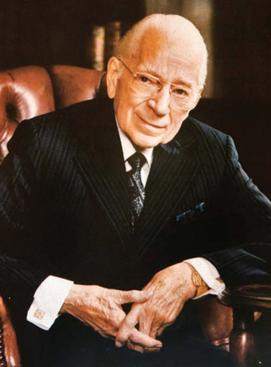
Mr. Herbert W. Armstrong

It’s like Six Degrees of Kevin Bacon, but hopefully a little more meaningful. Ready? I’ll go first.

Who taught me the truth of God? That would be my mom, in the most fundamental sense. Okay, so, who taught her? Her dad, my grandpa. Who taught him? Well, originally, Mr. Garner Ted Armstrong, who my grandpa heard preaching the Gospel on the radio when my mom was a tiny kid. And who taught Garner Ted Armstrong the things of God? His parents—one of whom was, of course, Mr. Herbert W. Armstrong. So, between me and Mr. Armstrong, there are really only four degrees of separation.

Your turn.

Maybe you didn’t grow up in the Church. Maybe you’re here because you saw a telecast, or read a magazine article, or befriended a Church member. But whoever introduced you to the truth of God, the right way of reading His word, I can almost guarantee you that there aren’t more than six degrees of separation between you and Mr. Armstrong—because many were his students.

So yeah—people still talk about him, and will continue to talk about him, because you never forget your Philip. And however any of us came into God’s Church, Mr. Herbert W. Armstrong is our Philip by no more than six degrees.


Thomas White headshot

Thomas White was one of the onsite Living Education students for the 2018-2019 semesters. He also has a Bachelor’s Degree in English. Thomas currently works as an Editorial Assistant for the Living Church of God. According to his wife, he eats pizza in entirely the wrong way.