
Archive for year: 2019
Living Education Students “Church History Timeline” project
In the Introduction to Doctrines class, one of our student groups designed a “Timeline of Church History”. To take a look at their work, just click on the link below!
“Introduction to Church History”
World Ahead – This Week
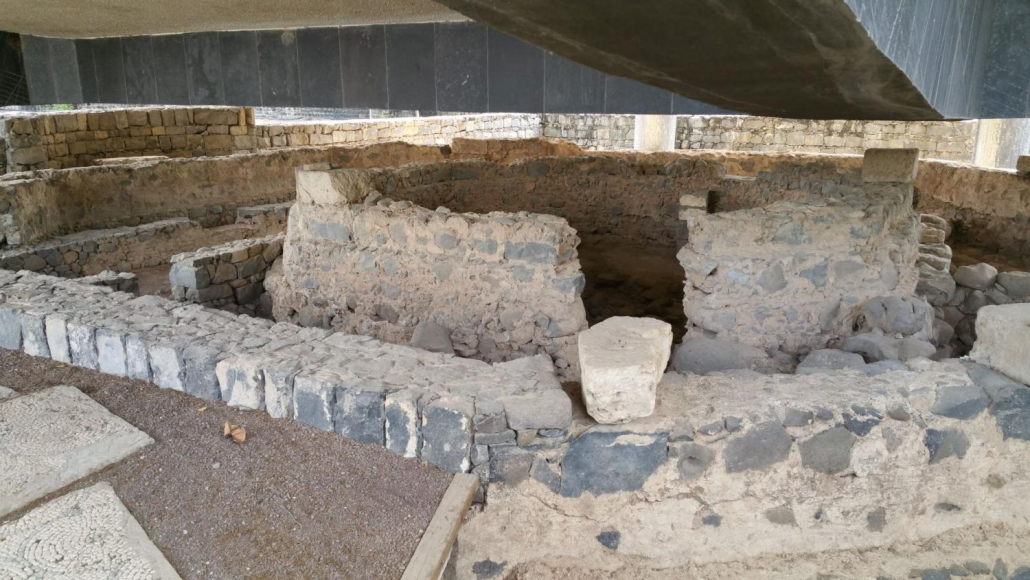
We’ve had almost thirty members express interest in participating in our Living Education Israel Dig and Tour 2020. You still have time to get involved! If you would like to learn more about the requirements and details, just go to www.lcgeducation.org, read about the program and pre-register.
This week, we’re opening registration for our Living Education-Charlotte 2020-21 program year. Living Education-Charlotte is designed as a nine-month intensive training program for young adults who are determined to build a strong foundation for a Godly life. Students gain a comprehensive overview of the Bible through a book by book review, study the fundamental Biblical doctrines that have defined the Church of God throughout history, and the basic principles that frame our Christian way of life. Each day is divided between classroom instruction and work-study within our Headquarters facility. In addition to the daily classroom instruction, students hear twice-weekly lectures on wide-ranging topics, presented by Mr. Gerald Weston, Mr. Richard Ames, Dr. Douglas Winnail, Mr. Mario Hernandez, and a bevy of other leaders, including visiting field ministers from the United States and abroad. Social opportunities to build camaraderie with other young people, field trips to interesting places in the area, and service opportunities round out the experience. If you know a young person who might be a fit for the program, encourage them to contact our admission staff for an application at [email protected]!
Second Thoughts: God Wrote a Book
Author: Thomas White | Editorial Department, Living Church of God
Mr. Gerald Weston’s recent assembly provided a fascinating “speed run” through the Old Testament, noting each book, its highlights, and the affect it has upon the overarching flow of the Bible’s storyline.
He recommended taking a “swiss cheese” approach to the Bible—accept that there are holes in your comprehension of it, but appreciate what you do know, the understanding you have been given, and use that to piece it together and grow in knowledge.
Not an Easy Read

That was encouraging to me, because it can be easy for us to feel like we’re hopelessly ignorant when it comes to the Bible. Growing up in the God’s Church, I’ve heard several people admit to being afraid to talk about the Bible with brethren, because of how “stupid” they think they’re going to sound.
I get it—I’ve felt that way, too. The Bible is a thick, complicated book, and that’s before you get into all the translation issues.
It contains seemingly countless names of people, places, and things, goes into a shocking amount of detail in some places, contains a puzzling lack of detail in others, and just when you think you’re following what’s going on, it whips out a genealogy and fast-forwards a few hundred years. The Bible is beautiful, terrifying, comforting, and confusing, and anyone who claims to have read it cover-to-cover without at least once going, “Wait, what?” is probably lying.
But how could it be anything else? God wrote a book.

Sometimes I have to let that statement sink in. The more you think about it, the more it kind of blows your mind: God, the Eternal Family who knows all that could ever possibly be known, who is intimately aware of truths no puny human brain can even begin to fathom, wrote a book explaining the deepest secrets of life, the universe, and everything—and you and I actually kind of understand it a little bit. I mean, we get the gist! Even though Isaiah and Jeremiah lose us sometimes, Paul’s run-on sentences occasionally leave us blinking perplexedly, and our brains go numb every so often from all the numbers in Numbers, we still recognize characters, principles, laws, examples, and poetry that God Himself wrote.
Grateful for the Chance to Know

That’s not a reason to brag—without God’s Holy Spirit to help, any of us might think Ezra was a name from a Star Wars episode. But if the Lord of the Universe wrote a book and has gifted us with even a cursory understanding of it, we shouldn’t feel afraid to discuss it because we’re ashamed of not knowing it better. We should feel excited to discuss it because we have the chance to know it better. And we should be incredibly grateful to our Creator for whatever knowledge we have of the most important thing ever written.
Truly knowing the mind of God is just about the entire purpose of human life, so we should probably expect it to take a lifetime. Don’t be discouraged by what you don’t know. Be encouraged by what you can know—already, you probably know more than you think.

Thomas White was one of the onsite Living Education students for the 2018-2019 semesters. He also has a Bachelor’s Degree in English. Thomas currently works as an Editorial Assistant for the Living Church of God. According to his wife, he eats pizza in entirely the wrong way.
Second Thoughts: God Likes Technology
Author: Thomas White | Editorial Staff, Living Church of God
No, really, He does.
I mean, not all technology equally—the commonly memorized Isaiah 2:4 makes that pretty obvious. The fact that in His government, people will “beat their swords into plowshares, and their spears into pruning hooks” shows that He’s more in favor of the pruning hook, plowshare, tractor side of technology than the sword, spear, machine gun side.

But to suppose that the Millennium is going to be Henry David Thoreau’s dream come true is to forget how very old the concept of technology is. Even the Bible is a type of technology, since scrolls, codices, and smartphone apps all had to be invented at some point. If God were against technology, it certainly wouldn’t make much sense for Him to use it to preserve and spread His inspired word.
God’s Word Through Tech
Such thoughts ran through my head as Mr. Daniel Guidry, IT Manager at LCG’s Charlotte headquarters, gave his assembly on, among other things, how thoroughly integrated God’s Work on Earth is with technology. Actually, every office I’ve seen in this building has a computer in it—and according to Mr. Guidry, God’s Work is being furthered by the tiny computers we have in our pockets, too, since more than 50 percent of visitors to our websites visit through their phones.
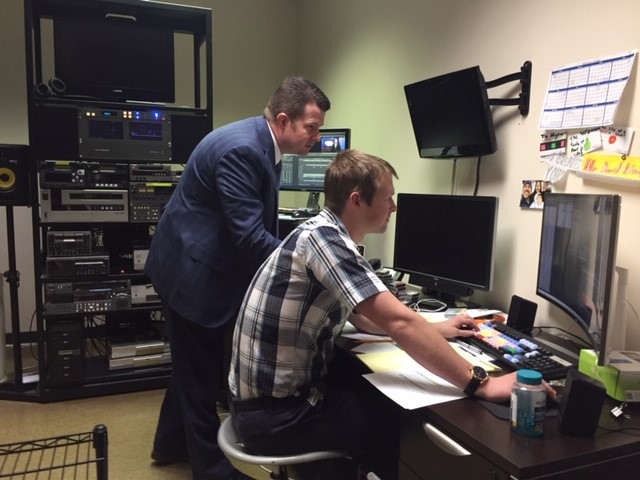
Not only does technology help us to take God’s work further than ever, it also allows us to be even better stewards of it. There was a time when a dog, little knowing the mischief it was doing, could set fire to twenty years’ worth of notes, and that was it: no more notes, unless you went through the time-intensive process of writing them all again. Now, we can upload documents and video files to the cloud, and back up entire databases four and five times over. The Church has backups for its backups, with multiple servers in North Carolina to handle web traffic and a server in Canada specifically for disaster recovery. As Mr. Guidry noted, “If this building burns down tomorrow, we can restore our systems from the Canadian offices and the business can continue.”
Faith and Prudence
More advanced technology usually means more ways of protecting the work God’s people are doing, and while our faith is completely in Him to sustain us and His mission, He’s definitely not against the time-honored trick of having a backup plan. Even David, one of the most faith-driven people to ever live, “chose for himself five smooth stones from the brook… and his sling was in his hand” (1 Samuel 17:40). Did he trust in God to take down Goliath? Absolutely. Was he about to “faithfully” head into battle with nothing but his bare hands? Not a chance. He took, along with his faith, his sling (technology) and four extra stones in case he missed with the first one. Faith works best when accompanied by prudence, and technology makes greater prudence possible.

God uses tech, and He always has. Of course, Satan uses it as well, and we would be prudent to acknowledge that every product of his world, be it comic book, musical instrument, chocolate bar, or IT innovation, may have at least a little of his influence in it. But God’s willingness, even readiness, to use some of those same products for good reveals that at least a little of His influence is behind human invention, too. God likes technology—if we’re using it to glorify Him, of course.
Thomas White was one of the onsite Living Education students for the 2018-2019 semesters. He also has a Bachelor’s Degree in English. Thomas currently works as an Editorial Assistant for the Living Church of God. According to his wife, he eats pizza in entirely the wrong way.
Second Thoughts: Thank God for Personalities
Author: Thomas White | Editorial Staff, Living Church of God

Personality can sometimes be a bit of a touchy subject, since… well, look at the word. Most of it is literally “personal.” Personality is personal, so approaching it as a topic inevitably asks you to look at yourself and wonder, “Is mine okay? What do people think of it? What do I think of it?”
This was the subject Mr. Richard Ames broached in his recent LivingEd-Charlotte Assembly, and he emphasized that while God intended none of us to be unique in character (one’s character being defined by how closely it resembles God’s), He absolutely intended us to be unique in personality.
If you’re like me, that can be a little confusing, so consider the example of the introvert and the extravert. Some would say, “Well, that’s a matter of character, since God wants us to be friendly and sociable,” but that’s really missing the point. Yes, introverts can be perpetually silent and thus spend all of their time either holed up in their bedrooms or creeping people out with thousand-yard stares—but extraverts can also be perpetually obnoxious and abrasive, making everyone around them wish they would just be quiet a second. There’s a dark side to both of these personalities, and whether or not someone falls into it is a matter of character.
More Than One Kind of Sociable
A sociable extravert can make a group feel energized and excited, bringing people together in a lively discussion and making everyone in that group interested in contributing to it. Extraverts gain energy from being around people, so groups are like giant batteries for them. By combining that energy with the character traits of kindness and empathy, they can lead a whole group of people into a genuinely great time, fulfilling and productive work, or even a lively, respectful, enlightening debate. Some of the most fascinating discussions I’ve ever been a part of were begun by sociable extraverts who started things off with, “Hey, I’ve got a question for you guys…”

Introverts don’t do groups. But that doesn’t mean they aren’t interested in people. An introvert spends energy on people, rather than gaining energy from them, so in a group setting, it’s like every individual in that group is taking energy from one source—the introvert is drained faster, and no recipient of that energy is getting very much. That’s why even sociable introverts might be quiet and reserved in group settings—their element is focused conversation where their social batteries can be spent gradually on one individual. A sociable introvert is interested in making a person feel safe, valued, and heard. Some of the most uplifting conversations I’ve ever had have been with sociable introverts who generously spent their energy on me.
The Vast Character of God
Of course, it’s not quite as simple as that—people are deep, and most are way too complicated to just be labeled “introvert,” “extravert,” or even “ambivert.”

But God bestowed an incredible blessing when He made such a range of personalities, enabling His perfect character to be expressed in a variety of ways, ensuring that we would never be an army of righteous robots. Who knows—maybe Christ and the Father even have different personalities. Maybe Christ, as the pre-incarnate Spokesman for the God Family, is more of the extravert, while the Father, as the one we pray to one-on-one, is more of the introvert.
Or maybe not—such things are mere speculation. Regardless, the image and character of God is vast enough to house a multitude of personalities, and we can all be sincerely, deeply thankful for that fact.
Thomas White was one of the onsite Living Education students for the 2018-2019 semesters. He also has a Bachelor’s Degree in English. Thomas currently works as an Editorial Assistant for the Living Church of God. According to his wife, he eats pizza in entirely the wrong way.