Second Thoughts: A Story About Work

“When you’re working hard and productive you’re happy.” – Mr. Gaylyn Bonjour

The Mail Processing Department here at headquarters is a bit like the front lines. Walking into MPD, the smell of fresh paper immediately pervades the senses, as the sight of stacks of crisp new envelopes to be stuffed, the whir of the printer putting addresses onto new cards for the semi-annual or for some other letter or offer, and the mechanical clicking of “Millie” (the envelope stuffer) give the feeling of a busy and productive environment. More than that, there is a certain passionate focus and warmth which brings a certain awareness that here, God’s work continues on. MPD is the last stop for every piece of mail sent out to the world, a fact which requires serious dedication and unity in spirit to do the job properly (as is required of all those who are a part of the work of God).

“There is profit in all labor.”
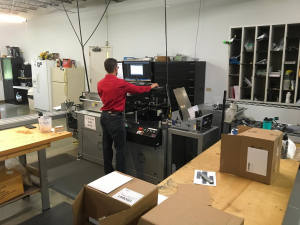
As Mr. Bonjour emphasized, when a person diligently applies himself to his work, there is a certain peace of mind and sense of accomplishment which comes by no other means. Proverbs talks about diligence as being “a man’s precious possession” (12:27) and the man who has it will be blessed (10:4). Doing the work of God requires diligence, and hard work, and there is no exception for the Mail Processing Department. In the words of Darren Brinson, one of the team-members in MPD, “We get to be physical and active, we get to see the names of people subscribing, to interact with members across the world, its cool to be in a facet that touches so many different areas.” Understanding the importance of being diligent in the work, Darren adds: “Whatever area you find yourself in, whether it’s working at headquarters, or being in the field, or a donor, or whatever, there is something important in it, as long as you are a part of it, and have your heart in it.”

“We work together as a team no matter what.”

Those in MPD seem to understand the necessity for teamwork. Many of the tasks in the department have overlap between members of the team. All the members have a function, but they cannot accomplish what they are meant to do without the help of all the other members. “We are in this together,” speaks Donald Matherly on the importance of teamwork, “We have to be able to help one another, and pull other members up.” The body of Christ works in a similar way, as every part of the body has a purpose and a function, yet cannot exist separately from the other parts. God gives different members of the body various roles and talents “…for the equipping of the saints for the work of ministry, for the edifying of the body of Christ, till we all come to the unity of the faith and of the knowledge of the Son of God, to a perfect man, to the measure of the stature of the fullness of Christ.” (Ephesians 4:12-13). God is creating a family, perfecting and molding every piece to perfectly fit together for the fulfillment of His great purpose.


Second Thoughts: What does water skiing have to do with following God?

“Following God is like water skiing” – Mr. Phil Sena

If you have ever been water skiing, you understand the exhilarating feeling of being pulled up out the cold water from the abrupt, powerful tug of the speeding boat ahead of you.

With the spray from the wake hitting your face, the wind whipping against your legs, every muscle tightens to brace against the choppy water under your skis. You feel the urge to pull your arms back against the rope, but knowing that if you try to pull, you will fall, you lock your arms and tighten your already burning grip on the rope handle. You begin to settle into the pace, finding an even balance on the skis, using your knees as shock absorbers to the chop, when without warning, the boat suddenly turns, sending you flying out toward the rough edges of the wake. White knuckled, you allow the boat to pull you over the jagged water, and just when you think you might fall, you are outside the wake, skis skimming smoothly across the calm water. Celebrating this small victory, you relax your grip slightly, perhaps even let go with one hand to wave at the spotter. You would love to stay outside of the wave forever, but inevitably you will have to go back across the choppy water. You once again grasp the rope firmly with both hands to prepare for the quick turn of the boat, which sends you flying across the whitecaps to the other side of the wake.

“Keep your knees bent…be ready for anything, expect the unexpected”

When you ski, you must always keep your knees bent. It helps you absorb the shock of bouncing over the chop. As the water behind the boat is not smooth, similarly life is not always smooth sailing. In life you must learn to take things in stride, and be ready for anything that may come your way. Keeping your knees bent keeps you balanced, and in life being prepared for the unexpected does as well.

“Keep your hands on the rope…Stay tied to God”

The most fundamental way to stay above the water when skiing is to never let go of the rope. In life we can never let go of our relationship with God. We must hold on to Him tightly, for He is our lifeline. He is the One who leads us through the trials and tests that come in life, for if we let go, we will fall. When you are about to cross the wake while skiing, you must tighten your grip to make it across safely. Similarly, when experiencing a difficult trial in life, we must draw closer to God and He will see us through (2 Peter 2:9). As Mr. Phil Sena told the students in assembly, “Stay tied to God, and He will take you through anything that you go through in life.”

*Photos from the Living Youth Program, TX Teen Camp, 2017

LEP Updates: Unit 2…coming soon!

Life, Ministry, and Teachings of Jesus Christ: Unit 1 – Final Lesson Available

The pilot unit for the Life, Ministry and Teachings of Jesus Christ is now fully available to all members.  As an additional feature, once you have completed all the lessons, you can go back and watch or listen to the lectures as part of a “play list”, without having to go through all the lesson material.  Just click on “Conclusion” at the bottom of the menu, and then click “Audio Playlist”, or “Video Playlist”.  Again, you can move at your own pace through the lessons, so enjoy the learning experience!  Our next unit will begin after the Feast of Tabernacles.  The date the first lesson will go live is October 7th.  Happy studying!

– Mr. Jonathan McNair, Director

Second Thoughts: Serving Connections


“When we are members of the God-family, and there are millions and billions of us, we will have connections with certain people because of the relationships we started in this life.” – Dr. Scott

Dr. Scott Winnail told us in this week’s assembly, “Look for opportunities to serve in the local congregation.” No matter the size of our congregation, taking the time to get to know the brethren, to learn what is going on in their lives, we will better understand their needs, thus shining light on the ways in which we can serve them. Serving others can be as simple as mowing an elderly person’s lawn, or reaching out to speak with someone new after services. We can begin to build relationships with each other through even seemingly insignificant actions of service.

“Some of the neatest relationships I’ve had with brethren have actually been made far better by visiting them in hospitals” – Dr. Scott

A man in the local Charlotte congregation was hospitalized several years ago after breaking his back. Dr. Scott made an effort to visit several times while the man was in the hospital. “Our relationship grew from that point,” Dr. Scott expressed thoughtfully, sharing that the connection he had made in those visits lead to the man coming to visit him and his family at home, going out together for dinners, assisting with projects at the man’s home, and even opening the doors for students from Living University to help him out in a variety of ways. While visiting someone in a hospital might seem like a small thing, one simple action with a heart of service can make a lasting impact.

“The relationships we build today…are relationships that will continue forward for eternity. So the friendships we begin to make, at this point in our lives, we’re going to have forever to build on, but starting them is really important.” – Dr. Scott

Dr. Scott reminded those of us attending the assembly that the connections we build today, sometimes through serving, have the potential to last forever. What are some simple ways we can reach out to others in our congregation to build lasting relationships?

Second Thoughts: To Be a Pioneer

“You are pioneers. You will be an example…” – Mr. Gerald Weston

When we begin working on something original, involve ourselves in a brand new project, venture into undiscovered or unknown territory, or even to step out of our comfort zone to be part of something bigger than ourselves, we become adventurers, inventors, pioneers. For the students in this first semester of the Living Education – Charlotte program, they have courageously stepped into the experience, accepting the task as pioneers in a new era of education in the church.


“We didn’t choose a time of entering this world…it was chosen for us.”


Pioneer: (n) “a person who is among those who first enter or settle a region, thus opening it for occupation and development by others.” (Dictionary.com)
While this may be the dictionary’s answer, what does it really mean to be a pioneer? What kind of responsibilities does pioneering require?


Addressing the fourteen, on-campus students of their involvement with the brand-new Living Education Program, Mr. Weston began, “I am going to explain to you the importance of your pioneering experience.” He continued by describing his experiences, and observations from his time at Ambassador College in the 1960’s. He related the lessons he learned there, to take care of others, of carefully following instructions and working within designated parameters, to carefully prioritize, and to dress professionally and modestly, in order to inspire the students to be mindful of how they conduct themselves as pioneers of the program.

“What we want to do here at Living Education is to be part of creating a culture of purity, honor and respect…a culture means more than one person.”

Mr. Weston encouraged the students to embrace and help establish good traditions at Living Education such as to enjoying Friday night dinners, building good habits of prayer and study into your daily routine, exemplifying of a high standard of living to your neighbors by keeping care of your property. To be an excellent pioneer means humbly embracing the role, developing a personal honor code, and understanding that a pioneer’s example continues far beyond the time they perform the part.


Books mentioned:
Dress for Success” John T. Malloy
When Character was King” Peggy Noonan

Living Education Update – Unit 1

Life, Teachings and Ministry of Jesus Christ, Unit One
This is a big “thank-you” to those who have patiently navigated the enrollment process for our first online unit.  If you are still having difficulties, please start by going to our Frequently Asked Questions (FAQ) menu on the front page of our lcgeducation.org site.  This page lists the answers to many questions you might have about how to use the system. If you can’t find the answer there, just send an email to [email protected] and we’ll try to help you out. Hopefully, you’ve found the lectures and supporting material beneficial.  Perhaps we’ve even provided some food for thought and conversation on the Sabbath with our discussion and study questions and “Learn More” components. Happy studying!
– Mr. Jonathan McNair, Director

Second Thoughts: Christian Discipline by Making Your Bed?

From Left: Collin Winnail, Tressie McNair, Mr. Richard Ames, Francesca Rodino, Thomas White

Yesterday, the Living Education students had the opportunity and privilege to hear Mr. Richard Ames speak at our weekly assembly. He based the title for his speech “Make Your Bed and Practice Godly Discipline” from Admiral William H. McRaven’s #1 New York Times Bestseller, “Make Your Bed: Little Things That Can Change Your Life…And Maybe the World”. Mr. Ames expounded on McRaven’s first two principles, discussing how beginning each day with a task completed, and making your bed every morning demonstrates discipline in your life. He explained the relevance of these principles for the on-campus students, illustrating with personal examples the disciplinary benefit of implementing even such a simple task as making your bed into your daily routine.

Read more

We Have Lift-Off!

This week is the kickoff for both our online and on-campus programs! A great deal of effort has been made by a team of people to get these programs off the ground – many of whom are behind the scenes and contribute one crucial component or another, then go about their normally assigned duties.  The ultimate goal is to serve you and your congregation, with the help of your elder and pastor.
To that end, there will be a webinar for all pastors and elders on this Thursday evening, August 16th, from 7pm to 8pm. EST titled “Keys to Implementing Living Education in your Congregation”.  Pastors and elders, please check your email inbox for more details. This session will help our pastors and elders to answer questions and plan to adapt the material to local needs. 
Here in Charlotte, fourteen young adults enjoyed orientation sessions and their first three days of classes, as they jumped right into the rhythm of learning a “better way of life”. With an “all-employee” welcome lunch and then a dinner hosted by Mr. and Mrs. Weston at their home on Monday, our group of seven men and seven women is set to begin the school year.
– Mr. Jonathan McNair
Director, Living Education

Living Education-Charlotte Orientation Schedule

Today we welcome our new students!

If you’d like to review the Orientation Schedule, just check it out below…


Who is the online program for? Are there age restrictions?

The online program is for members and attending prospective members of the Living Church of God. There are no age restrictions beyond the ability to read and study the Bible.

Internet access, an individual email address and a MyLCG account are required.