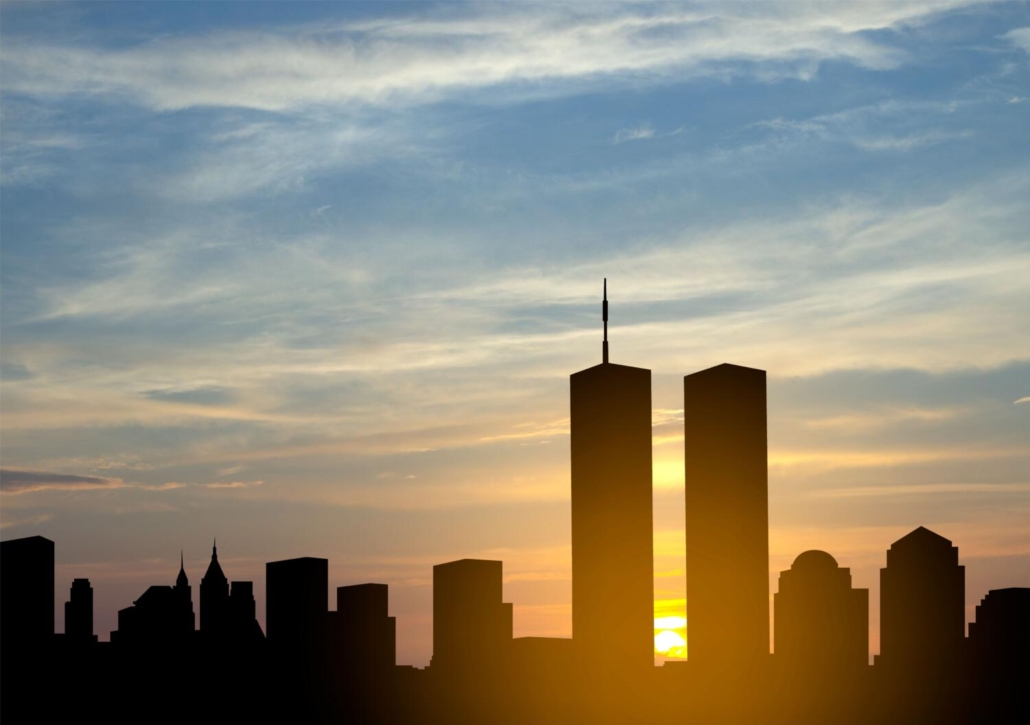
Mr. Wayne Tlumak: “Remembering the Events of 9/11”
These posts summarize the forums that our Living Education-Charlotte students attend each week.
This year marks the twenty-fifth anniversary of 9/11, a sobering attack that caused the deaths of roughly 2,977 victims in the US. Reflecting on the event, Mr. Wayne Tlumak, a New York City native who was living in New York when it occurred, reflected on what took place on September 11th, 2001.
“That Day”
The 9/11 attack started on a Tuesday morning, in the skies above a bustling New York City. It was another average day in the US, or so some would have thought. But around 8:46 am, a commercial passenger plane suddenly came out of the air and hurtled toward the World Trade Center. It was American Airlines’ Flight 11, and it was not going to change course. In seconds, the aircraft slammed into the North Tower, crippling the building’s structure. “I was actually on the phone with the local police station when the first plane hit,” Mr. Tlumak shared. He heard the commotion through the call and got confirmation of what was happening. At first, it seemed like the crash could have just been a horrible accident. Soon after, though, the South Tower followed, hit by United Airlines’ Flight 175. The United States was, indeed, under attack, and the Islamic terrorist group Al Qaeda was to blame.
At 9:37 am, AA Flight 77 then crashed into the Pentagon, causing further nationwide panic. A fourth plane was expected to follow, heading toward the White House. Though, just before that tragedy could happen, passengers of that aircraft took control, and the final plane fell onto an open field near Shanksville, Pennsylvania.
“The World Trade Center”
Three decades earlier, a massive project began to construct what would become the later-destroyed World Trade Center. Unlike the wedding-cake tier design of most skyscrapers, this one was built to sway with the wind. Instead of a large base compared to its top, the landmark was uniform in size from floor to floor. Its structural beams, too, were placed on the exterior versus inside, making it especially vulnerable when the airplanes hit. One hour and 43 minutes after impact, the two twin towers that made up the World Trade Center collapsed, its five surrounding, smaller towers imploding along with them.
“A Nation Affected”
After that situation in New York and after it was fully realized, those in and around the World Trade Center fled for their lives. People escaped eastward to Brooklyn, or west, where they were ferried across the Hudson River by every type of watercraft. The largest maritime evacuation in history took place then. The city immediately shut down all subways, tunnels, and roadways, stopped air traffic, and canceled flights. Quickly, helicopters arrived at the scene, but were blocked from helping any victims trapped on the roof of the Trade Center by the draft coming off the burning buildings. Regarding the Trade Center, Mr. Tlumak said, “Every single police officer was sent there.” Besides the constant ringing of sirens, the city was utterly silent.
By the end of it all, the World Trade Center was not the only place affected by the two plane crashes. Surrounding offices, shops, and restaurants were left half-broken, soot smothering their walls from the fires raging within the towers. And all inside the airplanes died, too. When Mr. Tlumak walked through the city afterward, he noticed that “Everything was locked down. You couldn’t even get into the city unless you had special credentials.” At the time, he had official status as part of the New York City Housing Authority. His agency was tasked with removing debris from affected sites. All night, assigned employees labored to clear streets so firefighters and rescue workers could keep working to find victims.
The situation could have been far more catastrophic, though. The sea wall beneath the Twin Towers, protecting them from the Hudson River, could have very well collapsed, sending floods throughout the New York City subway system and potentially killing millions had the planes hit the World Trade Center at a lower floor. Even more so, the aircrafts could have hit the buildings at a later time of day, and if they had, many more would have been inside. In fact, Mr. Tlumak was scheduled to go in himself for a meeting just an hour after the crashes. Had the attack taken place then, he, along with thousands more, would have died.
“Since Then”
Thankfully, 9/11 did not become the worst-case scenario, but it did pose a great national tragedy for the country at that time. Following the attack, many Americans lost trust in the US government, though for a short time immediately after, they were able to unite. Fearing a repeat, the government introduced many new national security measures. These included the Patriot Act and the creation of the Department of Homeland Security. Today, still, a majority of Americans have little faith in their country. They recognize even more that the US could be struck by terrorists once again. Now, with advanced weapons, such an attack could be far deadlier.
Author: Mary Wissinger | Living Education