
Children’s Bible Program – Level 3: Lesson 17 “Israel Rebels in the Wilderness”

  Sweet Publishing | FreeBibleImages.org

By Janth English

Read Together:  As God delivered Israel from Egypt, they witnessed miracle after miracle! The children of Israel walked through the Red Sea on dry land with walls of water on both sides. They watched the Egyptian army get swallowed up by the Red Sea as God allowed the water to crash down on them. But they still complained to God!  When they had no water, they complained. When they had no food, they complained again. It’s understandable that they were hungry and thirsty, but instead of asking God for help, they accused Him of bringing them out into the wilderness to die. Again and again, they said “Let’s go back to Egypt”. When Moses went up to the top of Mt. Sinai to receive the Ten Commandments from God, the Israelites made a golden calf to worship. They bowed down to it and called it their god, even though they had just promised to obey the real God who had brought them out of slavery! When Moses sent the spies to scout the land of Canaan, they came back with a bad report even though the land was full of delicious fruit. All the spies, except Joshua and Caleb, said they should not enter the promised land because they saw the giants who lived there. They had no faith that God would deliver them, so the people refused to go in and inherit the land God had promised.  For this, and for all their constant complaining and faithlessness, God sentenced them to wander in the wilderness for forty years. This was one year for each day the spies were in Canaan, until everyone of that generation had died.

Read Together:  Ex. 15:19-24, 16:2-4; Num. 11:1-10; Ex. 32:1-8; Num. 13:17-33, 14:1-4, 26-35

Discuss:

  • Point out to your child that three days after Israel came through the Red Sea they were complaining about water.  Israel had forgotten God’s power very quickly.  Discuss why this would happen.
  • Have a discussion with your child about faith. The Israelites knew God was real, but they lacked faith.  Israel proved that witnessing miracles does not guarantee faith. Include James 2:18 in the discussion.
  • Talk with your son or daughter about the Israelites’ tendency to complain.  Do we have the same characteristic?  How does God feel about complaining?  What is the antidote for complaining?

Review Memorization:

Deut. 30:15-16  “See, I have set before you today life and good, death and evil, in that I command you today to love the Lord your God, to walk in His ways, and to keep His commandments, His statutes, and His judgments, that you may live and multiply; and the Lord your God will bless you in the land which you go to possess.”

Printable PDF – L3.17

Children’s Bible Program – Level 2: Lesson 17 “Abram Leaves for Canaan”

Sweet Publishing | FreeBibleImages.org

By Janth English

Read Together:  Abram was born 292 years after the flood. His family lived in a city called “Ur”, which was in the area of modern-day Iraq.  He was the youngest son of his father Terah whose ancestor was Shem. Abram married his half-sister Sarai, but they did not have any children. Terah left Ur for Canaan and took Abram, Sarai, and Lot, his grandson, with him.  The family stopped for a while in Haran where Terah died. Abram had become very wealthy in Haran. By the time he was 75 years old, he owned livestock, and had silver, gold, and many servants. This would surely have made it hard to leave Haran. But God commanded Abram to leave his home and go to a distant land that He would show him. In return for his obedience, God promised to make Abram’s descendants a great nation. Amazingly, Abram immediately obeyed God. He simply took his wife, his nephew Lot, and all their possessions and left his home for good.

Read Together: Gen. 11:24-32; 12:1-10; 13:2-4

Discuss:

  • Explain to your child that it was not uncommon for people to marry close relatives in Abraham’s days.  Remind him/her that everyone was closely related after the flood because only one family survived. God later commanded the Israelites not to marry close relatives (Lev. 18:6-17).
  • Discuss with your son or daughter how difficult it must have been for Abram and Sarai to pack up and move to a place that they did not know.  There were no trucks or vans to move them and no hotels along the way. Ask your student what might have been some of the hardships Abram and Sarai could anticipate on their journey.
  • Abram must have known how hard his journey would be. Still, he did not argue with God. He just obeyed what God told him to do. Talk with your child about Abram’s character. Highlight the good example that Abram showed when he obeyed God immediately.
  • God promised Abram that he would become a great nation, but that promise was not fulfilled right away.  Explain to your student that obedience to God must come first before we receive any rewards.

 Review Memorization:

Heb 11:8 NKJV “By faith Abraham obeyed when he was called to go out to the place which he would receive as an inheritance. And he went out, not knowing where he was going.”

Printable PDF – L2.17

Second Thoughts: Don’t Be Chained to Your Thing

An essay on Mr. Richard Ames’ Student Assembly titled, “Expand Your Horizons”

by Thomas White, LivingEd-Charlotte

“There are times for meditation, and of course, for recreation, but…have discipline and…broaden your horizons.” ~ Mr. Richard Ames

Most of us have a Thing. You know the one. That Thing that checks all the boxes – you’re good at it, it’s good for you, and you love doing it. It’s good to have a Thing. After all, without anything to make our individual lives exciting and fulfilling in unique ways, we might as well be automatons. But God made an awful lot of Things, and He made each human being versatile enough to fit a lot more than one. In the assembly this week, Mr. Ames spoke about the importance of expanding our horizons, disciplining ourselves to continuously grow into more multifaceted Ambassadors for Christ.


“How do you expand your horizons? … One of the ways is through various hobbies and various interests.”

Another amazing aspect to us humans is that we can get excited about almost anything, given time and exposure. Now, this has a ton of downsides we have to be aware of, so as to avoid joining those who trick themselves into caring about what a random celebrity wears to a random place. But a major positive aspect to this is that if you think you could never possibly be interested in a potential new hobby, learning more about it will probably fix that. Nothing has to replace your Thing. Just don’t trap yourself into making your Thing your only Thing. Love reading? Maybe you can give mountain climbing a shot, too. Really into sports? You could try learning to draw after you’ve hit the showers. You never know what will give you a sense of unexpected fulfillment, and contrary to popular belief, you’re totally allowed to love doing something that you’re not actually all that naturally talented in. God might not intend for you to have a career in it, but that’s no reason not to do it for fun.

“Why do you [expand your horizons]? To make you a more effective ambassador for Christ, [who] can relate to people.

The more things we like to do, the more common ground we’ll find with others. And as Mr. Ames said, the more versatile we are, the more effective we can be as Christ’s Ambassadors. God made a lot of people, and almost all of them have passions they love talking about. Being able to talk to many different people, about many different things, can improve the light in which people see you, and improve the light in which they see “that Church you’re in.” It’s good to have a Thing, but as Mr. Ames showed, it’s even better to have many.

Children’s Bible Program – Level 3: Lesson 16 “God Explains the Statues”


Moody Publishing | FreeBibleImages.org

By Janth English

Read Together: Israel was so afraid when they heard God speak the Ten Commandments that they asked for Moses to relay God’s words to them. God agreed. In addition to the Ten Commandments, God gave Moses “statutes.” Statutes are laws that apply to more specific situations. They help us understand how to apply the Ten Commandments in everyday life. God’s laws and statutes were designed to provide Israel a fair and just legal system that would protect people and property. When Jesus came to earth, He supported the laws of God, including the statutes, and taught His disciples about how to keep them in our heart and mind.

Read Together: Deuteronomy 4:1–10; Exodus 22:5, 14, 28; Exodus 23:1–17; Leviticus 23:1–3; Deuteronomy 4:1–10; 22:8.


Discuss:

  • Explain to your student that the statutes are finer points to God’s Ten Commandments. For example, the Ten Commandments command us to keep the Sabbath, but the statutes explain there are “annual” Sabbaths as well (Leviticus 23:1–3).
  • Read, with your child, Exodus 22:28. Ask your child if he or she ever hears people “cursing” or making fun of leaders today. How would this statute guide a child to behave toward his or her parent or teacher?
  • Ask your child what the following statute means: “You shall not follow a crowd to do evil” (Exodus 23:2). Can he or she think of a time when they’ve had to resist following others to do something they knew was wrong?
  • With your child, read the statute in Exodus 23:4. Ask him or her, “Why would God want a person to bring back the animal of their enemy? Would that kind act possibly help them to be friends again?”
  • Ask your child what the statute in Deuteronomy 22:5 means. Ask if they can see how that could apply in our world today (when some are confused about gender).
  • Ask your child why God would make the statute in Deuteronomy 22:8. Would it not protect people from accidents?


Review Memorization.

Exodus 20:1–17 – The Ten Commandments (long form)

Printable PDF – L3.16

Printable PDF – L3.13-L3.16

Children’s Bible Program – Level 2: Lesson 16 “Nimrod’s Legacy”

Sweet Publishing | FreeBibleImages.org

By Janth English

Read Together: The Bible portrays Nimrod as an evil man, and we still see the effect of his evil influence today. Nimrod is the first recorded leader to organize people into city-states so that he could rule over them. He was a proud tyrant who was openly rebellious toward God. Nimrod built the city of Babel, and led the effort to undermine God’s plan for people to spread throughout the earth, building a tower that reached to the sky. Many historians trace the pagan traditions that are part of all of the world’s religions today back to this very city. People who are really following God avoid these traditions, even if they are mixed with a worship of Christ. Instead, God’s people keep His Sabbath, Holy Days and other commands.

Read Together: Genesis 10:8–12; 11:5–9; Revelation 17:5; 18:1–2.

Discuss:

  • Ask your child what are some wrong traditions that people in the world’s churches observe?
  • Explain that many modern church traditions of the world started a long time ago. (You may wish to refer to the booklet, “Satan’s Counterfeit Christianity,” pp. 8–10, https://www.tomorrowsworld.org/booklets/satans-counterfeit-christianity).
  • Ask your child, who is really behind the false traditions and religious deception of the world? (Reference Revelation 12:9)
  • Explain to your child that the Bible shows that end-time religious deception (“Babylon”) is just a modern version of traditions started long ago (the city of “Babel”). (Reference Genesis 11:9 and Revelation 17:5; 18:1–2)
  • Explain to your child that we can only understand God’s truth because He opens our mind and helps us not be deceived (John 6:44, Matthew 13:11).
  • Ask your child what about God’s way of life are they most thankful for?

Review Memorization.

Genesis 11:9 “Therefore its name is called Babel, because there the LORD confused the language of all the earth; and from there the LORD scattered them abroad over the face of all the earth.”

Printable PDF – L2.16

Printable PDF – L2.13-L2.16

Children’s Bible Program – Level 3: Lesson 15 “God Speaks the Ten Commandments”

Sweet Publishing | FreeBibleImages.org

By Janth English

Read Together: The children of Israel had been busy preparing to come before God for three days. As God approached the mountain, there were thunder and lightning strikes; the mountain quaked and the ground where they stood shook. There was an awesome display of God’s power as He descended to the mountain! Even Moses, who had been in God’s presence before, was so afraid that he too trembled! The top of the mountain looked to be on fire as God thundered the Ten Commandments from its midst. The display was to show the Israelites how mighty and powerful God is, so that they would remember and obey Him. Sadly, the Israelites were so overwhelmed by the power of God that they pleaded with Moses to ask Him not to speak to them directly anymore, because they feared they would die. God asked the Israelites to keep the Ten Commandments so He could bless them, and they agreed.

Read Together: Exodus 19:12–25; 20:1–26

Discuss:

  • Explain that the Ten Commandments are still in effect today (Matthew 5:17–18).
  • Why is the Sabbath Commandment important?
  • Explain that the Ten Commandments were given by God for our good; they are not a burden (1 John 5:3).
  • Discuss the beneficial effects of the Ten Commandments. What would the world be like if no one told lies, or if no one took what didn’t belong to him or her? How would the world be transformed if everyone put God first and loved Him?
  • Discuss the relationship between obedience to the Ten Commandments and the peace humanity desires. Help your child understand that it is breaking God’s laws that leads to the unhappiness mankind experiences. Use an example like stealing or lying to demonstrate this.

Review Memorization.

Exodus 20:1–17 – The Ten Commandments (long form)

Printable PDF – L3.15

Children’s Bible Program – Level 2: Lesson 15 “The Tower of Babel”

Sweet Publishing | FreeBibleImages.org

By Janth English

Read Together: The city of Babel was the beginning of Nimrod’s empire, and the beginning of mankind’s post-Flood attempt to govern himself apart from God. Nimrod led the people to build a very tall tower in rebellion against Him. But God was not pleased with their actions, so God decided to confuse the people’s language. They couldn’t share ideas and so they weren’t able to keep working on the tower. The word “Babel” itself means confusion, and you can imagine what happened when God confused the languages. Only those who spoke the same language could understand each other, and God divided the languages along family lines. People stayed with those they could understand, and they began to settle in their own territories as God wanted them to. Needless to say, work on the tower ceased. The Tower of Babel was never completed, but the attitude of mankind’s rebellion against God continues to this day.

Read Together: Genesis 11:1–9

Discuss:

  • Ask what the people of Babel did to show their defiance toward God.
  • Ask your child to imagine working on a group assignment when suddenly he or she could not understand anything other members of the team were saying. Would they be able to work together as a team? This is the same situation that occurred in Babel when God confused the languages.
  • Point out to your child that God wants people to communicate and understand one another. This is why He will restore a pure language to mankind in the Millennium (Zephaniah 3:9).

Review Memorization.

Genesis 11:9 “Therefore its name is called Babel, because there the LORD confused the language of all the earth; and from there the LORD scattered them abroad over the face of all the earth.”

Printable PDF – L2.15

Second Thoughts: Set a Guard Over My Keyboard

By Thomas White, Student at LivingEd-Charlotte

“The social media in the Work is a good thing, a very good thing, and it’s reaching a lot of people that we might not normally reach. Rightly used, social media are very helpful to millions of people in their daily communications…we should learn as much as we can, and then apply it, and then act with knowledgewhen we’re using social media, either for the Work, or for other, personal use.” ~ Mr. Dexter Wakefield

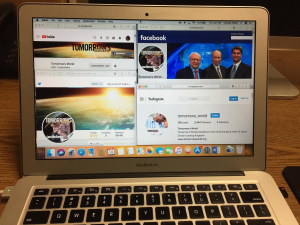
This week, Mr. Dexter Wakefield’s thought-provoking assembly informed me that God’s Church is actually more active on social media than I am, and I consider myself a fairly hip millennial. (That was a joke. Please never say “hip” to millennials.) The Living Church of God is on Facebook, YouTube, Twitter, and Instagram, and as Mr. Wakefield pointed out, there’s a very good reason for this.  “Of the four main platforms that we use,” Mr. Wakefield revealed, “we have over 700,000 followers.” He went on to say that approximately 171,000,000 minutes of Tomorrow’s Worldand Living Church of God video have been watched on YouTube. Even if you avoid social media like the plague, you have to admit that this is exciting! As God used radio to proclaim His message in Mr. Armstrong’s day, He’s now using social media and the broader internet to proclaim that same message in ours.

“Anonymity has its perils. … There’s a huge amount of money associated with social media activity, and if you’re going to avoid being taken advantage of, it’s essential that you act with knowledgewhen engaging with such media.”

But like sugar, alcohol, and croquet mallets, social media can be incredibly dangerous if used inappropriately, and Mr. Wakefield did not shy away from addressing its dark side. He described the “Social Validation Feedback Loop,” which is essentially the addiction that develops when we feel internet-popular. I’ve experienced it myself; if I post on Facebook, and people start “liking” that post, the amount of time I spend on Facebook skyrockets. It feels good to be liked, and the minds behind Facebook, Instagram, YouTube, and Twitter are well aware of this. They want us to spend every evening entranced by our phones, because for them, that’s advertisement revenue. As Mr. Wakefield repeatedly and poignantly said, we have to act with knowledge (Proverbs 13:16), with an awareness of how God wants us to spend our time. Do we apply the principle of moderation to our screen-fueled socializing?

 “People behave differently when they are anonymous. … They’ll do hurtful things when they’re anonymous. … And how much more so when they’re typinganonymously? … When you use social media to communicate, just be sure you act with knowledge…”

If a random person on the street walked up and said, “Hi! Let’s be friends”, I would naturally be a bit suspicious. If that person wore a ski mask, I would be more suspicious, and probably run. As Mr. Wakefield pointed out, social media makes it possible for people to try to gain your trust while wearing fabricated identities as their ski masks, so socializing with people you’ve never met offline is usually a bad idea. Acting with knowledge means being careful about who we believe online, as well as being careful about what we put there. “Set a guard, O LORD, over my mouth,” reads Psalm 141:3, and today, as Mr. Wakefield said, “mouth” could just as easily be “keyboard.” The internet is a mixture of good and evil, and if we act with knowledge, God can keep us from the latter.



Children’s Bible Program – Level 3: Lesson 14 “God and Israel: A Marriage Covenant”

By Janth English

Read Together: Have you ever been to a wedding? Think back to the ceremony and the wedding vows. You may remember that the minister asks the groom if he is willing to be a faithful husband. That means, is he willing to provide for, protect, and cherish his soon-to-be wife. In the same ceremony, the bride is asked if she is willing to love, honor, and obey her soon-to-be husband. They both must answer “I do” or else they don’t get married! And when they say “I do,” they have entered a covenant, which is a solemn promise to do what they said they would do. When you read Exodus 19:3–8, you can see that God proposed to take care of Israel in response to her obedience. If Israel would obey, God promised prosperity, peace, and safety. When all Israel said, “I do,” they promised to obey God. But sadly, they did not keep that promise. However, that is not the end of the story! Today, the Church is the “Bride of Christ,” which is preparing to marry Jesus at the resurrection. That means that each person, when baptized, agrees to enter into a marriage covenant with Christ (meaning, to honor and obey Him). In return, Jesus Christ, as the Church’s Husband, promises to love and faithfully care for each member of His Church. The marriage between Jesus Christ and the Church will take place at the resurrection, just before the Millennium begins. As all brides do, we look forward to that glorious event!

Read Together: Exodus 19:5, 8; Leviticus 26:1–6; Jeremiah 3:14, 20; Ephesians 5:31–32; Revelation 19:7–9

Discuss:

  • Discuss with your child the relationship between Jesus Christ, who was the God of the Old Testament (1 Corinthians 10:4), and ancient Israel. Did God perform His duties? How did ancient Israel respond?
  • Discuss the relationship with Jesus Christ and the Church. Show how it is an intimate family relationship. Use this as an opportunity to discuss the roles of fathers, mothers, and children in the family.
  • Explain that if your child is old enough to be baptized before Christ returns, he or she will have the opportunity to be part of the bride of Christ, too.

Review Memorization: Exodus 20:1–17, The Ten Commandments (long form)

Printable PDF – L3.14

Children’s Bible Program – Level 2: Lesson 14 “Nimrod’s Kingdom”

The Bible Journey – thebiblejourney.com | FreeBibleImages.org

By Janth English

Read Together: The people began to put their faith and trust in Nimrod, and Nimrod began to feel very proud of himself. The name Nimrod can mean “rebel,” and Nimrod was truly a rebel. Nimrod is known in history to be a ruler who turned people from the true worship of God and caused religious confusion. According to some historical sources, he began to gather people together in cities rather than encouraging them to spread out over the earth as God wanted. Initially, the reason for keeping people together might have been for protection. But it soon became clear that Nimrod wanted the people together so he could be a powerful ruler, and he became a cruel tyrant over them. Nimrod set out to establish a world-ruling kingdom and his first city was Babel. He also founded Erech, Accad, and Calneh in the land of Shinar which is near modern-day Iraq. He also took lands in Assyria that were occupied by the descendants of Shem, which included Nineveh, Rehoboth Ir, Calah, and Resen. This was likely not done peacefully, and it is probable that Nimrod introduced war again to the human family after the Flood.

Read Together: Genesis 10:6–12

Discuss:

  • Help your child identify ways in which history suggests Nimrod rebelled against God.
  • Nimrod was born in the third generation after the flood. Discuss with your child how short the time was before mankind forgot the lessons of the Flood. This is a good opportunity to discuss the fact that people who don’t learn from their mistakes are often doomed to repeat them.
  • Nimrod was a “mighty hunter” who helped the people in the beginning. But history says he had pride and credited himself for his accomplishments. Ask your student how humility might have helped Nimrod. Take this opportunity to talk about servant leadership.

Review Memorization:

Genesis 11:9 “Therefore its name is called Babel, because there the LORD confused the language of all the earth; and from there the LORD scattered them abroad over the face of all the earth.”


Printable PDF – L2.14