Author: Katelyn Wissinger| Student, Living Education – Charlotte, 2025-26
The Living Education students hosted a disc golf activity at the Church picnic on a mild Sunday morning in early November to serve the local Charlotte congregation. Church members who wanted to participate were split into groups and led around the disc golf course by students at the park where the picnic was being held. Both families, young adults and older members, joined in. There were participants of many different skill levels; however, everyone enjoyed themselves, and all were rewarded at the end with homemade chocolate chip cookies made by students. Hosting a disc golf activity at the picnic is just one way that students of Living Education can get involved in the local area and get to know their brethren better.
Author: Katelyn Wissinger| Student, Living Education – Charlotte, 2025-26
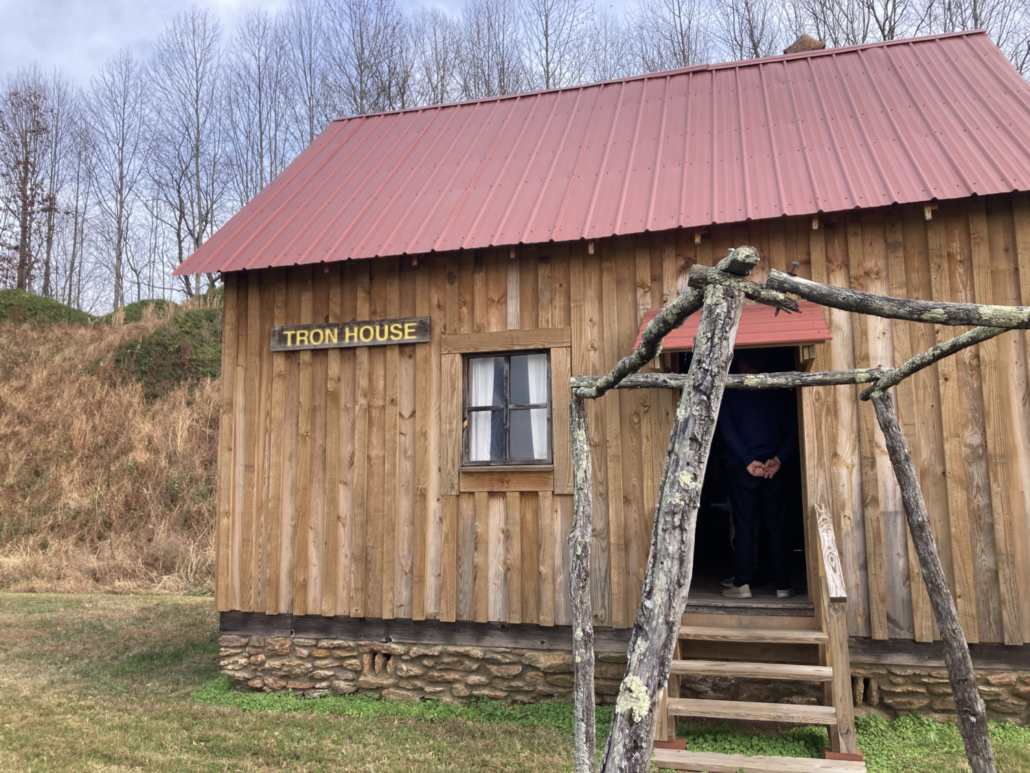
On November 19 the Living Education students along with faculty went on a field trip to the Waldensian Trail of Faith in Valdese, NC to learn more about Church history. The Waldensians were a group of Christians who the Living Church of God considers to be part of the Thyatira era of the Church mentioned in Revelation 2:18. They kept several of the true teachings from the Bible, such as the Sabbath, and faced much persecution as a result. The students toured the outdoor trail that included replicas of important buildings and monuments in Waldensian history and the second years gave speeches on several of these. This field trip broadened the understanding of this specific time period in Church history that that first year Living Education students had just been learning about in their Biblical Doctrines class.
Home of a Waldensian FamilyGheisa d’la TanaBarbi College
https://www.lcgeducation.org/wp-content/uploads/2025/11/Group-shot.jpg11251500Katelyn Wissingerhttps://www.lcgeducation.org/wp-content/uploads/2021/02/logo_basic-website-300x94.pngKatelyn Wissinger2025-11-25 14:02:542025-11-25 14:02:56Field Trip: Waldensian Trail of Faith
Author: Katelyn Wissinger| Student, Living Education – Charlotte, 2025-26
The Living Education ladies baked pumpkin spice loaves and muffins in a recent life roles class in the Church HQ kitchen to learn how to read a recipe and to serve their local neighbors by their dorm. The students used a well-loved recipe of Mrs. McNair; she explained to them how to make substitutions, such as honey to replace sugar and walnuts instead of dates or raisins. Gift boxes were put together along with cards, and the baked goods were carefully placed inside. When the ladies returned to their dorm at the end of the day, each one was assigned to a neighbor’s house to gift their pumpkin spice loaves. Gifting handmade baked goods was an opportunity to show goodwill towards the neighbors and help them have a great Thanksgiving!
https://www.lcgeducation.org/wp-content/uploads/2025/11/page-1.png13501080Katelyn Wissingerhttps://www.lcgeducation.org/wp-content/uploads/2021/02/logo_basic-website-300x94.pngKatelyn Wissinger2025-11-24 12:36:222025-12-04 14:59:13Women’s Life Roles: How to Read a Recipe
These summaries are written to give our audience an idea of the special forum messages our students have access to as part of the Living Education-Charlotte program.
In a recent forum delivered to this year’s Living Education students, evangelist Dr. Douglas Winnail, who serves as the Director of Church Administration, spent time relating the history of the Church of God through the ages. As a longtime minister who has been director of the ministry for around 20 years, Dr. Winnail presented a full and comprehensive view of the Church’s history, and emphasized how important it is that we understand what we are a part of.
The Church in the Wilderness
Some modern Christians may not realize that the heritage of the Church goes back long before the time of Christ. 1 Corinthians 10:3-4 states (referring to ancient Israel) that they “all ate the same spiritual food and all drank the same spiritual drink. For they drank of that spiritual Rock that followed them, and that Rock was Christ.” The ancient nation of Israel was the original Church of God, founded at Sinai.
Dr. Winnail pointed out that the laws God gave to His people were different than the nations around them—they laid the groundwork for a unique, godly culture. God’s law reflected what was important to Him—the value of human life, the importance and role of women, and principles of love, mercy, and justice, which were absent in most pagan cultures. These same principles and laws laid out in the Old Covenant were the groundwork for the New Covenant established by Christ. While the pagans around them practiced debauched rituals, the Israelites were meant to be different—and their Scriptures left laws and ideas that changed the world.
Jesus’ Teachings
Jesus stated in Matthew 16:18 that the gates of hell would not prevail against His Church—in other words, it would continue to exist in spite of challenges. The New Testament has preserved the fundamental doctrines of the early Church in detail, and as we attempt to trace the Church down through the ages, we are able to identify important characteristics. The New Testament calls it “the Church of God”—a consistent moniker. The Church believed in the coming Kingdom of God, the Messiahship of Jesus, Sabbathkeeping, the validity of the commandments, and other important doctrines. The Church also has the mission to preach the Gospel and to share a warning message to the Israelite nations.
What Happened to the Church?
We know from Jesus’ own words that the Church would continue to exist—so why does its history become so murky after the 1st century AD? As the Ephesian Era came to a close toward the end of the 1st century, heresy was beginning to creep in. With the death of the early apostles and the transition to the Smyrna Era, God allowed the Church to drift toward apostasy and experience persecution. The end of the Smyrna era saw the rise of the Catholic religion become the dominant religion of the Roman Empire under Constantine.
Throughout the Middle Ages, the false Catholic Church consistently persecuted the scattered remnants of the true Church, who kept hold of the truth. Across Europe and elsewhere, there are historic reports of Sabbathkeeping groups who were persecuted viciously—the Vaudois, Paulicians, Bogomils, Waldensians, and others. The eras of the Church laid out in Revelation can be traced to specific periods in recorded history.
The Church in America
As the Middle Ages came to a close, we find Sabbathkeepers were relatively prominent in Western Europe and Britain. Many of these individuals began to migrate to the United States, founding churches, schools, and communities. This was the time of the Sardis era, which in turn set the stage for the Philadelphian era to become so impactful. As Sabbathkeepers moved west in the United States, they brought with them important doctrines that were preserved down through history.
The Philadelphia Era
It was around this time that Mr. Herbert W. Armstrong came into contact with members in Oregon. Joining their fellowship, he would be ordained an elder. As time went on, Mr. Armstrong came to understand far more about the Bible that had not been completely preserved by the Church at the time. Recognizing the importance of Christ’s command to preach the Gospel to the world, Mr. Armstrong began to preach on the radio. This was the beginning of the Radio Church of God—later the Worldwide Church of God. As the Church grew substantially during this era, it was evident that Jesus Christ was blessing His Work. As the time of the Philadelphia Era came to a close after Mr. Armstrong’s death, God again allowed apostasy to creep in, leading to the Church becoming much smaller in scale. Today, the Church is continuing to do the Work to preach the Gospel and spread the message of the Kingdom of God.
Remember Why You Are Here
Dr. Winnail admonished the students to learn more about the history of the Church and to fully appreciate the heritage of what we are a part of. The Church has been preserved under Christ’s leadership down through history, and is continuing to do the Work today. Living Education is an important piece of that Work, and as the Church continues to grow, it is important that we take the time to understand where we have come from and why we are here.
David Markopoulos is a Living Education alumnus from the 2023-2025 school years. Originally hailing from Chicago, he currently works for the Living Education program.
https://www.lcgeducation.org/wp-content/uploads/2025/11/stone-archway-1069983_1280.jpg1280855David Markopouloshttps://www.lcgeducation.org/wp-content/uploads/2021/02/logo_basic-website-300x94.pngDavid Markopoulos2025-11-21 11:04:142025-12-03 14:07:06Dr. Douglas Winnail: Roots of the Church
These summaries are written to give our audience an idea of the special forum messages our students have access to as part of the Living Education-Charlotte program.
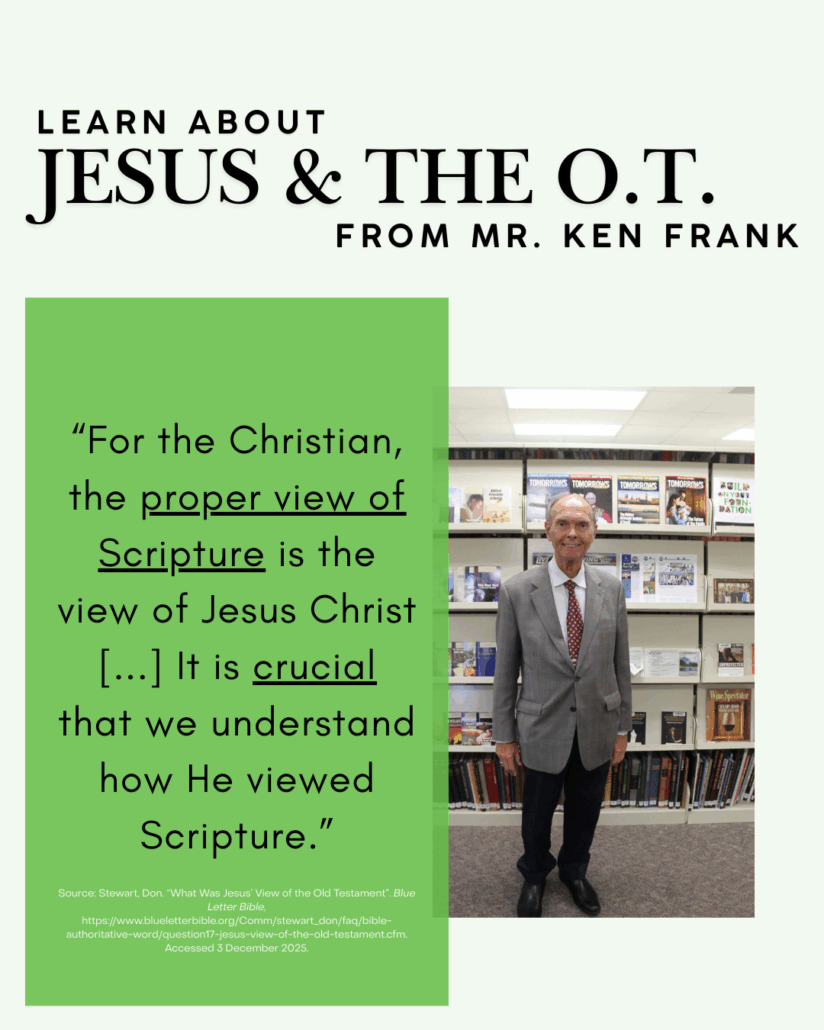
Mr. Kenneth Frank, a longtime minister and faculty member for both Living University and Living Education, presented a forum message to this year’s students. In his message, Mr. Frank illustrated important elements of Jesus’ message that helped confirm the authority of the Old Testament.
A Theme of Mercy
Jesus did not come to destroy the law, but to magnify it. Matthew 22:36-38 records the first and great commandment, which is to love the Lord with all our hearts. The second great commandment, like it, is to love our neighbor as ourselves. These themes are consistent across the Old and New Testaments, and it was something Jesus emphasized in order to contextualize the Old Covenant rather than replace it. His mission was not to undermine the Old Testament, but to fulfill it.
Rather than a picture of a harsh, lawgiving God of whom we can only gain understanding through the Old Testament, we get the full picture contextualized by Jesus Christ’s message. The story of David taking bread when he had need for his men is not an example of a rigid breaking of the law, but an allowance for a need—the same mercy we see exemplified in Christ. Hosea 6:6 states: “For I desire mercy and not sacrifice, and the knowledge of God more than burnt offerings.” We clearly see this principle reflected and magnified in Jesus Christ, whose mind and character are consistent and reinforced across the entire Bible.
Examples of History
Jesus Christ was also the One who directly inspired those Scriptures to be written, so they should not be discounted so quickly. There are several key instances of Jesus Christ confirming the validity of the Old Testament—and if Christ treated those stories as Scripture, we should too.
In Matthew 12:40, for instance, Jesus staked His entire ministry on the story of Jonah: “For as Jonah was three days and three nights in the belly of the great fish, so will the Son of Man be three days and three nights in the heart of the earth.” While the notion of Jonah surviving three days and nights in a fish’s belly seems laughable to skeptics, Jesus clearly believed that it happened, and staked His entire credibility on it.
Jesus also referenced prophecies as if they carried weight and were applicable directly to Him. In Matthew 26:31, He quoted the prophecy given in Zechariah 13:7: “I will strike the Shepherd, and the sheep of the flock will be scattered” —pointing to His own death and the subsequent scattering of His disciples. In so doing, Jesus was confirming that this prophecy was directly applicable to Him.
The Lord and His Lord
One important Scripture that shows a link between the Old and New Testaments is Psalm 110. In it, David writes that “The LORD said to my Lord, ‘Sit at My right hand, till I make Your enemies Your footstool.’” This passage reflects a conversation between the Father and the Son, and Jesus quoted it in Matthew 22:43-45, asking rhetorically: “If David then calls Him ‘Lord,’ how is He his Son?” It is clear that the Individual in question is not David’s Son, but God’s, and this distinction—and its later reference by Christ—is a critical point.
Every Word is Holy
Matthew 4:4 states that “Man shall not live by bread alone, but by every word that proceeds from the mouth of God.” Jesus Christ believed in and vocally backed the authenticity of the Old Testament, and while skeptics may throw out the Old in favor of the New, or vice versa, it is undeniable that these two accounts confirm and complement each other in an important way. We should be thankful to God for inspiring these words and for using His servants for His purposes. The authenticity and divine inspiration of the Bible is something none of us can take for granted.
David Markopoulos is a Living Education alumnus from the 2023-2025 school years. Originally hailing from Chicago, he currently works for the Living Education program.
https://www.lcgeducation.org/wp-content/uploads/2025/11/bread-5470532_1280.jpg8531280David Markopouloshttps://www.lcgeducation.org/wp-content/uploads/2021/02/logo_basic-website-300x94.pngDavid Markopoulos2025-11-20 18:30:002025-12-04 10:24:35Mr. Kenneth Frank: Jesus and the Old Testament
These summaries are written to give our audience an idea of the special forum messages our students have access to as part of the Living Education-Charlotte program.
Mr. Dexter Wakefield, a long-time minister serving as the Director of Legal Affairs at Headquarters, has a long background in finance, business, and entrepreneurship. In a recent forum to the Living Education students, he addressed a growing trend in our modern culture toward socialism, its implications, and the problem with this school of thought.
Socialism on the Rise
With the recent election of a Democratic Socialist, Zohran Mamdani, to the role of New York City mayor, socialism has come to the forefront of America’s attention lately. Mayor-elect Mamdani has been a vocal critic of capitalism, calling it “theft.” But is this the most accurate descriptor of the capitalist model, and is socialism a safe alternative?
Labor Theory of Value
One element of Socialism is the Labor Theory of Value. This rule dictates that the value of a product can only be equal to the labor that went into it. Looking at economics from this standpoint means that any price not determined by these factors would seem unfair. Further, in order to make any kind of profit, you have to pay workers less than what is “fair.” However, the issue is that this does not account accurately for supply and demand, and a consumer’s personal judgment on utility. A consumer will typically pay the price they personally deem the best—meaning their notion of value supersedes the thought process behind why that item was marked as such to begin with.
Creation of Wealth
Creation involves destruction—or, in a more economic sense, to create products, you have to destroy the raw materials as you found them and put them back together to make something new. Raw metals mined in the earth need to be refined and shaped. This process carries risk—not just physical risk, but financial and legal risk. As Mr. Wakefield pointed out, with all the unknowns that lie along the creative process, the ultimate value of a product depends greatly on how well you manage risk. This adds a completely new dimension to the discussion that socialism often fails to account for.
Mr. Wakefield also pointed out that economics is not “trickle-down,” but rather “ripple-out.” Capitalist societies are typically much more stable than socialist societies because they account for these factors. It also creates more room for innovation and long-term growth. This is missing from socialism, where autocrats make top-down decisions for the people.
Pillars of Entrepreneurship
Entrepreneurs and businessmen have a difficult job competing in the market. However, understanding the democracy of the market is a critical skill, and it is important to understand the principles of the economic climate in which we operate. Understanding what goes into a product, what determines its price, and the service it provides is an important focus for entrepreneurs and for those living and operating in a capitalistic society.
David Markopoulos is a Living Education alumnus from the 2023-2025 school years. Originally hailing from Chicago, he currently works for the Living Education program.
https://www.lcgeducation.org/wp-content/uploads/2025/11/money-2180330_1280.jpg8531280David Markopouloshttps://www.lcgeducation.org/wp-content/uploads/2021/02/logo_basic-website-300x94.pngDavid Markopoulos2025-11-13 18:30:002025-12-03 14:16:48Mr. Dexter Wakefield: A Crash Course in Economics
These summaries are written to give our audience an idea of the special forum messages our students have access to as part of the Living Education-Charlotte program.
Mr. Tyler Wayne, who serves as Executive Administrative Assistant for the Church Administration Department, addressed the Living Education students in a recent forum. Based on the book Extreme Ownership: How US Navy Seals Lead and Win by author Jocko Willink, Mr. Wayne began his talk by telling the students an uncomfortable truth: it’s your fault.
It’s Your Fault—No, Really, it is
While tongue-in-cheek, this simple sentence is also an important principle. Mr. Wayne argued that extreme ownership means you have a part to play in everything that happens in your life—in other words, when something doesn’t go right, there is always something that you can do about it. You have a part to play in these situations, whether by how you got yourself into it, or how you react. You can’t control everything in life, but you can control yourself.
You Can’t Control Everything
There are many things you don’t appear to control in life. We all interact with or have teachers, assignments, bosses, coworkers, friends, and romantic interests—all these people and factors are variables that are outside our control. The people around us have minds of their own—our workloads get out of hand, our bosses can be demanding, and we can have conflict with our friends. How should we react when there’s conflict, or things don’t go our way?
Mr. Wayne offered a formula for taking ownership of these kinds of situations:
“I’m sorry—it’s my fault”
Recognizing your involvement in a problem and be humble enough to apologize for it.
Say What You’re Sorry For
You must identify and acknowledge the portion of the problem that is your fault.
What Am I Going to Do To Make Sure This Doesn’t Happen Again?
You must be able to offer a sincere and realistic solution to solve the problem and resolve the conflict.
Believe What You’re Saying!
In order for these steps to work, you need to be sincere. Not only will others identify a lack of sincerity, but the problem will inevitably continue unless you are committed to doing your part.
Real Applications
Mr. Wayne encouraged the students to practice these steps, and reminded them that they are more than pleasantries—having an attitude of extreme ownership means putting in the work.
When your team misses a deadline, don’t blame someone else (Bob in accounting didn’t get us the report on time). Instead, acknowledge your part, and offer a solution (I failed to communicate; next time, I’m going to give us enough time and communicate with Bob face-to-face).
If you’re frustrated by your parents’ rules (My parents won’t let me stay out late tonight), don’t get reactionary. Instead, try to understand their side of it. (I know you’re looking out for me and I respect your decision; in the future, I’m going to try to be more responsible so you’ll trust me in situations like this more). In situations like these, you may not always fix the issue simply by taking ownership, but part of developing character means that we should learn to do it anyway.
Practice Extreme Ownership
Part of developing godly character means learning to take accountability for our actions, owning up to our mistakes, and even stepping up when it isn’t our fault—but it is our responsibility to deal with the aftermath. There are a myriad of real-world situations that we will have to deal with throughout our lives, and the sooner we learn the principle of extreme ownership, the more equipped we will be to handle difficult situations and life’s problems with grace and integrity.
David Markopoulos is a Living Education alumnus from the 2023-2025 school years. Originally hailing from Chicago, he currently works for the Living Education program.
https://www.lcgeducation.org/wp-content/uploads/2025/11/garbage-3259455_1280.jpg8531280David Markopouloshttps://www.lcgeducation.org/wp-content/uploads/2021/02/logo_basic-website-300x94.pngDavid Markopoulos2025-11-13 18:30:002025-12-03 14:15:52Mr. Tyler Wayne: It’s Your Fault
These summaries are written to give our audience an idea of the special forum messages our students have access to as part of the Living Education-Charlotte program.
Mr. Lambert Greer is a longtime minister in the Church of God with many years of pastoral experience. In a recent forum addressed to the Living Educations students, he took the time to explain Jesus’ command in Matthew to “enter by the narrow gate.” Mr. Greer used this example to relate important principles regarding our Christian walk in life.
The Importance of Gates
Matthew 7:13 states: “Enter by the narrow gate; for wide is the gate and broad is the way that leads to destruction, and there are many who go in by it. Because narrow is the gate and difficult is the way that leads to life, and there are few who find it.”
Mr. Greer explained the principle of a gate—for a fortified city, gates led directly inside and were the first point of contact and entry. Some ancient cities would have narrow gates to improve defensive capabilities—however, that proverbial narrow path and gate are, by their nature, difficult to traverse.
Our Path
As it relates to our Christian journey, the path we walk can be a hard one. Life is filled with hardships, temptations, and risks that can take us from one side of the road to the other. When we reach the point of being glorified as members of God’s Family, we will have overcome the world and its snares.
By contrast, the wide gate and the broad way reflect a way of life that is carefree and easy. It is smooth and inviting, but ultimately leads to destruction. The temptations and pitfalls that lie along this path can easily draw us in, and away from the narrow way.
Difficulties of the Narrow Way
Mr. Greer acknowledged that the narrow way is difficult, and that as we walk down it, there can be a temptation to veer to one side or the other. That is why balance can be a key issue for many trying to walk with God.
Many things are laid out clearly in Scripture, but there are also many things that we can only do according to our best understanding of the principles given by God. Our challenge is to learn to understand God’s mind and will as we seek to apply those principles daily. It can be easy to be too passive, disengaged, or lax in our spiritual life, which is a dangerous recipe for losing our zeal. And it can be just as easy to be overly harsh, rigid, and Pharisaical. Leaning too far toward this extreme shows a lack of understanding of God’s principles—God’s way accounts for mercy and balance.
Mr. Greer admonished the students to “keep your heart with all diligence, for out of it spring the issues of life” (Proverbs 4:34). God looks at the heart of an individual to see whether a person is committed to obeying Him, and allows them to be tested in order to help them develop His character. As we keep God’s commandments and learn to apply His principles, we come to know God better, which in turn helps us keep His commandments and observe those principles more effectively.
Challenges for the Church
We may be tested in our personal lives, but the Church also collectively experiences those tests at times. Mr. Greer reflected back on the apostasy that occurred in the Worldwide Church of God that led so many astray, and the difficulties that many members and ministers faced during that time. The examples of overemphasis or underemphasis on certain doctrines, extreme rigidity or lack of firmness where needed, and many other issues presented unique challenges for the Church as a whole. But, as Mr. Greer stated, we cannot judge God by the weaknesses and sins of men—we must stand before God on our own. Even when others fall off the path, we cannot always help them or push them to change—we have to make the best choices we can, be a positive example, and encourage them, but ultimately remember that we each have our own path.
Ultimately, Mr. Greer pointed out that we must be careful along the way, be attentive to our surroundings, and be on guard for things that can take us off the path—especially the small things. We have to see the big picture and avoid getting caught up in things that could take us away from our calling.
Draw Near to God
The narrow path on which we walk can be difficult, but the trials, tests, and difficulties we experience along the way are nothing compared to what we are offered at the end. As we strive for balance in our walk, we must stay on-track throughout our Christian walk, keeping the end goal in mind. Mr. Greer’s encouragement was to take advantage of what has been given to us, seek clarity and understanding from God, and to take ownership of what God has given us. We must pledge our heart to God and strive to stay the course of the narrow way.
David Markopoulos is a Living Education alumnus from the 2023-2025 school years. Originally hailing from Chicago, he currently works for the Living Education program.
https://www.lcgeducation.org/wp-content/uploads/2025/11/garden-gate-5312586_1280.jpg8541280David Markopouloshttps://www.lcgeducation.org/wp-content/uploads/2021/02/logo_basic-website-300x94.pngDavid Markopoulos2025-11-13 18:30:002025-12-03 14:15:29Mr. Lambert Greer: The Narrow Gate
https://www.lcgeducation.org/wp-content/uploads/2022/01/ben-white-mO9vKbG5csg-unsplash.jpg10011500lcgadminhttps://www.lcgeducation.org/wp-content/uploads/2021/02/logo_basic-website-300x94.pnglcgadmin2025-11-08 17:15:002025-11-12 14:44:46Forum Summary: A Look into the Role of Pastoring
These summaries are written to give our audience an idea of the special forum messages our students have access to as part of the Living Education-Charlotte program.
In a recent forum, Mr. Michael Brown, a pastor serving in Manitoba, Western Ontario, and North Dakota, spoke to the students about important trends to be on guard for in the modern digital age.
No one can deny that the world in which we now live has been following a trajectory of radicalism. Sociopolitical tension seems to be higher than ever, and all around us there is a deep-seated disdain for traditional values, the social order, and government as a whole. Many of these ideas are rooted in Marxist ideology, which involves the promotion of radical change through a violent overturning of the social order—a sentiment we see brewing in our own society today. We see distrust of the government, aversion to religion, and erosion of morals to the point of desensitization.
These trends, while dangerous, go further than Marxism—they are the result of targeted degradation of western Israelite-descended nations. When we see things that attack our morals outlined in the Bible, our guard should go up. Mr. Brown warned against two areas that operate as vehicles for these trends to take hold in society:
Universities & Mainstream Media
Universities and the mainstream news media are some of the most powerful vehicles for Marxist ideology to be spread. The education scene is dominated by idealists, political radicals, and progressives whose ideologies are often deeply at odds with the Christian values we have historically held in western Israelite-descended nations. The news media is also often a tricky realm to navigate, saturated with opinions and supercharged with sensationalized, carefully-curated talking points. One key example is the ongoing conflict between Israel and Hamas, which is the latest iteration of a long-term conflict between two states—on the one hand, Israel lays claim to its ancestral territory being occupied by outsiders, while the Palestinian state accuses the other side of genocide.
Mr. Brown pointed out Proverbs 18:17, which states: “The first one to plead his cause seems right, until his neighbor comes and examines him.” One side or the other can seem to make a convincing argument, but, as Mr. Brown stated, it is critical for us to avoid having emotional reactions in favor of one side or another. Most left-wing news sources omit the atrocities committed by the radical group Hamas against Israel. Their actions add a different dimension to the conflict as it is understood by most people casually following the news.
Entertainment
Another place we see the lines blurred and our values challenged is the entertainment industry. Mr. Brown pointed out that we have been desensitized to the graphic entertainment being promoted today. Between intense gore and lewdness, our sense of what is appropriate, profitable, or harmful has come under attack. The truth is simple: prolonged exposure to sin dulls your sensitivity to its effect.
The sinful messages and imagery that have become the norm for our society are deeply harmful to our relationship with God. We have a responsibility to take charge of our media usage and be intentional about what we allow to flood our minds. The messages to which we habituate ourselves are often deeply harmful, compromising our Christian values.
Stay on Guard
Mr. Brown stated that no one gets ahead in life with eroded morals. No matter how much it seems that wicked people prosper or seem to enjoy success by this world’s standards, the things they stake their claim on will come to nothing. We cannot allow ourselves to slip in our Christian walk and compromise on our values. And as much as entertainment and media can damage our morals, the effect can even be exacerbated by others. It is difficult, and can even be harmful, to spend too much time with those in the world devoid of God’s Spirit. 1 Corinthians 15:33 states: “Do not be deceived: evil company corrupts good habits.” The people, perspectives, entertainment, and news sources with which we keep company can be corrosive to our morals.
Mr. Brown encouraged the students to seek out entertainment that is also productive—good books, music, documentaries on interesting topics, and more. He also encouraged them to seek wisdom in God’s word, to think critically about the perspectives and messages we hear, and to spend quality time with real people—taking the time to invest in stronger social bonds can take time and effort, but it will pay off. As iron sharpens iron, we should make the effort to strengthen each other in the faith as we apply wisdom to everything we hear and see.
David Markopoulos is a Living Education alumnus from the 2023-2025 school years. Originally hailing from Chicago, he currently works for the Living Education program.
https://www.lcgeducation.org/wp-content/uploads/2025/11/tv-1844964_1280.jpg8541280David Markopouloshttps://www.lcgeducation.org/wp-content/uploads/2021/02/logo_basic-website-300x94.pngDavid Markopoulos2025-11-07 12:26:472025-12-03 14:14:56Mr. Michael Brown: Be On Guard