Second Thoughts: The War of the Worlds

By Thomas White, Student at LivingEd – Charlotte

“We do not live, ever, in a godly culture as long as man is in charge here.” ~ Mr. Gerald Weston

It’s not just a classic science fiction novel by H.G Wells, or one of roughly six gazillion alie  n invasion movies. It’s what’s being fought right now, on this earth. Mr. Gerald Weston’s Assembly this week highlighted the cultural warfare all around us, as Republicans battle with Democrats, “liberals” clash with “conservatives,” the “left” dukes it out with the “right,” and we, as God’s people, hopefully stand our ground against the whole lot of them. In a world where cultural warfare and political ideologies seem to infect virtually everything we see, it can be all too easy to get caught up in one agenda vs. another, this party vs. that party, capitalism vs. socialism…and forget that the war we should be fighting is between two trees, between Satan’s world and the coming Kingdom of God.

“The word of God is the foundation of our beliefs, and we need to constantly keep that in mind…we do have to understand what God’s mind is on some of these subjects, and sometimes you have to search a little bit, because it’s not always readily evident in every case.”

Of course, not one of us would ever purposely side with Satan’s world. We do, after all, know that it’s eventually going to lose, and we genuinely want to honor God with all we choose to do and be. But what if we don’t always recognize when we’re on the wrong side? Our enemy is a master manipulator, so as Mr. Weston said, we have to be constantly critiquing what the world presents as favorable. Do we ever catch ourselves thinking of an unborn child as a nigh-inanimate “fetus” instead of a baby? Are we ever tempted to shrug off homosexuality as “just another type of love”? One way that I often find myself sliding into the world’s camp is simply by considering one sin “less bad” than another. That’s exactly what the world wants us to think, while God’s word says, “whoever shall keep the whole law, and yet stumble in one point, he is guilty of all” (James 2:10).

 “A culture involves more than one person…it involves a common set of beliefs and standards…and those common beliefs and standards must come from Scripture.”

As Mr. Weston adamantly said, we have to look at everything that’s happening, everything that the world’s culture is hurling at us, from the perspective of God’s revealed plan. The agenda of humanity is always going to be in rebellion against its Creator, so whatever the subject, we have to search God’s word for His perfect perspective on it. It’s important to stay informed, but there’s a big difference between being informed and being invested, and if we find ourselves supporting one ungodly culture over another, it’s probably time to refocus on the culture we really need to spread across the world. As Mr. Weston has said many times before, there can be no compromise; there are only two trees. In the war of the worlds, are we confident and unyielding in the side we claim to be fighting for?


Books Mentioned:
Economics in One Lesson by Henry Hazlitt

Course Spotlight: Unit 4 – Lessons of Peter’s Denial

Here are a few comments from students answering the “Student Thoughts” question from Unit 4, Lesson 3: Why did Peter deny Christ (Luke 22:54-62)? What can we do in our own lives to make sure we do not deny Him (Matthew 10:32-33)?

________________________________________________________________________________________

Why did Peter deny Christ?  Here is a man who exhibits great boldness.  He is the one that always has a ready answer. He is the one who asked to walk out on the water to Jesus.  He tells Jesus that he would not allow Him to be put to death, and he really meant what he said. Here’s is a man, armed with a sword, who attempts to protect Christ from being taken captive. And, he is told to put away the sword!  Peter was expecting a Messiah that would institute the Kingdom immediately, and all of a sudden things were not going where he had thought.  He had to be very confused, but even so Peter continued to be as close as he dared to Jesus.  He and John were the only ones that we see that did follow along.  Peter was terribly frightened. His leader was having the unthinkable happen to Him, and all this just didn’t match up with Peter’s concept of what was going to occur.  All his bravery was not enough.  He could not rely on his own strength.  Pushed into the corner, he did what is the human thing.  He lied.  He denied Christ.  Something that only a few hours before, he would have thought impossible.  Fear, confusion, and despair, and then the awful knowledge that he had denied the Christ.  We can be very thankful that this is included for us to read and to learn from, because there are vital lessons and warnings for us.  We cannot do what we must do on our own strength.  Our faith and trust must be in Christ and the Father. Things that we encounter don’t always appear as clearly as we would like, and so we have to develop that relationship with Christ and the Father so that we begin to develop the mind of Christ.  Peter’s weakness there gives us hope and comfort because we see that upon his repentance he was forgiven. God extended mercy to him as He does to us upon repentance.  Peter was relying on his own power and strength and he failed just as we will fail if we think that we can do anything right using only our own power.  There may be a time when we will be put to this extreme test, and we have the example of Peter to help us.  It is easy to make God in our own image and have it “all figured out,” but when things don’t work out the way we think, we learn to trust that God know what He is doing, and His way is always right.” – MJB

Read more

Children’s Bible Program – Level 3: Lesson 13 “Israel Prepares to Meet God”

Author: Janth English

Read Together: God changed Jacob’s name to Israel. Israel’s descendants lived in Egypt and grew into a great nation. But the Egyptians enslaved them and put them to hard labor. God worked many miracles to free Israel from slavery. After the death of all the firstborn in Egypt, God led Israel out from Egypt under the leadership of Moses. They miraculously walked on dry land through the Red Sea, and God protected His people from the Egyptian army. God told Moses to bring the children of Israel to Him at Mt. Sinai after they left Egypt (Exodus 3:12). A few weeks after leaving Egypt, the children of Israel were encamped near Mt. Sinai, the mountain of God. God called Moses and told him to offer the people of Israel a special agreement, called a covenant. Israel would obey Him, and in return, He would make them His special people. The people agreed. God instructed the Israelites to clean up and wash their clothes, and “consecrate” themselves (which means to prepare themselves to meet with God). They were getting ready to meet their Creator!

Read Together: Exodus 1:1–14; 14:5–31; 19:1–11

Discuss:

  • Explain that even though they had witnessed God’s miraculous interventions, Israel had not been obedient since leaving Egypt. They complained about the water and food (Exodus 15:22–25; 16:2–3). They broke the Sabbath (Exodus 16:26–29). And they complained against Moses (Exodus 17:2–3). Explain that experiencing miracles does not make it automatic that a person will respond by having faith in God.  We still have to choose to obey and respond to Him.
  • Ask your child why he or she thinks God told Israel to bathe and wash their clothes. What preparation would one make to visit the Queen of England? Use this as an opportunity to emphasize why we dress up for Sabbath services.
  • Discuss what it means to be “consecrated,” which means “set apart for holy use.” Explain that the Church is the Israel of God and that we are set apart by God’s Holy Spirit. Help your child understand that if our parents (or parent) is baptized and in the Church, that means that we have a chance to have a relationship with God that we otherwise wouldn’t have (Acts 2:38–39, 1 Corinthians 7:14)

Review Memorization:

Exodus 20:1–17 The Ten Commandments (long form)


Printable PDF – L3.13

Children’s Bible Program – Level 2: Lesson 13 “Nimrod the Mighty Hunter”

Author: Janth English

Read Together: God saved eight people from the great flood He brought upon the earth: Noah and his wife, his sons Shem, Ham, and Japheth, and his sons’ wives. The sons of Noah began to have children, and their families grew into all the nations of the world. The names of their descendants (children, grandchildren, etc.) can be found in Genesis 10. Even as these families grew into tribes and nations, the earth was still very sparsely populated. One of the sons of Ham was named Cush, and one of the sons of Cush was named Nimrod, who was a mighty hunter. The people began to trust in Nimrod for their protection in place of God Almighty. They called Nimrod “the mighty hunter before the LORD” (Genesis 10:9). People began to idolize him, and most of them soon forgot the lessons of the Flood.

Read Together: Genesis 9:18–19; 10:1–8, 13–32; Acts 17:26

Discuss:

  • Explain to your child that knowing the names of the ancient peoples and lands they lived in is important because it helps us identify their descendants today. This also helps us understand prophecies that affect them.
  • Discuss Acts 17:26 with your child. Explain that Acts 17:26 shows that God has given different parts of Noah’s family different lands to inherit.
  • Ask your child to picture himself or herself on the earth about 100 years after the flood. Would it be frightening to live in an area where wild animals outnumber humans? What would be the natural thing to do? What should they have done?
  • Ask your child what lessons he or she thinks people should have learned from the Flood. How does the people’s attitude toward Nimrod show they had not learned those lessons?

Review Memorization:

Genesis 11:9 “Therefore its name is called Babel, because there the LORD confused the language of all the earth; and from there the LORD scattered them abroad over the face of all the earth.”

Printable PDF – L2.13

Second Thoughts: The Immensity of Small Things

By Thomas White, Student at Living Ed – Charlotte

“We all understand that God is preparing us for big things, for being kings and priests…things we are doing today that may seem mundane may make all the difference in the future, in our future, in our destiny.” ~ Mr. Rod McNair

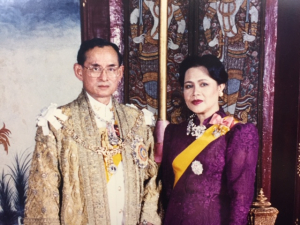
King Bhumibol and Queen Sirikit of Thailand – Photo courtesy of Dr. Germano, Living University

You know that nightmare where you randomly have to give a speech, and you didn’t prepare for it, and now everyone’s watching? Imagine that feeling multiplied by millions and you may have an idea of how Bhumibol Adulyadej felt when he was suddenly the King of Thailand at age 22. Mr. Rod McNair’s Assembly this week was largely based upon this singularly remarkable man, who had been so far down the line of succession for Thailand’s throne that he hadn’t been trained in any “kingly” subjects whatsoever.  What he did have, however, was an education in science, ecology, and conservation, and as the years went by, his knowledge turned out to be just what his people needed. King Bhumibol influenced the development of dams, reservoirs, water irrigation systems, and beyond. Since the top problem for 80% of Thailand’s people had been an inadequate water supply, he became an immensely popular ruler, all because of what he learned in his youth.

“…maybe a hundred, or two hundred, or five hundred years from now, as you are in God’s government and His Kingdom, administering and serving…you may think back to 2018, or 2019, and the lesson you learned back then that you’re using at that precise moment.”

Thankfully, God’s word tells us in advance of our ultimate destiny, so kingship hopefully won’t surprise us the way it surprised King Bhumibol. Even so, we probably will be surprised by how what we’re learning now, no matter how inconsequential it may seem, will end up being used by God to immense effect. Mr. McNair used the example of Joseph, who probably never thought for a second that his time as a slave and a prisoner would teach him skills he would later use to govern the nation of Egypt. But (spoilers!) that’s exactly what happened (Genesis 45:3-8). Mr. McNair advised us to look beyond what we see, to consider how what we’re learning right now might be used to unexpectedly shape our lives and the lives of others. As Mr. McNair said, “It’s always easy to think that the big, valuable stuff will be somewhere else, will be at another time, will be in another place…and to miss the goldmine in front of you.”

“We all have different abilities, we all have different talents, all with the potential to be used directly by God for a specific purpose in His government.”

As Mr. McNair pointed out, if God is planning on using what you and I are currently learning for the benefit of tomorrow’s world, we need to take advantage of what is right in front of us, and learn to interact with a variety of personalities. A king’s major responsibility is to care for the people he reigns over, so it’s crucial that we expand our personalities enough to genuinely understand people who are vastly different from us. It’s easy to coast along if we seem to be doing well enough, but does God want kings and priests who think, “Eh, this city seems fine,” or does He want those who go all out? If we foster a habit of learning, keep God at the center of our lives, and appreciate “the day of small things” (Zechariah 4:10), we can look forward to being shown just how immense those small things really are.